








Thriving Under PressureJune 1, 2026
Leadership That Makes a Difference By Kathy MonteThriving Under Pressure
Leadership That Makes a Difference
Janet Dell speaking at The Freeman Company’s annual internal leadership event, known as Camp Buck.
When uncertainty hits the meetings and events industry, the strongest leaders know that clarity is their most powerful tool. Teams perform best under pressure when leaders articulate a clear vision, define roles and communicate transparently. As the events industry grapples with budget constraints, shifting client priorities and global disruptions, clarity has become the difference between stability and strain.
The best leaders excel at communication. They establish protocols that specify response times, priority levels and decision-making authority. In addition, they simplify complexity rather than managing it. They break large-scale projects into manageable parts and eliminate unnecessary processes that create friction and burnout.
Research indicates that leaders who thrive in uncertainty concentrate on what truly drives value. For meeting planners, this means identifying the elements that directly impact the attendee experience and cutting through peripheral concerns. Resilient teams operate with streamlined systems that allow for quick pivots when external factors shift.
Leading With Emotional Intelligence & Connection
Meeting planning often means managing people in high-stress environments — from anxious speakers to demanding clients to exhausted team members. Leaders who help their teams thrive cultivate emotional intelligence that allows them to regulate their own stress and provide stability for others.
The most effective leaders practice “emotional contagion management,” slowing their reactions so their teams don’t absorb their stress. Acknowledging pressure openly, rather than pretending it doesn’t exist, creates a sense of safety and confidence.
Building genuine team connections also fosters resilience that extends beyond individual projects.
Recognition That Drives Long-Term Engagement
During high-pressure situations, recognition becomes even more important. Effective leaders sustain motivation by acknowledging both achievements and efforts, especially when the workload is intense.
Personalized recognition resonates most. Some team members appreciate public acknowledgment, while others prefer private appreciation. Strong leaders use multiple channels — from formal team celebrations to informal messages — to ensure everyone feels valued.
Leading by Example
“Uncertainty is not new to our industry, but the level of it right now feels higher. The biggest mistake leaders make is believing they need to remove the uncertainty. You do not. You need to remove the ambiguity,” says Nicola Kastner, CEO of Event Leaders Exchange (ELX), in Toronto, Canada.
“People can handle pressure when they know what matters, what success looks like and where they have authority to act. I try to create calm by giving my team context, clarity and priorities. I do not make promises I cannot stand behind. If I do not know an answer, I say so, then outline the parameters we are working within,” says Kastner.
She adds, “I communicate vision by anchoring everything in the reason behind the work, connecting it to measurable outcomes and making sure every person sees their role in achieving it. Vision is not something you announce once. It needs to show up in your decisions, your language and your priorities. Because when people understand the end goal, and know what is expected of them, they make better choices in the grey areas and you spend less time correcting.”
Kastner shares three tactics she uses when leading during times of uncertainty: define decision boundaries, use scenario thinking instead of rigid plans and model composure.
“Do not make your team guess what requires escalation and what they can run with. Clarity builds speed and confidence,” she says. “I do not pretend to have one perfect roadmap when things are shifting. I build frameworks that support multiple outcomes so the team already understands our options. Your tone becomes your team’s temperature. Even when I feel pressure, I try to slow down my reaction, because urgency does not require panic.”
According to Kastner, effective leaders have vision, decisiveness and humanity. “You need to see what is ahead, make decisions without waiting for perfect information and create an environment where people feel trusted and supported. I do not need to be the smartest person in the room. I need to create the conditions where the right ideas surface and get delivered, and that starts with culture,” she says.
ELX had a speaker at a recent event named Toby Bassford from a company called Tillon who said something that resonated deeply with Kastner. “I’m paraphrasing here but he said that leaders have a responsibility to define the culture of their team and that needs to be intentional not accidental,” she says. “We need to think about this through three different lenses — What you model, what you tolerate, what you celebrate.”
“Leadership is not performance. It is impact, accountability and how your team feels about working with you when things get difficult. Influence comes with the role, and I take seriously the responsibility that comes with it,” says Kastner.
She draws inspiration from leaders she has worked with throughout her career. “The great ones showed me what great leadership looks like in high-stakes environments. The difficult ones taught me just as much by showing me exactly what not to replicate. I pay attention to behaviors, not job titles. I take note of what earns loyalty and what erodes it,” she says.
“The biggest influence on me as a leader has been working in roles where there was no safety net. When you lead large teams, manage multimillion-dollar investments and operate under public scrutiny, you learn fast that clarity and composure are not optional,” she says. “The best leadership advice I ever received was to stop measuring myself by what I could personally deliver and start measuring myself by what I could enable. That shifted how I delegate, how I build teams and how I think about leadership.”
Is there a mantra that inspires Kastner as a leader? “A phrase that has stayed with me throughout my career is, ‘You set the tone whether you mean to or not. Your presence is part of the job.’ That line reflects how I think about influence and leadership. Teams pay far more attention to what you model than what you say. If your presence creates clarity instead of confusion, people perform with more confidence,” she says. “For me, leadership is not about authority. It is about the environment you create and the standard you set through your behavior.”
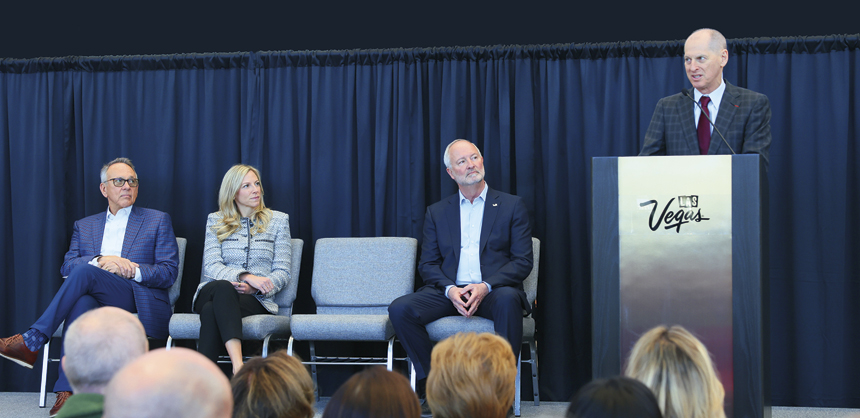
Gary Shapiro, CEO & Vice Chair of the Consumer Technology Association, speaking at the Consumer Electronics Show, which he produces.
Leading With Empathy
Janet Dell, CEO of The Freeman Company in Chicago, IL, a global leader in events with approximately 5,000 full-time employees and contractors, joins a small group of female leaders holding top roles in the events industry.
Her leadership skills are legendary. When asked about the uncertainty in the events industry today, she says, “An evolving landscape has always been part of this business; it’s just more visible now. The best leaders create calm by grounding people in purpose and clarity. When teams understand why we’re making decisions and feel heard, uncertainty becomes manageable. At Freeman, we really try to lean into empathy and our values, because those never change.”
Clear vision is imperative. “Vision gives people a sense of direction when the road ahead isn’t clear. For me, it means connecting the dots between our long-term goals and the work happening on the ground every day. I try to reinforce it consistently, in all-hands meetings, in office visits and in how we celebrate wins. Clarity is not about buzzwords; it’s about helping people see how their efforts ladder up to something bigger,” says Dell.
How does she lead her team in this time of uncertainty? “First, communicate early, often and honestly. Even saying, ‘We don’t have all the answers yet,’ helps people feel included. Second, lead with empathy. After 9/11, I learned that when people are navigating stress or change, humanity matters most. And finally, empower people. Set clear guardrails, then let teams move fast and make decisions. That trust creates resilience.”
“Effective leaders balance empathy and accountability. They’re decisive, but they listen deeply. They create clarity, not chaos. And they know when to step back and let others shine. Leadership isn’t about having all the answers; it’s about helping people see their own potential and bringing out their best, even when the environment is uncertain,” says Dell.
Lessons in Leadership Agility
Gary Shapiro’s book, “Pivot or Die: How Leaders Thrive When Everything Changes,” features a framework focused on leadership amid disruption. Drawing from his more than three decades as CEO and Vice Chair of the Consumer Technology Association in Arlington, VA, and producer of the Consumer Electronics Show (CES), which is in Las Vegas, NV yearly, Shapiro says the ability to pivot is essential for survival in a world defined by rapid technological and market change.
There are four types of pivots that leaders must master, says Shapiro. They are the startup pivot (leveraging new ideas and staying flexible as feedback evolves), the forced pivot (responding decisively to crises such as pandemics or regulatory changes), the failure pivot (turning setbacks into learning opportunities) and the success pivot (evolving even at the top of one’s game).
Shapiro emphasizes resilience, curiosity, assertiveness and foresight as traits of leaders who thrive. “Clear vision to me means a big goal that can inspire and rally your employees and constituencies. It encompasses ethics, culture and specific goals creating a framework for decision-making and leadership,” says Shapiro.
During the pandemic, Shapiro relied on experts to make data-informed decisions. “That reliance on smart people was helpful. We cancelled our physical event seven months out and saved our constituencies enormous money,” he says. “Telling people early that times will be tough, setting expectations and talking about the light at the end of the tunnel, and describing how we can serve our mission, kept our staff focused, productive and allowed us to learn new skills in a challenging environment.”
He believes effective leaders demonstrate “trust, emotional intelligence, the willingness to take risks and the ability to separate from the crowd of competitors.” Mentors and collaboration have shaped his own leadership style. “But my secret success comes from relying on incredibly smart women. I am competitive and feed off of others who know how to get things done,” he says.
Experience has taught him to value lessons from both failure and success. “I try to learn from every bad situation and failure. Success is sometimes dangerous as you may start getting overly cocky and think you can be a solo genius,” says Shapiro.
Shapiro’s perspective reinforces a key truth for the meetings industry: in a world of constant disruption, leadership agility is not optional — it’s the foundation of sustainable success.
Service-Oriented Leadership
Janet Traphagen began her career in operations and account management positions at Cardinal Health and Motivation Excellence. She later joined Creative Group in Schaumburg, IL in 1996 and quickly moved from operations to sales to leading the sales organization. She was part of Creative Group’s executive committee when the company was sold to Direct Travel in 2015 and was appointed president of Creative Group.
“The best piece of leadership advice I ever received is that leadership is influence, and you likely have more of it than you think,” she says. “That insight fundamentally shifted how I approach leadership. I’ve learned that the depth of your impact is directly tied to how well you know yourself and how consistently you lead from an authentic set of values. That requires deep self-awareness, continuous self-assessment and the humility to recognize that leadership isn’t about control, it’s about service.”
“In times of uncertainty, I’ve found that motivation doesn’t come from offering false assurances, it comes from offering clarity. One of the most impactful leadership principles I follow is from Brené Brown: ‘Clear is kind,’” says Traphagen. “While people naturally crave certainty during crisis or change, I’ve learned to be honest about what I can and cannot provide. I won’t promise certainty when it’s not possible, but I do commit to providing clarity through transparency, timely information and open communication.”
She also makes it a point to communicate frequently — weekly or monthly, depending on the level of disruption. “Consistent, honest communication helps ground people, reduces fear and reinforces that we’re navigating the unknown together.”
Hiring and growing top talent should be a successful leader’s focus, Traphagen adds. “A company is only as strong as its leaders, and those we bring into leadership roles have an outsized influence — not just on outcomes, but on the culture itself. That’s why I’m intentional about hiring through the lens of clearly defined core values. Skills can be developed, but values alignment is non-negotiable,” she says.
“Culture, to me, isn’t a perk or a set of surface-level benefits, it’s the company’s informal operating system. It shapes how people communicate, solve problems, celebrate, make decisions and treat each other. When you get the right leaders in place, aligned with the right values, you create an environment where people can truly thrive. But the wrong leadership choices can just as easily lead to burnout and attrition,” she says.
“So, I see my role as building and scaling not just a team, but a culture — through intentional hiring, continuous development and by modeling the behaviors I expect others to lead with.”
A mantra that resonates with Traphagen: “Everyone wins when a leader gets better.”
Across the meetings and incentive industry, leaders like Kastner, Shapiro, Dell and Traphagen define effective leadership. They demonstrate that it’s not defined by authority but by clarity, composure and connection. |C&IT|