







The Power of PlayFebruary 1, 2026
Making Team Building a Priority By Matt SwensonThe Power of Play
Making Team Building a Priority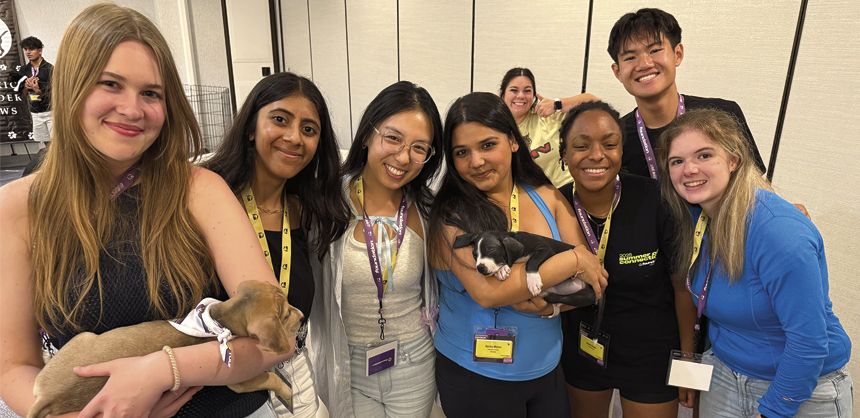
At a Taco Bell Foundation event, they partnered with a local shelter, made a donation and had a puppy yoga event for attendees.
Corporate planners find it’s increasingly important to include fun and engaging activities to build teamwork and trust. Whether through CSR projects like building something for the community, working together to create a performance or engaging in icebreaker activities to get to know each other better, team building activities are essential to making a team run more smoothly.
Christine Goodman, a global project manager at ConferenceDirect, first became familiar with Base Camp, a children’s cancer foundation, when her son became afflicted with the disease that would take his life at 16 years old.
Despite the tragic outcome, she recalls the care Base Camp took to support the entire family.
In a full-circle moment, Goodman coordinated a corporate team-building activity for Siemens Energy, her employer during her son’s illness, benefiting the foundation based in Orlando, FL.
Goodman’s belief was the group of engineers attending the meeting would value a bonding experience directly benefiting children battling cancer. As it turns out, Goodman may have underestimated the effectiveness of the program building 20 bicycles.
“It wasn’t just a noble activity — it paid dividends in how people worked together,” she says.
Corporate Social Responsibility (CSR) projects like building bicycles for ailing kids or disadvantaged communities are a powerful way for corporate events to leave a positive impact on a destination.
As a bonus, for all of the good that the final products do for the recipients, the experience is just as stirring for the participants.
The laughter, smiles and hugs demonstrate the emotions and enjoyment attendees experience during CSR activities. Often, it’s these memories that last longer than the one-on-one appointments, happy hours and keynote speeches that comprise traditional corporate meeting agendas.
Creating Meaning
The combination of helping those in need and building connections with teammates makes such charitable team building among the most popular options offered by Wildly Different, an Orlando-based team-building company that led the bicycle-making at the Siemens Energy meeting.
“You’ve given up three days of your personal life. You want to feel like those three days meant something,” says Jane Schuliger, who runs operations for the company.
Wildly Different is among many organizations planners and DMCs can partner with for group activities across the country. Typically, the company will identify a local cause or unique exercise to help attendees unwind and gain a greater sense of appreciation for the meeting destination.
Schuliger’s official title is Chief Fun Officer, which gives a sense of Wildly Different’s approach to strengthening bonds.
Your group can be working to benefit sick individuals, but the moment doesn’t need to be and shouldn’t be all serious work. The two hours away from the meeting rooms are a chance to meet new friends, strengthen existing relationships, test boundaries, and, most importantly, have a blast, says Schuliger.
Without the fun, there won’t be nearly the same impact, notes Tyler Kempf, creative director of Second City Works, a corporate team-building extension of the famed Chicago-based improv company. It has assisted Adobe, HubSpot, Facebook, Uber and other large corporations.
Having seen how quick-thinking and humor naturally forged ties between comedians, Second City has taken those same principles and applied them to companies seeking to enliven their workforce.
“There’s always a sense of play, and there’s always team building,” says Kempf. “We don’t even need to focus on team building. It’s inherent to the results of the program.”
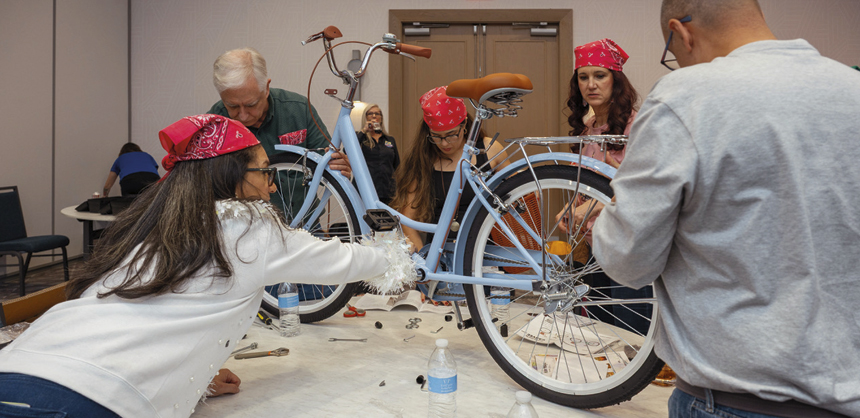
A Wildly Different build-a-bike activity became a bonding moment for engineers at Siemens Energy.
Coming Together
In many regards, team building at corporate events is more important than ever.
While we are several years removed from the COVID pandemic, its after-effects are felt to this day. Isolation then heightened already existing societal issues. In 2023, the U.S. Surgeon General declared an epidemic of loneliness. In a different era, workers would congregate in the office, chitchat around the water cooler, and engage in post-work gatherings like happy hour or a team trip to a ballgame.
In today’s age, the corporate workplace is shaped by hybrid and/or virtual policies that have lasted through the pandemic and the effects of mergers and acquisitions.
The corporate workforce is seemingly struggling to adapt to today’s new world. While events aim to create a community among attendees to foster regular attendance, their own teams are likely struggling with associates and team members developing trust and friendship. According to the Pew Research Center, 53% of remote workers say working from home hurts their ability to stay connected.
Those who come into the office, if only a few times per week, often fall victim to the trap of working within silos, and thus, do not interact regularly between departments. Fewer than two in 10 of those who are only able to work onsite said they have been engaged at work, according to Gallup’s State of the Global Workplace report.
The drain is felt by employers and employees. A study from The Corel Company found 41% of employees have either quit or considered leaving their company due to poor teamwork. Meanwhile, Salesforce reports that 86% of organizational leaders say ineffective collaboration and communication is at the root of a company failure.
Sales kickoffs, internal meetings, training and other gatherings are rare opportunities to interact in-person. Corporations cannot afford to not make the most of the time together.
As important as a gathering’s primary objective is, it’s wise to dedicate at least one or two hours to a team-building activity. While the break may not seemingly align with the rest of the agenda, it could very well be the most productive stretch of the event.
“It’s not just about a moment — it’s about fostering community for the long term,” says Daniel Horgan, founder and CEO of CoLabL, which specializes in events for young professionals.
Workers are inclined to capture that missing chemistry and notice the pitfalls of separate workplaces. A study from Resume Builder found that one in four remote employees say working remotely has led to a decline in their social skills.
These are more than just numbers for the staff at Wildly Different, which has seen the challenges firsthand. “We’re just finding that a lot of people are disconnected in the workplace,” says Schuliger. “When they’re coming in for a meeting, it’s so important to be face to face.”
Child’s Play
Like a school dance, there are likely to be quite a few wallflowers upon entering a team building event, says Horgan, who has worked with some of the world’s largest brands, including LinkedIn, Pfizer, Apple, Starbucks, Deloitte, Cisco, Taco Bell and Gap Inc.
Horgan regularly partners with Fit City Adventures, a San Diego-based team-building company that supports events across the country. Among their most successful collaborations has been a multi-year partnership for professional development conferences for 350 Taco Bell Foundation “scholars.”
Fittingly for a younger crowd, popular activities have included graffiti art projects and DJ challenges, in which teams build a set and perform during a showcase.
The idea is to have so much fun, attendees are getting caught up in the team-building dynamics without even noticing it. Sparking multiple senses speeds engagement, Horgan finds.
“As soon as you walk into the room, the music is going, the lighting is set — you’re about to immerse yourself in the experience,” he says.
Survey results show the impact. Horgan says at last summer’s conference, 96.8% of attendees maintained at least one new connection post-conference more than 90 days later and 97% made progress on a personal or professional goal that they set at conference.
“These stats showcase the impact of creating engaging experiences rooted in creative expression, community building and growth opportunities,” he says.
Setting the right tone before diving into the primary team-building activity is key, agrees Schuliger. Wildly Different typically spends the first hour of a two-hour session breaking the ice, she says, adding that simple nostalgia-based games reveal personal connections naturally.
Second City likes to engage in fast-paced word games or having attendees either sit down or remain standing based on prompts from the facilitator, adds Kempf.
By sharing information in the games, team members are tearing down the walls blocking communication and collaboration, notes Kempf. “We are inviting people to be vulnerable with each other, and that’s where the real connection happens,” he says.
That initial breakthrough can lead to quick results. “At the beginning, they’re shy; but by the end, they’re cracking up, singing, totally relaxed with their team,” Schuliger says.
At the Taco Bell Foundation events, Horgan likes to host a team-building moment on the first night to set the stage for the rest of the program. “By doing that on the very first night, you set the example that this is a safe space,” he says.
On the event’s third day, Horgan holds another activity to elevate those new connections, emphasizing the importance of community.
The lesson applies to all corporate events. Savvy companies use the gatherings to create enthusiasm for the future and instill loyalty, both of which will translate into better productivity in the office.
That’s why Schuliger is such a fan of creating events for philanthropic causes like Base Camp. Two of Wildly Different’s most popular programs are “The Art of Giving,” where teams put together art kits for ailing children, and “The Red Wagon Brigade,” where participants build and decorate wagons before collecting toys that will be donated.
“It gives you more of an affinity for the company … you’re part of something bigger that this company is doing, and doing it together as a team,” says Schuliger.
Health and Wellness
Amid the isolation crisis in the country, it’s not surprising attendees are leaning into activities rooted in health and wellness. Fit City reports 82% of people consider wellness to be a top priority in their lives, which is spilling over into conferences. This also is a chance for team members to get to bond over shared activities and get to know each other better.
Events have long offered basics like morning 5K runs, yoga classes and spa treatments. Trying to keep the options from becoming stale, Fit City and other team-building organizations are seeking out new experiences.
“Choose Your Adventure Day” featuring hiking and biking opportunities is among the wellness trends that Fit City Adventures Chief Experience Officer Angela Minardi listed in a presentation at IMEX America.
Other breaks from the norm include puppy yoga, which enlivens the standard meditation, and group Tai Chi classes, often conducted in a scenic setting.
Horgan notes that he’s added a CSR element to puppy yoga to leave a greater lasting impression. “We partnered with a local shelter and made a donation; it became a full-circle moment,” he says.
Kempf points out improv is a powerful way to sharpen the mind and build trust. But he adds one two-hour class with Second City won’t cure all of a dysfunctional office’s ills.
“Improv is yoga for your social skills; you can’t go to one class and suddenly be a yogi,” he says.
The classic corporate golf or tennis tournaments remain popular options to get team members into the fresh air to have a good time and enjoy personal chats.
Pickleball has grown in popularity not as a sport, but as a corporate team-building opportunity. Beyond a class or conference tournament, planners can take groups to venues blending the game with F&B like Chicken N Pickle, a chain operating off a similar model as Topgolf, another regular team-building site.
Scavenger hunts and escape rooms are other activities that companies are likely to sign up for.
Schuliger says she will purposefully pair attendees from different departments together to spur interaction that has not been occurring in the workplace.
Seemingly insignificant, that small talk builds bridges that lead to collaboration. Schuliger says the following is the improved thought process: “Now I know the people in accounting … When I call them, they’re going to respond.”
Valuable Additions
Few would dispute the benefits of team-building exercises at events, but planners feeling a time and financial crunch may feel they have no choice but to stick to a by-the-books agenda.
Schuliger says she recently talked to a planner in that situation and their event suffered. “She says, ‘We didn’t do team building the last couple of years, and we’re getting pummeled in surveys.’”
She sympathizes with that planner, and suggests corporations should reconsider their priorities in an age when building bonds in the workplace is so challenging.
“They think the content is king,” Schuliger says. “But long term, we say the relationships you build during those two hours are king.”
Horgan agrees, adding that casual experiences can have outsized impact: “These activities might feel off-topic, but that energy is what people remember.”
Continuing, Horgan says: “Building community is key. Companies that focus only on transactions are the ones struggling.”
He concludes by predicting corporate events would do well to follow the lead of yogis who look inward to find peace. “Companies that stay focused on internal relationships are the ones that continue to innovate and succeed,” he says. C&IT