








The Power Of PlaceSeptember 1, 2026
How Immersive Destinations Transform Incentive Travel By Zach ChouteauThe Power Of Place
How Immersive Destinations Transform Incentive Travel
The best events immerse attendees into the culture of a destination and give them a sense of place.
Every meeting planner knows the scene: a beautifully decorated ballroom, a well-executed reception, polished entertainment and a menu that checks all the boxes. Yet, even with all the proper elements, there’s often that nagging sense that the event could be happening anywhere. For attendees who travel frequently, the feeling is even sharper — the décor may change, but the experience blurs.
Today’s most memorable incentive programs and corporate gatherings succeed not because they ignore their location, but because they embrace it fully. They turn the destination into a narrative thread, a sensory anchor and a reward in itself. The best events don’t simply take place in a city — they take place because of it.
Across the industry, planners and destination experts are rethinking how to build meetings and incentives that immerse attendees in the culture, flavor and personality of a locale. Their message is clear: place matters, and when planners design with intention, attendees don’t just remember the event — they remember the destination.
Why Destination-Led Events Matter
The shift toward destination-driven event design isn’t just a trend, but a strategic evolution in how organizations motivate, reward and connect their people.
Andjela Kessler, president of Incentive Travel & Meetings in Atlanta, GA, captures this philosophy with clarity. “Building an incentive event around a destination is about making the destination itself the reward — not simply the location where meetings take place,” she says, emphasizing that the destination should be woven into every aspect of the experience, so participants leave with memorable experiences that motivate future performance.
Kessler notes that every element, from arrival through departure, should reinforce the destination’s unique identity while recognizing participants’ achievements.
Her approach begins with a theme inspired by the locale itself. “Start with a clear theme inspired by the destination,” she says, offering examples such as ‘La Dolce Vita’ for Italy, ‘Discover the Atlantic Spirit’ for Portugal, ‘Tradition Meets Innovation’ for Japan and ‘Celebrate in Paradise’ for the Caribbean. These themes become the backbone of the experience, guiding décor, programming, cuisine and even the tone of recognition moments.
Kessler’s perspective underscores a broader truth: destinations aren’t just settings — they’re emotional frameworks. They shape how attendees feel, how they connect and how they remember.
Designing Events That Could Only Happen There
If there’s one principle that unites all five experts, it’s this: avoid the generic at all costs.
Dave Green, chief mysterious officer at Mystery Trip in Los Angeles, CA, is known for designing events that are inseparable from their surroundings. “We don’t build events that happen to be in a city; rather we build events that only work because of that city,” he says, stressing that most ‘destination’ events could be picked up and dropped into another city without anything changing. “That’s the thing we try to avoid with our activations,” he adds, noting that authenticity is the antidote to sameness.
Green’s philosophy is rooted in immersion. “We send people into the actual streets,” he explains, describing scavenger hunts and challenges built around real neighborhoods, landmarks and interactions. “Stuff that forces people to interact with the place instead of just looking at it through a hotel window,” he says.
He believes that, in order for planners to elevate the overall experience, they should treat the destination as part of the event design, not just the backdrop.
Green shares two vivid examples that illustrate how cities can become the backbone of an event:
In Louisville, KY: “Behind-the-scenes tour of Churchill Downs; followed by dinner at Mike Linnig’s, a 100-year-old institution for a fish fry and frog legs; finishing the night at Copper & Kings, a distillery, for a tour and tasting,” he says. The progression — from iconic sports history to beloved local cuisine to bourbon culture — created a layered experience that attendees couldn’t replicate anywhere else.
In Las Vegas, NV: “Photographic scavenger hunt on Fremont Street, followed by a private dinner at Letty’s de Leticia’s Cocina, which has been featured on ‘Diners, DriveIns, and Dives,’ in the Arts District,” he says. Even in a city known for spectacle, Green’s team found ways to highlight neighborhoods and institutions that feel personal and unexpected.
Green encourages planners to ask one question repeatedly: What could this group only experience here? “If the answer could happen in any ballroom in any city, keep pushing,” he says. “The goal is not just to show people the destination. It is to let the destination help shape the overall experience.”
Immersion Through Culture & Community
Immersion isn’t about volume — it’s about authenticity and designing experiences that feel rooted in the city’s rhythm, history and personality.
Green warns planners against treating the destination as a backdrop. “Every destination has its own rhythm, history, food, neighborhoods, creative communities and unexpected corners,” he says. “The most memorable events find ways to bring attendees into that.”
Shannon Bream, event operations manager at GoGather in Escondido, CA, echoes this sentiment. “The location has to earn the trip,” she says.
Her examples show how immersion can be woven into agendas without overwhelming attendees:
- At the Waldorf Astoria Orlando, her team ran an executive scavenger hunt in Epcot as the networking event.
- At the JW Marriott Marco Island, mornings opened with sunrise beach workouts before sessions.
- In New Orleans, an awards dinner doubled as a casino game night with Mardi Gras-themed desserts and décor.
“Tying local cuisine, activities and vibe to the destination takes the attendee experience from a zero to 100,” she says, “and gives real meaning to why everyone traveled there.”
Bream also emphasizes the importance of leaning on local partners. “Once a destination is picked, lean on hotel partners and local vendors for the knowledge and references that set a place apart from anywhere else you could host,” she says. She shared an example from a roofing conference last year in Marco Island, where the property brought in fire dancers and hosted dinner in the sand. “The agenda leaned into the setting and felt like nowhere else in the country.”
Coming back to the same destination annually also requires creativity. “Returning to the same city, like four years running in Orlando, means finding new anchors each year so attendees never feel like it is the same event in the same place,” she says.
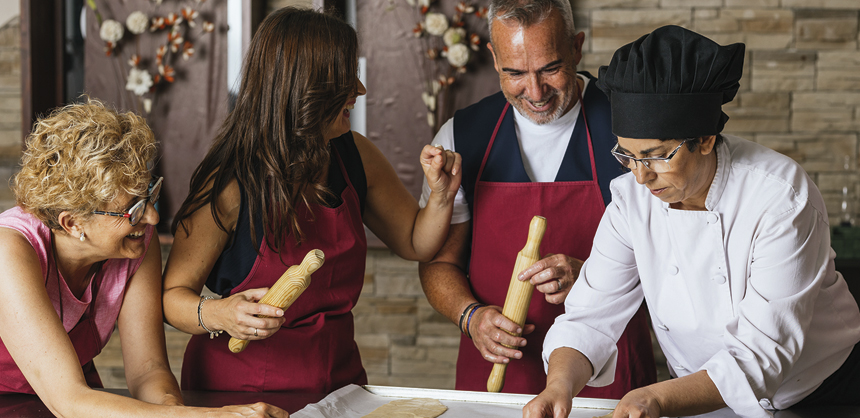
A cooking class using local ingredients is an interactive way to get attendees immersed in the destination’s culture.
Food as a Gateway to Authenticity
Food is one of the most powerful ways to connect attendees to a destination — and every expert agrees.
Green’s advice is delightfully blunt: “For the love of all that is holy: no chains!” he says, urging planners to choose local institutions, family-run spots and chefs who shape their communities. “Food does not have to be fancy to be memorable; it just has to feel specific to the locale,” he says.
He also encourages planners to think beyond the meal itself. “Dining can be more than just the meal,” Green shares. “It can be a market visit, a hands-on cooking experience, a chef-led tasting, a private dinner in an unexpected space or a progressive meal through a neighborhood.”
Mary Ellen Smith, account director at Poretta & Orr in Doylestown, PA, explains how she immerses attendees in the culture through food. “Rather than defaulting to set banquet menus, I work with the venue to showcase local and regional ingredients at our events.”
She offers a perfect illustration when talking about one of her events. “The resort’s chef created a private cooking class featuring foods of the Baja, including ceviche, aguachile, local oysters, as well as Hamachi, inspired by Baja’s modern food scene,” she explains. “Of all the activities offered throughout the week, the cooking class was the most popular and the attendees thoroughly enjoyed themselves.”
Smith also encourages planners to think about food as a cultural bridge.
Local Partnerships, Authentic Storytelling
Authenticity doesn’t stop at food — it extends to gifts, décor, entertainment and partnerships.
Smith underscores the value of local sourcing. “Branded swag certainly has its place,” she says, “but for incentive trips, instead of ordering from a large promotional company and shipping internationally or having to bring extra checked bags on the plane, we prefer to source locally whenever possible.”
Her private mercado experience was a standout. “Attendees received colorful printed ‘money’ to shop at stands featuring local items and handcrafted keepsakes,” she explains. “We received more positive feedback about this experience than any other aspect of the trip.”
Diane Lyons, CMP, DMCP, CEO/owner of ACCENT New Orleans in Louisiana, reinforces the importance of local partnerships. “After more than 35 years producing meetings and incentive programs, I’ve learned that the events people remember aren’t the ones that could have happened anywhere,” she states. “They’re the ones where attendees genuinely felt connected to the destination.”
Lyons encourages planners to start with venues that already have a story to tell. “A historic property, a renovated warehouse or a space with a memorable view immediately creates a connection to the destination,” she says. “But, if the best fit is a ballroom or convention center, don’t see that as a disadvantage. Think of it as a blank canvas.”
She adds, “One local touch isn’t enough. A signature cocktail or a local band is a great start, but what really makes an event feel authentic is when all of those details work together.”
Memorable Moments Attendees Take Home
Memorable moments are the heartbeat of destination-driven events. Lyons explains, “When planners get this right, she says, “people don’t just remember the event. They remember the place.”
Her New Orleans examples show how moments become memories: “Welcoming attendees with a brass band, having a local artist paint live during the reception, offering a hands-on crawfish boil or praline demonstration or serving coffee from a beloved local roaster,” she says. “In another city, those experiences will be completely different, and they should be.”
Bream’s Nashville example adds another layer. “During a client’s Nashville sales kickoff, we used the Grand Ole Opry with backstage access and time on the stage as a VIP moment,” she says. “Next year, we are renting out a honky-tonk to keep it fresh year over year.”
These moments aren’t just fun — they’re strategic. They reinforce achievement, build community and create stories attendees bring home.
The Destination is the Experience
Destination-driven events aren’t about sightseeing or checking boxes — they’re about immersion, identity and intention. When planners design experiences that could only happen in one place, attendees don’t just remember the event. They remember the city, the culture, the flavors, the people and the stories. They really feel as if they expeirenced the place, not just visited it. And that leads them to more avidly share their experiences and makes them want to attend the next event created by the planner.
Final Thoughts: From Concept to Agenda
For planners who embrace the idea of destination‑driven design but feel overwhelmed by where to start, it helps to translate philosophy into a simple, repeatable process. The goal isn’t to reinvent your entire planning workflow — it’s to layer the destination into decisions you’re already making, so the place becomes a through-line rather than an afterthought.
Begin with one sentence that defines why this destination matters for this group. It might be something like, “We’re going to Lisbon to celebrate resilience and explore Atlantic‑facing innovation,” or “We’re in Nashville to honor performance and tap into the city’s storytelling culture.” That single sentence becomes a filter: if an agenda item, venue or activity doesn’t connect to it, you question whether it belongs.
Next, map out the attendee journey from arrival to departure and ask at each touchpoint, “Where does the destination show up?” At the airport, that might mean a welcome desk with local snacks or a short printed guide to neighborhoods they’ll see. At check‑in, it could be a small, locally sourced amenity instead of a generic branded item. During general sessions, it might be a local emcee, regional music between segments, or visuals that highlight the city’s architecture and landscape rather than stock imagery.
Then, review your networking and recognition moments — these are prime opportunities to deepen the sense of place. Instead of a standard cocktail reception, could you host a progressive event through a historic district, with small bites and stories at each stop? Could your awards dinner incorporate a local tradition, like a New Orleans second line, a Japanese tea element or a coastal sunset ritual? When achievement is celebrated in a way that feels rooted in the destination, the memory of the recognition and the memory of the place become intertwined.
Don’t overlook the downtime and optional activities, which can make or break how attendees feel about a trip. Rather than offering a long list of generic excursions, curate a smaller set of experiences that reflect the city’s identity: a street art tour led by a local artist, a market visit with a chef, a neighborhood walk hosted by a historian or a hands‑on workshop with a regional craftsperson. The point isn’t to fill every waking hour; it’s to make the hours they do spend outside the meeting room feel intentional and connected.
Finally, build in reflection and storytelling. That might be as simple as a closing session where attendees share their favorite moments and what surprised them about the destination, or a digital photo wall where people upload images and short captions from the trip. When you give people space to articulate what the place meant to them, you reinforce the emotional connection you worked so hard to create. C&IT