








The Power of CertificationsMarch 1, 2026
By Matt SwensonThe Power of Certifications
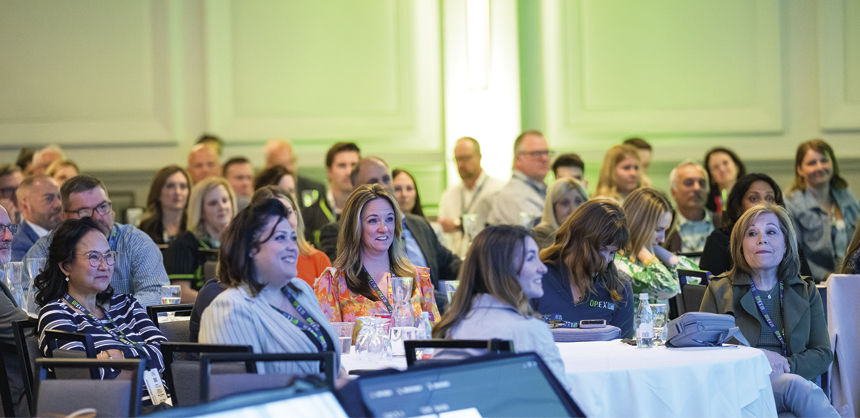
Having a CMP or other designation is a mark of excellence for planners. Pictured: Team members listen during a leadership presentation at an operational excellence conference for a national healthcare services organization in Chicago, IL.
Haley Sovulewski, CMP, a corporate event manager at We Crush Events, in Sacramento, CA, isn’t new to meeting planning. But when she sat down to take her Certified Meeting Professional exam last year, Sovulewski felt nervous.
“The test was hard,” she says of the 165-question exam. “It was long, and a lot of second-guessing was happening in that chair.”
Happily, her decade of experience in the industry and her four to five hours per week studying didn’t go for naught. She joined an elite tier of event professionals who add three coveted letters to their title: CMP.
It’s a mark of excellence that even industry veterans like Gregg Lauer, CMP, associate director of site selection at the Atlanta-based meeting management company Etherio, still appreciates nearly 30 years after he first passed the exam. “It’s the designation that everybody knows,” says Lauer, who became a CMP in 1997. “If you are in the meetings and events industry and you’re serious about this, then this is the designation you should have.”
Foundation of Knowledge
The Event Industry Council (EIC) first launched the CMP program in 1985 at a time when meeting planning was often confused as party planning. According to the EIC website, the goal then and now is “to enhance the knowledge and performance of meeting professionals, promote the status and credibility of the meeting profession and advance uniform standards of practice.”
“The CMP program is such an essential foundational credential for our industry,” says Washington-D.C.-based Amy Calvert, who became president and CEO of the EIC in 2019.
Calvert’s short tenure speaks to the seemingly nonstop challenges corporate event planners face and why industry organizations work diligently to prepare them for what’s ahead. Six short years feel like a lifetime to the event professionals who stuck it out through trying times, including the COVID-19 pandemic, the surge in hotel room rates, F&B costs and AV pricing, as well as ongoing geopolitical concerns and decreased international travel to the United States. Meanwhile, artificial intelligence is changing the ways companies run their business, how employees do their jobs and is shaping the global economy. “The world is getting more and more complex,” she says.
While no corporation is immune to those challenges, they have pressed forward with immense expectations in a world where capturing brand loyalty from increasingly demanding consumers and customers is harder than ever. If they were not before, live events are now chief economic engines for brands big and small. Underscoring that point, more than $1.2 trillion is spent on global business events annually, according to EIC data.
In-person experiences are the culmination of internal goals such as recruiting and nurturing talent, developing long-lasting teamwork, disseminating long-term goals to an entire company and rewarding top performers. Externally, brand activations, product launches, client meetings, trade shows and more are critical moments to engage with and influence audiences in make-or-break moments.
The pressure is on event planners to deliver, and the CMP provides the backbone of knowledge to thrive, says Lauer, who is vice chair of the CMP Study Group Committee through Georgia chapter of MPI, which provides a forum for cohorts to learn together.
A Sign of Dedication
The EIC reports that more than 12,000 meeting professionals in 55 countries around the globe hold the CMP designation. Despite language differences and myriad experiences, the CMP unites event professionals like few other aspects of the industry. It’s common to find a CMP breakfast or reception at an industry event, and local groups of designees gather for happy hours and other functions.
To apply to take the CMP exam, candidates must have completed 25 hours of meeting management education within the five years prior to submitting their application. You also need 36 months of full-time experience in the meetings industry, or 24 months with a relevant degree.
There’s no need to retake and pass the test once you’ve done so, but CMPs must seek recertification every five years, which requires continuous education. That, in itself, is a commitment to excellence for both the individual and the industry at large.
By maintaining his CMP for so long and over the span of multiple positions, Lauer says, “I have proven to myself that I am embedded in the industry.”
Prior to his current role, Lauer was director of catering and convention services at The Westin Peachtree Plaza in Atlanta and served as an internal corporate event planner at Equifax, a noted financial firm.
That range of experience is why Calvert confidently says: “The CMP is relevant no matter what your role is, where you reside or what part of the industry you work in.”
Calvert notes about 90% of CMPs recertify, maintaining their unofficial membership in a club of event professionals who strive to stand out. The relationships and networking that come from being a CMP are certainly advantages, but there is a much more tangible benefit as well.
According to PCMA research, meeting professionals who hold the CMP earn more annually than their non-certified counterparts. The salary jump is typically higher for event professionals who hold additional certifications. Other notable designations within the corporate events industry include:
- CEM – Certified Event Manager
- CIS – Certified Incentive Specialist
- CSEP – Certified Special Events Professional
- DES – Digital Event Strategist
DES, in particular, is a powerful certification post-pandemic as corporations operate globally and rely on regular virtual and hybrid events to maintain communication and collaboration. PCMA data notes that meeting planners earn more annually with a DES certification compared to those without it.
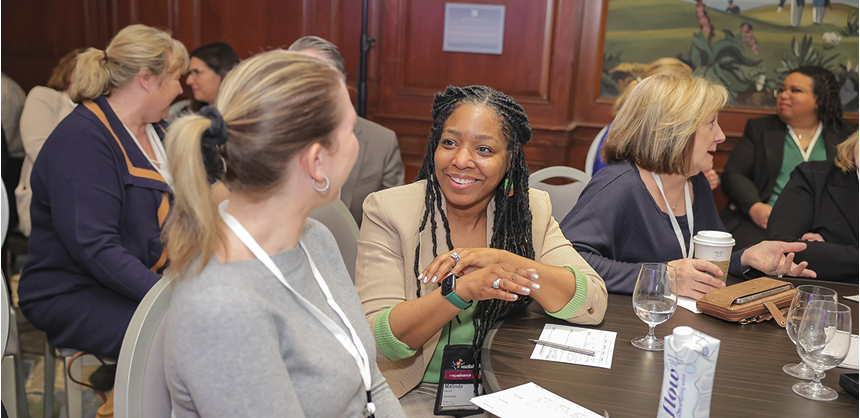
A CMP designation puts planners in a club of event professionals who strive for excellence. Photo courtesy of EIC
The 12 Pillars
Calvert says the CMP covers general knowledge of event planning that leads to specialty accreditation related to only one or a few aspects of the industry. The idea is to help event professionals on their educational journey without overwhelming them.
More than 1,000 global subject matter experts (SMEs) participate in the process of updating the CMP to meet the needs of the moment. The review takes place every three to five years. While the pandemic illuminated areas of meeting planning that needed greater focus, Calvert says the EIC made a concerted effort to act thoughtfully. “We were very committed to not rushing through a time of upheaval,” she says.
After the latest revisions, published in early 2025, there are 12 pillars that comprise the CMP:
- Strategic Planning
- Project Management
- Sustainability and Social Impact
- Risk Management
- Financial Management
- Talent Management
- Stakeholder Management
- Event Design
- Site Management
- Marketing and Communications
- Technology Integration
- Evaluation Process
Calvert notes it’s not coincidental that the pillars align closely with the World Economic Forum report on necessary future workforce skills. “The CMP shows that an individual brings capabilities beyond just technical skills — they bring strategic thinking,” she says.
Sustainability and social impact are among the examples of modernizing the accreditation to meet industry standards, says Calvert. AI, digital transformation, adaptive workplaces, neurodiversity and inclusivity are also emerging topics. Risk assessment and mitigation remain evergreen foundational competencies, she adds.
One of the largest misconceptions about the CMP is what its last initial stands for — “professional” and not “planner.” The designation was designed through a collaboration between planners and suppliers in the meetings industry to enhance the professionalism of everyone involved with events and meetings, Calvert notes.
Adds Lauer: “You learn what the standards are, and you learn a common body of terminology.”
Nowhere is it more important to understand the fundamentals of events than at the negotiating table. The CMP covers a lot of the important, yet unglamorous sides of the industry, notes Lauer. Content covers logistics like speaker fees, room set calculations, coffee gallon yield and volunteer management, among other topics.
Lauer, who has been on both sides of contract talks, says it’s obvious when you are dealing with an individual who has not taken the CMP. “If you mention attrition and they don’t know what that is, you know immediately,” he says.
During negotiations for one meeting, Lauer saved about $250,000 from the original terms of the contract — a testament to the fact that CMP knowledge helps planners anticipate risks and prevent costly mistakes, he says.
While not all members of the C-suite will notice the efforts, Lauer says true industry professionals understand the steps planners take to create successful events. “I think the people who matter are the ones you work with closely — and they get it.”
‘Bang for Your Buck’
As demonstrated earlier, it’s in a planner’s best financial interest to earn a CMP. But savvy companies will sponsor their event organizers’ efforts so they are in a better position to execute a productive and profitable event.
We Crush Events financially supported the efforts of Sovulewski and her teammates so they could serve their clients at an elite level. Sovulewski’s CMP was more rigorous than standard because she operated during a six-month time span. A standard timeline takes about a year.
The efforts paid off both in big-picture items and fundamental efforts of planning. For instance, she utilized her recently gained knowledge to use software to diagram a meeting space that allowed attendees to eat comfortably in the same room as the meeting. The client, who had never envisioned that setup before, was grateful, Sovulewski says.
Not only did she create a more efficient space, but that process helped guide the clients in the venue selection process. Once they knew where they wanted the meeting, Sovulewski went to work negotiating on their behalf. “I was able to really hit the ground pretty hard with this venue for the client so they could have the best bang for their buck,” she says.
Many of Sovulewski’s clients are also CMP-certified. She believes achieving the same designation adds mutual respect and trust. “It goes to show I’m hungry to learn. I take my job seriously. I take your event seriously,” she says.
It certainly adds self-confidence. As Lauer puts it: “You worked darn hard to get that CMP after your name.”
Strategic Thinking
Sovulewski says the CMP opened her eyes to how she could integrate sustainability into events strategically. “Sustainability was a huge one that I had never considered as something that would set you apart as a planner,” she admits.
Calvert, who was senior vice president of convention sales at Visit Baltimore prior to taking over the EIC, says that revelation falls under planners understanding the culture of the company they are working for. “Events are a manifestation of an organization’s values and their strategies,” says Calvert.
Planners who move beyond event manager titles to the C-Suite are the individuals who look beyond day-to-day operations to understand how the meeting fits in with a global corporate strategy. A person planning an event without the same training, as is the case with many administrative assistants asked to carry the load, would have difficulty seeing events as integral to corporate strategy, not just gatherings, says Lauer.
As more companies build year-round marketing campaigns around live experiences, it’s vital for event professionals to see how events fit into a larger business structure, says Calvert.
“Committing to being a lifelong learner and having this CMP designation, which is truly a mark of excellence, is critical to the future of our industry,” she says.
The EIC positions itself as a guidance provider, not prescriptive. While it firmly believes the CMP is a pathway to success, there is not an overt marketing campaign to attract new designees. The designation sells itself to planners ready to advance, notes Calvert. Common barriers to the CMP pursuit include timing, cost and competing life priorities, adds Calvert.
“I don’t really feel like we have to sell the validity of the credential,” Calvert says. “I think we have to help people understand why credentialing matters and where to go to find the tools and resources to begin your learning journey.”
“It’s a very saturated industry; it’s very competitive,” says Sovulewski, who cites her example of growth with the CMP training after 10 years of real-world experience as proof the time and resources are worth investing in. It will help you in your current role and your entire career, she adds. C&IT