








Beyond the BallroomApril 1, 2026
How Resorts Boost Corporate Event ROI By Zach ChouteauBeyond the Ballroom
How Resorts Boost Corporate Event ROI
Resorts offering easy access to nature and hiking paths provides teams with the serenity needed to focus and unlock their creativity.
In the high-stakes arena of corporate events, the venue is now a strategic choice that can dramatically influence meeting outcomes. While traditional conference centers and urban hotels still obviously have their purpose, resort destinations are emerging as powerful catalysts for engagement, innovation and a measurable return on investment (ROI).
A resort setting might not be the optimal choice for every event group or fit every budget, but for those corporate functions choosing to escape the traditional conference room, the payoff is tangible. This tactical location decision optimizes a resort’s singular setting, where the blend of professional and recreational activities is known to foster a more dynamic and productive atmosphere. By leveraging a destination that provides state-of-the-art facilities and a relaxed, rejuvenating locale, companies can elevate attendee interaction, improve networking opportunities, and create a positive lasting impression that translates directly into business growth and employee satisfaction.
Nature, Wellness & Performance
The impact of the surrounding environment on human behavior and functioning is well-documented. Studies from the University of Exeter and Harvard’s School of Public Health reveal that exposure to nature boosts cognitive function, lowers stress and inspires creativity. These findings are particularly relevant for corporate retreats and strategy sessions, where mental clarity and collaboration are paramount.
“Location is paramount and the resort setting allows a corporate meeting to have a setting that is best for mental acuity, collaboration and connectivity,” says Michael Dominguez, president & CEO of Associated Luxury Hotels International (ALHI) in Plano, TX. “Natural resort settings traditionally offer plenty of sun, ocean and nature, which benefits circadian rhythm, alertness and overall productivity. This is why they are such popular destinations for these types of meetings.”
Joe Martin, partner and director of conferences & meetings at BDI Events in New York, adds, “These elements balance out and even accentuate the sales, trainings and content being provided. More and more often, we are incorporating these offerings into the overall schedule or as a suggestion for planned breaks. To help facilitate an impactful break, wellness options and nature can really make a difference. After all, there’s no better ambiance for a break than beautiful natural surroundings that elevate mindfulness.”
Atmosphere as a Catalyst: Real-World Examples of Resort Impact
The immersive quality of resort environments can lead to breakthrough moments — both personal and professional. Dominguez shares a fresh, vivid example.
“Recently, we experienced a winemaker’s dinner that was paired with an amazing menu outdoors and with perfect weather that just allowed for an incredible evening,” he remarks. “The storytelling from the local wine producer made the meal even better.”
Martin offers two compelling case studies, saying: “A client who is a global organization hosted a personal business growth retreat. The destination was a remote mountain resort in Banff, Alberta, Canada. A main outcome included breakthroughs for individual attendees. The stunning natural setting allowed the attendees to settle into the mountain air and provided opportunities to explore the area on hikes and walks. These peaceful surroundings and lack of distractions helped unlock creativity and ideas they took home with them.
A client who is a global association of CMOs & CEOs hosted an event at an oceanside resort near Santa Barbara, CA. There were various outcomes for that, including breakthrough ideas and stronger relationships among the CMOs. The stronger connections were built due to everyone remaining on property for the entire duration of the event. In the end, the Net Promoter Score for this event was a record 86% (previously in the mid-70s), translating into much excitement about returning in 2026.”
Measuring Impact Holistically
While the emotional and experiential pluses of resort-based events might seem clear, companies are increasingly demanding tangible data to justify their investments. Martin outlines a three-tiered blueprint for success:
“First, we highly recommend resorts provide built-in or add-on technology options for RFID scanning capabilities. Many corporations are now looking for data, and usually they are cost-prohibitive to add on. Providing a solution that is built into the space would really make the venue stand out,” he says.
Secondly, he adds that resorts would benefit from helping corporations analyze cost-effectiveness per business goal by breaking down spending by category — then mapping that to value-adding outcomes, such as leads generated, deals accelerated and training scores, to calculate cost-per-impact metrics.
And on the final point, Martin explains that it would be incredibly valuable for the property to provide a pre-event survey regarding attendee expectations and amenities the attendees plan to enjoy while onsite. For additional ROI, he says, having this information pre-stay helps to prepare your team for staffing and logistics, and then it can also be compared post-event to actual usage.
These concepts are in concert with best practices seen throughout the industry. According to MeetingScouts.com, for example, measuring event ROI involves observing financial and non-financial benefits. These include improved brand awareness, better lead generation and stronger customer relationships. The opportunity to monitor attendee engagement, satisfaction and behavioral results is emerging as a must-have.
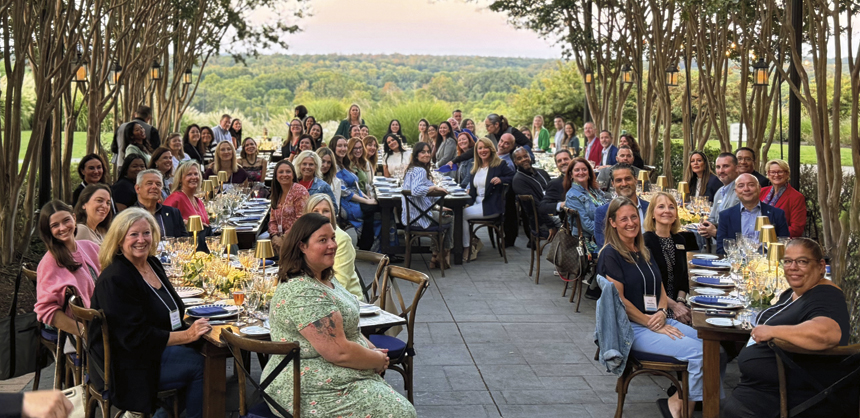
An outdoor winemakers dinner at Lansdowne Resort in Virginia was a memorable experience for the Associated Luxury Hotels International group.
Amenities Drive Engagement & Performance
Resorts offer a unique blend of business infrastructure and leisure experiences that can elevate team performance. Dominguez emphasizes the importance of curated programming. “The ability for teams to connect in an engaging and memorable way is critical in environments where team engagement overall is very low scoring. Resorts can design programming that utilizes outdoor spaces, and we have found F&B experiences and classes to be one of the best opportunities for team bonding and connection that you can find,” he says.
Martin adds, “Resorts can boost team performance and engagement by blending functional business amenities with memorable experiences. Providing quiet, easily accessible spaces for impromptu private or semi-private meetings allows sales teams and leaders to connect with customers or colleagues on the fly.”
Pairing these practical options with curated dine-around experiences, Martin believes, fosters collaboration, camaraderie and motivation long after the event ends.
Tailored Services = Strategic Outcomes
Customization is vital for complementing resort experiences with corporate goals — whether it’s innovation, leadership development or culture-building. Martin says, “Resorts will stand apart if they have a network of local, top-quality content experts and professional speakers. Having this Rolodex of easily accessible experts would be very advantageous and support the company’s budget by avoiding expensive travel costs.”
Flexibility in space usage is also critical, he says, since every company has different needs and preferences when it comes to utilizing a resort’s space.
“That’s why it’s important the resort is flexible in how its space is utilized and even provides several options for space usage,” he explains. “We find that most of our clients would prefer to move their event around from different cities and hotels. If a client is considering returning to a venue, they need ideas on how to ‘reinvent’ the experience.”
Martin adds that his company has already begun having conversations with the venue on how to create an experience that feels completely reinvented from the 2025 event.
Accessibility & Exclusivity
As corporate teams become more global, accessibility and uniqueness are rising priorities. Martin notes, “Most companies are looking to host in major markets mainly due to the availability of direct flights. This is often beneficial in terms of cost, as well as timing, because event schedules are already limited, so they cannot afford to add too much travel time.”
He also remarks that companies are looking for unexpected destinations, with many clients asking where they can go that other companies are not. They want to stand apart, make it unique and create new memories.
Recent data emphasizes this trend: RetreatsAndVenues.com shares that more than 70% of mid-size to large companies host annual retreats, with nature-based and rural destinations in high demand. The wish for uniqueness and originality is spurring interest in lesser-known resort towns, eco-lodges and boutique properties. These locations provide a fresh experience but also a sense of discovery. The combination creates an emotional hook that greatly elevates the event’s memorability and outcomes.
The Future of Resort-Based Events
Looking forward, resort destinations are positioned to serve an even larger role in corporate strategy. With a burgeoning focus on sustainability, wellness and experiential gatherings, resorts are stepping up to offer:
- Carbon-neutral event packages
- Onsite wellness coaches and mindfulness facilitators
- Local immersion experiences (e.g., culinary tours, artisan workshops)
- Hybrid-ready infrastructure for global teams
Martin emphasizes that the demand for uniqueness and accessibility will continue to shape the market. “A growing number of our clients have global teams and customers,” he shares. “They want to stand apart, make it unique and create new memories.”
Resorts that embrace these trends and invest in flexible, future-ready infrastructure will be best positioned to serve the evolving needs of corporate planners. Whether it’s a hybrid leadership summit or a fully immersive retreat, the ability to deliver both logistical ease and emotional impact is what sets resort venues apart.
The Bottom Line:
ROI You Can Feel—and Measure
Corporate retreats and offsite meetings are no longer indulgent perks — they’re strategic investments. The ROI includes improved employee engagement, increased productivity, reduced burnout, stronger company culture and accelerated business outcomes. When thoughtfully executed, resort-based events deliver both emotional resonance and hard metrics.
Dominguez sums it up smoothly, saying, “The resort’s historical knowledge of what has been successful for other groups is a critical opportunity for planners to learn and tweak to fit their needs and know that success has been seen in past experiences.”
And Martin reinforces the significance of strategic collaboration with resorts by adding,“ Every company has different needs and preferences when it comes to utilizing the resort’s space … If a client is considering returning to a venue, they need ideas on how to ‘reinvent’ the experience.”
In our current ultra-competitive landscape, the most successful corporate events are those that combine purpose with place, and the setting itself becomes a strategic benefit. Resorts provide more than just a picturesque backdrop — they provide immersive experiences that drive connection, creativity and measurable results. C&IT