








Engaging EconomicsJune 1, 2026
Getting Attendees Involved Doesn’t Have to Break the Bank By Zach ChouteauEngaging Economics
Getting Attendees Involved Doesn’t Have to Break the Bank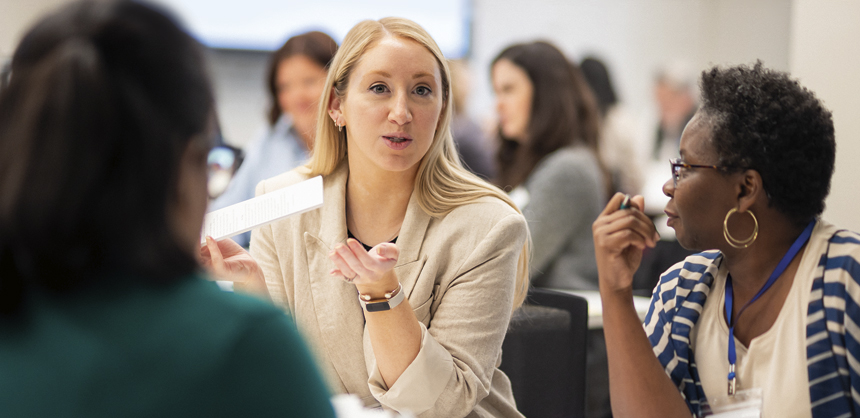
Improve event engagement by creating a room design that welcomes interaction. Photo courtesy of Better Meetings
In a time when meeting budgets are more highly scrutinized than ever, planners encounter a familiar but increasingly urgent challenge: how to energize attendee engagement without elevating costs.[/caption]
Engagement is the lifeblood of any successful event — fueling learning, networking, satisfaction, and ultimately, return on investment. Still, the assumption persists that boosting engagement requires big-ticket activations, elaborate tech or high-profile speakers.
The real story, according to several seasoned event strategists, is far more optimistic. Engagement isn’t something you purchase — it’s something you design. And often, the most powerful tools for drawing attendees in are inexpensive or even free. Creativity, intentionality and human connection consistently outperform flashy production elements when it comes to driving meaningful participation.
To discover what truly moves the needle, we spoke with three industry leaders who have mastered the art of high-impact, low-cost engagement: Timothy Arnold, regional vice president at HPN Global in Scottsdale, AZ; Liz Lathan, CMP, co-founder of Club Ichi in Austin, TX, and Jeffrey Cesari, principal of XO Consulting, LLC in Los Angeles, CA.
Their insights reveal a shared belief that engagement is less about budget lines and more about thoughtful design, clear communication and the courage to rethink long-held assumptions. What follows is a deep dive into their strategies, philosophies and practical advice for maximizing return on engagement (ROE) in 2026 and beyond.
The Power of Simple, Human-Centered Design
For Arnold, raising engagement begins with rethinking the basics — especially room setups, conversation flow and the social dynamics that shape how attendees interact. “I prefer room setups that allow for better attendee conversation. Crescent rounds over theater or classroom. Content can be tailored to have more time for discussion and interaction,” he explains.
It’s a simple shift, but one that immediately changes the energy in the room. Crescent rounds encourage eye contact, collaboration and dialogue — three ingredients essential to engagement.
Instead of leaving networking to random chance, table hosts ensure that no attendee feels isolated and that conversations have purpose. “For meals, consider having table hosts that make sure all are involved in the conversation and that there are introductions happening,” says Arnold.
Even receptions — which can be noisy, crowded and overwhelming — can be reconfigured to foster connection. “For receptions, don’t have the music blaring. It makes it difficult to converse with one another. I like having smaller stations around the pre-function space so that people could enjoy a shared activity, away from the sometimes overwhelming nature of the event. I have seen things like making crafts for kids in a local hospital, writing cards to soldiers, etc.,” he says.
These activities cost little to nothing, yet they create shared experiences that bond attendees and give them something meaningful to talk about. As Arnold puts it, “None of these costs much; many are free, but can increase attendee interaction and engagement in a huge manner.”
Spending Smarter, Not Bigger
When budgets constrict, planners often feel pressure to cut corners in ways that inadvertently reduce engagement. But Arnold argues that the real issue is misaligned spending priorities. “Having an event host or a consistent emcee can be a game changer and typically leads to more engagement,” he remarks. “I would rather spend here than on pricey AV that might look cool, but often does not drive communication and engagement. A good host makes the event feel more cohesive, especially on panel discussions.”
A talented emcee can tie sessions together, reinforce key messages and maintain energy — tasks no lighting package can accomplish. Similarly, Arnold encourages planners to rethink the value of celebrity speakers. He says, “Look at the speakers or entertainment that you are paying for and figure out how they drive value to your target audience. Having a famous quarterback or actor might be flashy, but if their presence is not valuable to the industry that they are speaking to, that money might be better spent on subject matter experts in that field.”
He also adds, “I am a huge fan of spending money on speakers that drive value for the industry, not just the ones that have a big profile. I don’t go to meetings based on the big-name speakers. I attend the ones that will make me better at my job.”
Another high-impact, low-cost tactic: encouraging speakers to remain onsite after their sessions. He says, “Having the speakers stay behind and interact with attendees in some way is a big benefit for attendees. This can be a great place for a sponsor to host a networking break with a speaker and invite attendees.” This brings huge ROI for the sponsor and a great chance for attendee engagement as well.
Setting Expectations Early:
The Role of Pre-Event Communication
Engagement doesn’t start onsite — it begins long before attendees arrive. “This can be a huge opportunity to connect with attendees before they get onsite,” Arnold says. “And by using social media, attendees can connect with other attendees beforehand too, which will increase their overall return on investment.”
Pre-event communication can build anticipation, clarify goals and help attendees feel invested in the experience. It also sets the tone for the kind of engagement planners hope to see onsite.
Defining Engagement Before Designing It
Many planners chase engagement as a vague ideal. Lathan argues that the first step is defining what engagement actually means for the event’s success metrics.
“Stop listening to people who say engagement is an add-on to your tech tool or an expensive hallway activation or a top-tier keynote speaker,” she says. Instead, she encourages planners to start with clarity: “Start deciding what engagement means to your success metrics. I break it into three categories: Cognitive (do you need them to learn?), Behavioral (do you need them to do something?) and Emotional (do you need them to feel something?), and how will you measure those?”
This framework allows planners to design with intention instead of defaulting to costly add-ons.
Regarding cognitive engagement — where learning and retention are key — Lathan says, “Designing for this kind of engagement is all about the speakers, the room environment and the activities.” This aligns closely with Arnold’s emphasis on conversation-friendly setups and interactive formats.
Behavioral engagement, on the other hand, is about motivating specific actions. “Maybe it’s a sweepstakes to get the badge scanned to win a prize. Maybe it’s an insane Instagram moment for the social posts. Maybe it’s free margaritas at the 4 p.m. last session of the day,” says Lathan.
Emotional engagement is about belonging, loyalty and community. She says, “It could be as simple as creating community moments that bring people together or giving everyone a branded T-shirt and having them wear it on the final day of the event, or ensuring the conversations continue past the event inside a community.”
Her message is straightforward enough: “Driving engagement starts with defining engagement, then you can figure out what gets you the result without adding more costs!”
Participation Over Production:
A Shift in Mindset
For Cesari, engagement is a fundamental design choice — not a budget item. “When resources are limited, I shift from production value to participation value,” he remarks.
One of his most effective strategies is also one of the simplest: “Give the room back to the room. Facilitated roundtables consistently outperform lecture-style sessions because people learn best from peers.”
This peer-driven model creates deeper connections and more actionable takeaways. “They discover their challenges are not unique. They exchange real-world solutions and they leave with actionable next steps instead of just inspiration.”
Psychological safety is central to this approach. “When expectations are set clearly and participants know the space is confidential and judgment-free, engagement deepens immediately.” He points to communities like Event Leaders Exchange, where conversations operate under the Chatham House Rule, a system for holding discussions where the identity of the speaker is withheld to encourage more freedom of expression, as examples of how trust fuels participation.
Cesari also notes that physical presence matters. “I have also found that stepping off the stage changes everything. In smaller breakout settings, when I can engage directly, adapt in real time and crowd-source discussion, the dynamic shifts from presentation to shared dialogue,” he says.
His conclusion is unequivocal: “You do not need bigger décor. You need better design. Connection drives engagement.”
Avoiding the Trap of Oversized General Sessions
One of the most common — and costly — oversights Cesari witnesses is the tendency to overextend general sessions. “Three full days in a large main tent environment can significantly increase production costs without increasing impact. Staging, lighting, labor and room rental multiply quickly. Bigger does not always mean better. Often it simply means more expensive,” he says.
Tradition often perpetuates these choices. “Sometimes, the resistance to change is not strategic. It is historical. ‘We have always done it this way’ can quietly erode ROI.”
His solution: compress the general session into a single, high impact day. “Deliver concise, purposeful main stage moments that align around clear objectives. Then transition participants into smaller breakout environments where ideas can be reinforced, debated and workshopped,” he says.
This shift not only reduces costs but also improves retention and clarity. “When attendees actively process content in smaller settings, retention improves and next steps become clearer. That is where return shows up,” he adds.
Engineering Energy Through Flow, Not Flash
High energy doesn’t come from pyrotechnics or LED walls — it comes from movement, pacing and human interaction.
“Energy is engineered, not purchased,” Cesari says. “Some of the most dynamic experiences I have seen relied on intentional flow rather than expensive builds or complex technology.”
He stresses that attendees don’t want to sit all day. “The most valuable square footage at an event is not the stage. It is the hallway,” he says.
Those in-between moments — walking between sessions, standing in line for lunch — are where ideas often crystallize. “When people are moving, they are processing. When they are processing, they are connecting. And when they are connecting, ideas compound.”
Planners can harness this without spending more: shorten seated segments, build in transition time, encourage walking conversations and design room layouts that invite interaction.
“High energy does not come from adding more production. It comes from activating what is already in the room,” Cesari says.
Communication as the Multiplier of Engagement
For Cesari, communication is the common thread that webs engagement together before, during and after the event. “You can design a strong agenda, but if participants do not understand the purpose, engagement will fall short. People need clarity on why they are there, what matters and how they contribute to the bigger picture,” he says.
Before the event, communication builds alignment and prevents scope creep. During the event, a strong emcee reinforces objectives and connects sessions to overarching goals. After the event, communication turns inspiration into action.
“Clear action items, defined next steps and accountability checkpoints translate inspiration into implementation,” he explains. “Engagement should not end when the lights go down. It should convert into momentum.”
The Bottom Line:
Engagement Is Designed, Not Purchased
Across all three experts, a consistent message emerges: engagement is not a function of budget, but of intention. It’s about designing environments where people feel connected, empowered and invested. It’s about clarity, trust and human-centered experiences. And it’s about resisting the temptation to equate production value with engagement value.
As Cesari puts it, “If engagement requires a larger check, it may be time to redesign the format rather than expand the budget.”
In 2026, the most effective engagement strategies won’t be the flashiest — they’ll be the smartest. And they’ll remind planners that the most powerful tools for creating meaningful experiences are often the simplest ones. |C&IT|