








Risk Management: The Best DefenseApril 1, 2013
Proactive Planners Provide Safe and Secure Meeting Environments By Derek ReveronRisk Management: The Best Defense
Proactive Planners Provide Safe and Secure Meeting Environments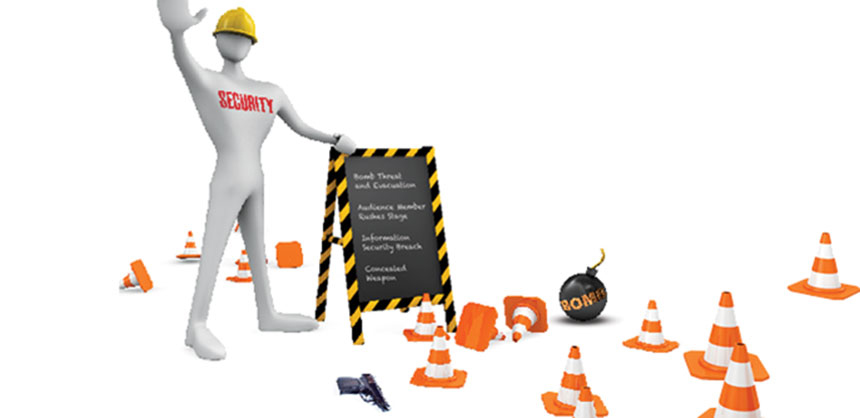 Some threats to the physical safety and security of attendees, including natural disasters such as Hurricane Sandy, provide at least some warning. But other types of threats such as accidents, medical issues, crime and terrorist attacks strike with no notice and can disrupt or completely ruin a meeting or event.
That’s why planners must have a written strategy to assess and mitigate safety risks. “Having a security plan is part of the responsibility for putting on a successful meeting,” says Susan Goldberg, CMP, president of Glen Cove, NY-based Segue Consulting Inc. A meeting planner and risk management consultant, Goldberg says, “Although planners wear 12 hats, they have to understand that safety is an integral part of planning. They have to start early in the planning process to identify risks and do it simultaneously with other duties. Planners must take a proactive role in security.”
Corporate security experts such as William Besse agree. “Security planning should begin when you know what kind of trip it is and where you plan to go,” says Besse, vice president, consulting and investigations of Los Angeles, CA-headquartered Andrews International LLC, a full-service provider of risk and mitigation services. “Starting early can dictate whether security can be done easily and inexpensively or whether it should be more robust, complex and costly. Security should not be tacked onto the end of the planning process after making reservations, itineraries and other commitments,” says Besse, who is based in Irving, TX.
Ignoring safety and security could lead to legal problems, warn security experts. Indeed, legal precedent and case law have established that meeting planning is among the professions and industries that have an obligation to provide a reasonable standard of care while taking actions that could foreseeably harm others.
Planners can avoid legal issues and keep attendees safe by preparing in advance. Medical issues, accidents and incidents related to human frailty are the most common issues that occur. “In all the trips I have taken with large or small groups, there are far more cases of medical emergencies of varying degrees than any other kind of security incident. I spend a lot of time preparing for medical emergencies,” says Besse, who previously served as the director of global security for Mary Kay Cosmetics.
Some planners can go many years or even their entire careers without ever facing medical emergencies or other significant security threats. But don’t count on being one of those people, planners and security experts advise. It’s best to heed the advice of planners, such as those interviewed for this article, who have experienced security and safety issues. Here are some of their examples:
Bomb threat and evacuation. Goldberg once experienced a bomb threat at a meeting at a resort in Florida. “We evacuated the hotel, and the FBI came. They searched the hotel and there was no bomb. It turned out there was a waiter who called in the threat offsite. They found him by looking at who called in sick that day,” says Goldberg.
Audience member rushes stage. Goldberg cites another example: “We had a situation at a meeting where a person in the audience rushed the stage. We didn’t know what she was doing. It turned out that she was from Hawaii and wanted to put a lei around the speaker’s neck. Security stopped the woman by gently diverting her in the opposite direction.”
Information security breach. Another planner, a CMP, recalls the following incident: “I had a group of 70 staying at a five-star hotel in Mexico, and the fitness center required our last and first names and room number upon sign-in,” says the planner. “The sign-in sheet was unattended and just sitting there for all to see. It was standard procedure and no one had ever questioned it. I spoke with the (fitness center) manager and general manager about the risks it posed. It was changed the very same day.”
Concealed weapon. Yet another planner faced this near-horrifying scenario. “A well-dressed person came to the registration desk with a briefcase, casually asking questions about the names of people who attended. A person at the registration desk became suspicious, contacted us, and we contacted security. We found out that person had a gun in the briefcase and had come specifically to target someone. She was arrested.”
New Strategies
Due to potential physical threats, planners and corporations are taking several steps to increase security and safety for meeting groups and business travelers. According to a recent survey by the Global Business Travel Association (GBTA), travel managers have implemented several strategies.
Alternative transportation arrangements is the most common tactic, with 32 percent of respondents taking this route. Other actions include emergency contact information (70 percent); tracking support (66 percent); destination and crisis information (59 percent); crisis and evacuation plans (44 percent); and mass mobile communication tools (29 percent).
Experts say that most planners lack such strategies, including an overall safety and security plan. Meeting planners tend to avoid creating a plan because they fear it is too time consuming, difficult and overwhelming. However, once a plan is finished, it can serve as a blueprint for every meeting, large and small, with certain modifications for each event.
The Components of the Plan
The plan should include steps to take before meetings and after a safety or security incident. When creating the plan, it’s best to imagine problems that could occur in four basic categories:
• Natural disasters such as earthquakes, hurricanes and storms.
• Accidents — medical and human frailty issues.
• Crime.
• Technology and computers.
Kevin Iwamoto, GLP, GTP, vice president of industry strategy for Active Network, a San Jose, CA-based online registration and event management company, advises planners to always include a venue and location/destination safety and security review and advise clients if the meeting site or destination has a history of issues. “Planners should ask all venues that are considered for the meeting to provide a copy of safety and security plans and build ongoing communication for the organizers and attendees,” says Iwamoto, former president and CEO of the National Business Travel Association (former name of the GBTA).
“Planners can get information from various sources and should develop a checklist of standard operating procedures to demonstrate due diligence in safety and security vetting for every meeting they handle,” he adds.
Here are additional pointers for creating a security plan that covers all contingencies for small and large meetings.
Conduct a risk assessment. Identify possible threats. These include food poisoning, natural disasters, criminal activity, demonstrations, terrorism, evacuations, fires, construction, hazardous materials, power outages, transportation issues and work stoppages.
Determine unique threats. For example, a corporation’s product, service or executives may have received negative publicity and could be targets of protestors inside and outside of a meeting. Is there a VIP who travels with personal security or requires extra protection or a safe room? Perhaps an attendee has received a personal threat or has a disgruntled partner or spouse.
Determine medical issues. Ask questions on the registration form such as, “Are there any medical issues that you care to voluntarily share?”
Assess other meetings. Find out if there are meetings taking place simultaneously on the property. Does the other group have any unique security risks? For example, a company wouldn’t want to hold a new product introduction meeting in the same hotel where a competitor is booked.
Talk to hotel staff. Determine if the hotel has safety and security procedures in place, preferably during a site visit. Mary Ann Willingham, vice president, meetings and incentives, for Plymouth, MN-based Travel Leaders Group LLC, a full-service travel agency, includes hotel security staff in her pre-meeting planning sessions with properties. Willingham explains her approach: “These sessions take place in advance of the final preparation for the event via conference calls and webcasts. We also hold an in-person meeting at the event venue to ensure that every tiny detail of the meeting is addressed and thoroughly understood. During these sessions, we review hotel security procedures, sleeping room access practices, after-hours security staffing and any unique security officers hired for non-standard duties,” says Willingham.
Obtain a copy of the plan. If the hotel doesn’t provide a copy, ask questions about the facility’s security procedures. Besse suggests talking to the head of security and general manager and asking questions from a security checklist that includes the following:
• What kinds of incidents have taken place in and around the hotel?
• How quickly do police respond?
• How long does it take ambulances and emergency medical services to arrive? What are the evacuation procedures?
• What happens in the middle of the night if a fire alarm rings?
Talk to local law enforcement. “You can always contact local police and tell them you are bringing a group, where they will be staying and for how long. Most police departments have a community liaison that will be glad to help you” by providing crime statistics for the hotel and surrounding area, says Goldberg.
Assess every meeting. A key thing to remember about safety risk assessments: Conduct them even when you return to a property where you have previously met, even if it was the prior year. “We do risk assessments every time regardless of whether we met there because things can change — staffs, the environment around the hotel and the venue,” says Besse. “It doesn’t have to be a full-blown assessment if you are going back to the same place, but do some level of assessment,” he says.
Share the plan. Go through what-if scenarios and response procedures with the staff and train them. Goldberg says she compares it to producing a movie. “I have a script (security plan) and a production team (meeting staff), and we choreograph our relationship with each other.”
911 procedures. “At a large hotel or resort, sometimes it takes medical help several minutes after they arrive to find a person in a meeting room,” says Besse. “I like to know what the protocol is for helping the EMTs find the person in need after getting to the hotel. It’s crucial that whomever calls 911 be able to direct EMTs to the property entrance that’s nearest to the meeting room and the quickest way to get there once inside.”
Media relations. Determine who will handle relations with media, relatives, attendees, vendors and the hotel should something serious happen. Designate responsible people who will handle inquiries onsite and at the planner’s home office.
Create a contact list. Include phone numbers and location of the nearest medical facilities, ambulance services, and fire and police stations. Also include numbers for the hotel security staff, manager, concierge, head of food and beverage, and maintenance and meeting vendors.
The Global Approach
Apply the basics of the security plan to meetings in foreign countries, but take into account some key additional issues. In recent years, spontaneous political and economic protests have sporadically erupted in the Middle East, Europe, Asia and Latin America. Technology such as social media fuels causes so that a small protest can spread quickly and threaten a meeting.
In addition, groups from the U.S. stand out in other countries, making them obvious potential targets. “The global nature of the business travel industry can inevitably lead to travelers being in dangerous situations,” Mike McCormick, GBTA executive director and COO, says in a statement releasing the group’s survey results. “Travel managers need to have a crisis plan ready to go at a moment’s notice to ensure they can help get employees out of frightening situations and return them to safety.”
Security experts offer this advice on keeping groups safe in other countries:
Follow major news about the foreign nation. Track demonstrations and major political upheavals along with the impact they are having on a group’s meeting destination.
Provide groups with information about a country’s customs. This will avoid unintentionally offending people and increasing the likelihood of a confrontation.
Review local laws and procedures. Specifically, check out the laws for police and emergency medical staff responding to incidents.
Know the location and phone number of the local U.S. embassy. When planning the meeting, get help from the Smart Traveler Enrollment Program (STEP), a U.S. State Department website. The site allows users to get security-related information about a country and receive assistance from a U.S. embassy or consulate. Register for the service at https://step.state.gov/step.
Maintain records. Security problems that occur overseas and in the U.S. require effective record-keeping and follow-up. Iwamoto cautions planners to maintain detailed records “of their efforts in research and execution of safety and security planning,” Iwamoto says, “Keep dates, times, names, conversations and detailed written records of planning activities as information will most likely be requested by legal representatives from all sides to determine culpability. This is where working with corporate risk management whenever possible really works in favor of a planner because it demonstrates a good faith effort to plan for the safety and security of attendees in advance.”
Final Thoughts
Experts advise independent meeting planners to view security planning as part of their standard services. Even planners who lack the time or expertise to do complete safety planning should bring up the issue with clients to ask how they prefer to approach it.
More planners should take an approach similar to that described by Willingham: “It is our policy to use our knowledge and expertise and the resources available to us and the meeting venue to do everything we can to ensure the meetings we coordinate are a safe and enjoyable experience for everyone involved.” C&IT