








Meetings & Incentives at SeaFebruary 1, 2026
By David SwansonMeetings & Incentives at Sea
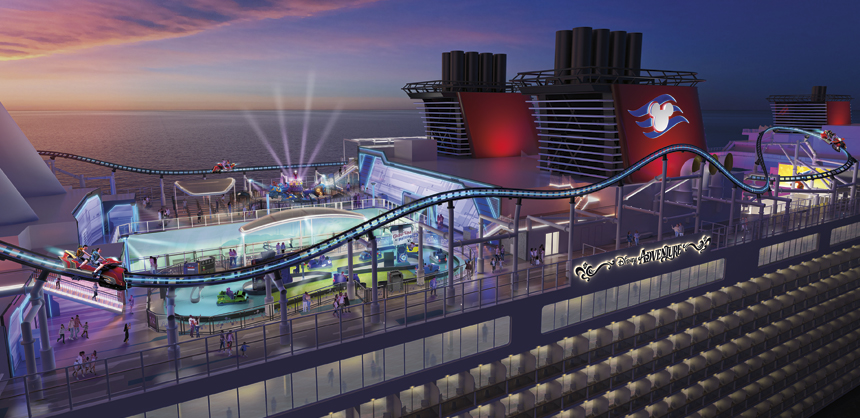
The Disney Adventure, slated to arrive this spring, will be the eighth ship for Disney Cruise Line. Photo courtesy of Disney
Meeting planners handling the logistics for a busy meeting or incentive program know how challenging it can be to assemble the disparate pieces for a successful event. Between room blocks, transportation, dining venues, meeting rooms, AV requirements and activities to appeal to a multi-faceted group, fitting together the puzzle pieces requires a commitment of time, energy and money.
But cruise-based programs streamline many elements of planning. By assembling the disparate functions under one umbrella, logistics can be contained. Meeting planners we’ve spoken to say that such bundling also usually leads to cost savings over comparable land-based meeting options.
No wonder a growing number of companies are finding that corporate events at sea often offer an edge over traditional land-based programs.
And the cruise industry is booming. In its annual 2025 State of the Industry report, Cruise Lines International Association (CLIA) announced that the number of passengers projected to cruise this year would reach 39.6 million, up 5% from last year, fueled by a growing supply of new ships, both large and small.
In March, Norwegian Cruise Line will debut the approximately 3,550-passenger Norwegian Luna, sister to the well-received Norwegian Aqua that arrived last year and revitalized the line’s onboard experience. Like its predecessor, Norwegian Luna is actually slightly smaller than the line’s other recent ships. Traffic flows more smoothly, public spaces feel less crowded when sailing at full capacity, and the ship has a broad Ocean Boulevard, encircling the entire vessel like on old-style ocean liner, offering casual food options, loungers and a pair of infinity pools. There is plenty to do onboard, including a digital sports complex, which transforms into a nightclub at night. For those wanting to relax when not in meetings, the Vibe Beach Club, an adults-only, open-air lounge, provides respite. Passengers can dine in style at one of the many culinary possibilities, including new experiences, returning NCL favorite venues and a food hall with 10 different food stations, as well as bar and lounge options.
Fifteen ocean cruise ships are scheduled to debut in 2026, according to Seatrade Cruise News. Included are ships from well-known lines such as Royal Caribbean, Norwegian and Disney Cruise Line, along with the introduction of new brands Four Seasons Yachts and Orient Express, which will debut with intimate ships carrying fewer than 200 passengers.
A growing number of these cruises are being sold to the corporate and incentive market, either as full-ship charters or as a block of cabins on a publicly-available itinerary. Cost is a key advantage, say planners.
“There are no F&B minimums or meeting room rentals,” explains Vicki Fernandez, senior manager of client services for Miami-based Landry & Kling, one of the leaders in cruise ship charters and meetings. “The costs for AV are minimal when compared to building out a ballroom. Additionally, there is no need to create a program for plus-ones or pay for entertainment, which is first rate and is included in the fare. There is so much on the ship to do that they can take care of themselves while participants are in meetings. In addition, there are no resort fees or municipal charges that vary city to city.”
Diana Bloss, co-founder and vice president for Worldwide Cruise Associates, adds that costs and planning are more predictable for cruise-based events. “Before even stepping onboard, planners know exactly what their expenses will be, eliminating uncertainty and ensuring there are no surprises,” says Bloss. “A dedicated onboard ship team supports your daily programming, reducing the need for incentive houses or planners to bring extensive staff. In the weeks and months leading up to the event, every detail is carefully planned, confirmed and coordinated with all onboard departments.” As a result, when your team and attendees arrive, she says, everything is in place — allowing the event to run seamlessly from start to finish.
“A comparable land program would be approximately 30% higher than a cruise program,” estimates Karen Devine, CITP, CEO and Founder of 3D Cruise Partners. “The all-inclusive nature of a cruise makes it so easy for the planner to maintain a budget and take advantage of the inclusiveness to deliver that positive no-nickel-and-diming experience.”
Last summer, Devine worked with Celebrity Cruises to book an incentive program for a Fortune 500 company involved in global supply chain solutions. The client had 750 attendees aboard the 2,910-passenger Celebrity Apex for a cruise from Southampton, England through the Norwegian fjords. “The client had worked very successfully with Celebrity previously a few years prior and the product fit them well,” notes Devine. “Celebrity’s willingness to customize and work with them, given the ship size, and the available space on board was also key, along with the price point. The premium level fit the caliber of this incentive and attendees beautifully.”
“The client really wanted the fjords and northern Europe,” says Devine. That, along with a newer and larger ship than their previous sailing, easy air in and out of London, and being able to customize onboard events, made it ideal for the group.” It was important to put all of the attendees in comparable balcony cabins, which is not always possible depending on the size of the group and ship configuration. Devine also needed to be creative with private events, working around fixed spaces and ensuring other cruisers were disrupted as little as possible.
“Our private meetings in the main theater were complimentary, with AV included, along with concessioned receptions,” says Devine. The ship has a daily itinerary to keep, so planners must program onboard events accordingly, working around the timing of the ship’s departures from one port to the next. “However, cruises are inclusive so there’s no need for transportation, venue rentals or catering, so this usually becomes quite a positive. Good communication is key, and a clear understanding of the spaces that can accommodate the group is critical. That said, it’s important for planners to choose an itinerary and port schedule that works for their program.”
Launching last November, Celebrity’s latest ship, Celebrity Xcel, is the fifth in the line’s Edge Class series. Celebrity Xcel introduced a series of new spaces to the fleet, including the Bazaar, a transformational venue designed to blur the line between ship and shore by creating festivals with food, entertainment and shopping themed to the ports and changing every two days. The ship operates Caribbean itineraries out of Miami and Fort Lauderdale in the winter, with Mediterranean sailings from Barcelona and Athens in summer.
For a company planning a meeting-intensive event for 228 attendees this summer, Worldwide Cruise Associates recommended the client book with Crystal Cruises. “The meeting space was of critical importance,” says Bloss. “To ensure complete confidence and secure positive feedback, we conducted a site cruise with the client prior to contracting. We have consistently found this to be the most effective way to showcase the product and align expectations before final commitment.”
“We selected the 606-passenger Crystal Symphony based on several key factors,” adds Bloss. “First, the itinerary featured a unique destination that was experiencing strong demand. Second, the ship is classified within the luxury segment, aligning with the client’s expectations and brand positioning. Third, and most critical for this program, the ship was able to accommodate an extensive meeting schedule with multiple breakout sessions, which was a core requirement for the client.”
Bloss says the Crystal Symphony offers numerous meeting spaces capable of accommodating groups of varying sizes. “The client’s program requires plenary sessions for all attendees, as well as multiple smaller breakout meetings running simultaneously,” explains Bloss. “The ship’s state-of-the-art presentation technology fully supported these needs.”
The group will represent about one-third of the total passengers aboard the cruise. “This is one of the key reasons we chose Crystal,” says Bloss. “Their team understands how to successfully accommodate group requests and customized programming, without negatively impacting either the group or the regular attendees. Crystal has been highly collaborative in integrating our program into the ship’s regular schedule. They are flexible, accommodating, and have been consistently positive to work with throughout the process.”
Bloss continues: “The quality of the culinary offerings and onboard entertainment further supports the client’s objective of delivering a meeting-intensive program without compromising on luxury. Crystal Symphony features a wide range of restaurant venues, which we will utilize for both group dining and intimate VIP gatherings. The result is a well-orchestrated, hour-by-hour agenda that balances productive meetings with dining, onboard entertainment and meaningful destination experiences. While the program will be meeting-intensive, it’s equally important to ensure ample opportunity for attendees to explore the destinations and experience each port of call.”
Crystal recently announced the name of its first new ocean vessel in 25 years: Crystal Grace, scheduled for delivery in May 2028. The 650-passenger ship will continue the brand’s all-suite, all-veranda configuration — purpose-built luxury hardware that supports high-end corporate and incentive programs. The design of Crystal Grace will emphasize spacious accommodations, high staff-to-guest ratios and onboard entertainment, all well-suited to hosting executive-level programs, rewards travel and intimate corporate gatherings in a highly controlled, seamless setting.
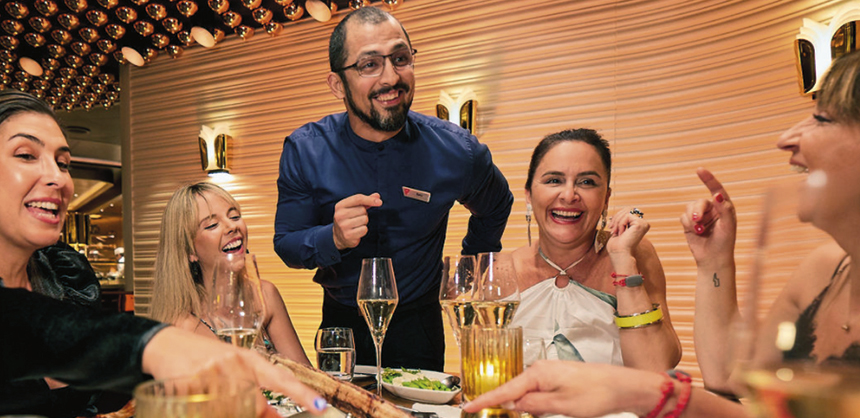
A big benefit for having a meeting at sea is that F&B is included. Photo courtesy of Virgin Voyages
The adults-only Virgin Voyages has strived to chart a new course in the industry. Last summer, the line launched its fourth ship, the 2,770-passenger Brilliant Lady. Virgin has topped several reader polls, particularly for its come-as-you-are aesthetic.
Fernandez has a client who is a continuing education group in the medical field, that will have 100 attendees embarking on a seven-night Greek Isles cruise aboard Virgin’s Scarlett Lady this summer. “It’s a mid-sized ship, and Virgin has unique features that are not found on other lines,” explains Fernandez. “For instance, there’s no main dining room, but it offers smaller restaurants with varying cuisine at no additional cost. This makes it fun for dine-arounds in smaller groups within the group.”
Fernandez continues: “The group has specific requirements, such as 15 to 20 hours of meetings during the cruise and room setup to meet their continuing education need.” She notes that a mistake some groups make when planning a cruise meeting is not taking the itinerary into consideration. “If you have a lot of required meeting time, then a port-intensive itinerary doesn’t work — participants will resent missing time in port. Flexibility with the ship’s itinerary is important. Another hurdle is thinking you have to run the event exactly as on land. A cruise means investing time for creativity and flexibility to breathe new life into an annual event. This client wanted an adult only experience, and in Europe. The price point fit their budget.”
Virgin Voyages’ fleet of ships is currently departing from Miami, Barcelona, Athens and San Juan. On-board, more than 20 eateries feature culinary experiences from Michelin-star chefs, larger-than-life entertainment, designer suites, a Mermaid-inspired spa and other amenities to keep attendees enjoying themselves when not in meetings.
Full-ship charters free up almost all the spaces on a ship, allowing planners a greater degree of flexibility with the schedule. Some cruise lines, such as Royal Caribbean and Celebrity, have invested in dedicated conference venues aboard their ships, making it easier to secure the meeting space needed when taking a block of cabins. Most cruise lines are organized more around leisure travel, and therefore gatherings are usually focused on the theaters in the morning or even dining rooms during non-meal hours.
But Fernandez says the positives outweigh the negatives, including access to state-of-the-art technology, a minimal charge for set up, and ship facilities with their own décor, so you won’t be tasked with dressing up a drab ballroom. “We worked with the cruise line to secure a lounge that could be set up classroom-style and had appropriate AV,” adds Fernandez. “The client was flexible to choose their hours around the hours spent in port, but the key when cruising as a group is to secure and confirm meeting space at contract to avoid scrambling later. This is not Virgin’s usual audience, but they worked with us to make it happen, and the Greek Isles itinerary and date works beautifully with the client’s plans.”
“Work with the sales and operations planning teams to secure the meeting requirements you need,” concludes Fernandez. “We’ve had other groups sail on Virgin and the onboard team has been fantastic, collaborating with us to execute a flawless program that exceeded expectations.”
Though well established, another cruise line that may not be obvious to planners for an event at sea is Disney Cruise Line. Although the passenger mix for the line obviously skews heavily to the family audience that visits the theme parks in Orlando and Anaheim, the ships have also started to develop a following in the MICE community as a base for constructive events.
“We use Disney Cruise Line exclusively because our events are built around families,” explains Karen Hines, CRNA, DNAP and Owner of Southern Anesthesia Seminars. “Our attendees are primarily CRNAs who work long, high-stress hours and often have limited opportunities to fully disconnect. A cruise environment allows us to intentionally condense the educational portion of the experience while still delivering exceptional content. Many attendees register because they want to take their family on a Disney cruise, often with the added benefit of employer reimbursement or potential tax deductions, but they are frequently surprised by the depth and quality of the education we provide.”
The educational component is scheduled during focused blocks, and once sessions conclude, the attendees are able to reconnect with their families and enjoy time together — without commuting, logistics or competing demands. “A cruise-based event allows us to combine two things our anesthesiologists value deeply: high-quality continuing education and meaningful family time,” adds Hines.
Disney’s seven ships were not designed for traditional educational meetings, and dedicated conference rooms with full AV capabilities are limited. “To address this, we’ve successfully used venues such as Animator’s Palate, which already includes integrated video screens,” says Hines. “This has worked exceptionally well, allowing attendees to clearly view content from anywhere in the room and creating a more immersive, less clinical learning environment. Our hands-on workshops are scheduled from 7 to 10 a.m. on sea days only, never on port days. This ensures families have the remainder of each day to enjoy onboard activities or destinations together.”
The primary operational challenge Hines deals with is bringing aboard medical equipment, such as ultrasound devices, airway equipment and procedural supplies — all of which must be coordinated with ship security. Certain supplies, such as needles, are secured by the ship, monitored during use by a designated crew member and stored safely when not in session. “This limits what can be brought onboard compared to land-based events,” explains Hines. “But we’ve developed processes that allow us to deliver true hands-on education while remaining compliant with maritime safety protocols.”
One limitation Hines finds is catering the sessions during breakfast, when continental service — coffee and pastries — is the only available option (outside busy restaurants). Some attendees prefer a more substantial offering following the three-hour workshop. “This has been the only consistent catering challenge we’ve experienced,” says Hines. “We do host private onboard functions, including a welcome reception and an exclusive mixology experience for attendees and one guest. These events help create a VIP experience and foster connection among participants.”
Disney Cruise Line’s seventh ship, the 4,000-passenger Disney Destiny, launched in November, operating three- to seven-night Caribbean and Bahamian itineraries out of Fort Lauderdale (a majority of the line’s sailings stick to the Caribbean, with some itineraries to Alaska, Mexico’s Pacific Coast and Europe). Disney’s eighth ship will be a game-changer for the line. The 6,700-passenger Disney Adventure, which arrives this spring, is the world’s 11th largest and will operate exclusively out of Singapore for now, principally serving Disney’s growing legion of fans in Asia. Four more ships are scheduled to be added to the Disney Cruise Line fleet between 2027 and 2031.
For those seeking more intimate options for cruise-based events, the trend toward larger ships has been matched with an equal number of smaller vessels. This summer, Explora Journeys will debut its third ship, the succinctly named Explora III, a 926-passenger vessel that lays on the creature comforts, while this year Windstar Cruises adds its first new ships in more than a decade, the 224-passenger Star Seeker and Star Explorer.
Smaller still is the fast-growing river cruise market, in which size is limited (in most regions) by river depth and bridge height. Few river ships exceed 200 passenger capacity, making them ideal for smaller meeting charters. The river cruise product is generally more inclusive than ocean-going ships — wine and beer is included with meals, along with shore excursions, making the final price even more predictable.
One river operator pursuing the MICE sector is Uniworld, with a fleet based primarily in Europe, but also in India, Egypt, Peru and Southeast Asia. Itineraries are more flexible for full-ship charters, and menus, shore excursions and entertainment can be customized as well. The boutique ambience is well represented by Uniworld’s newest ship, the S.S. Emilie, inspired by the paintings of Gustav Klimt and his life partner and muse, Emilie Flöge, and distinguished by the artist’s trademark gold hues and distinct Art Deco elements. The 154-passenger ship operates on the Danube, with seven-night itineraries, navigating behind the Iron Curtain through Slovakia, Hungary and Croatia to Belgrade. In 2027, Uniworld will launch four new ships.
As cruise lines continue to add to their portfolio of possibilities and destinations, the choices are greater than ever. No matter which ship a planner chooses, they are sure to find an option that will meet their goals. C&IT