







Trade ShowsJuly 1, 2026
Spectacle vs. Substance By Matt SwensonTrade Shows
Spectacle vs. Substance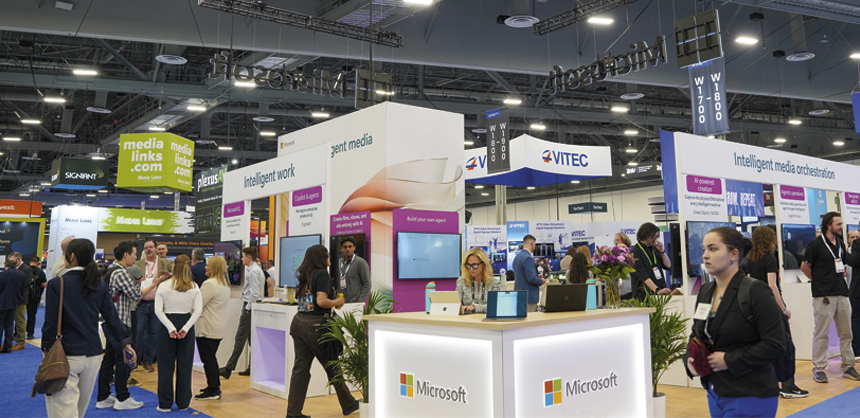
To increase attendance, the National Association of Broadcasters widened its target audience and created curated experiences at the NAB Show.
Of the more than 58,000 registered attendees at the National Association of Broadcasters (NAB) in Las Vegas this year, 48% were first-timers. That’s not an accident, but rather the result of NAB rethinking its entire event strategy, says Karen Chupka, executive vice president of NAB Show, based in Washington D.C.
In reframing its conference and trade show around business growth and professional relevance, NAB intentionally broadened beyond traditional broadcasters into creators, streamers, enterprise video teams and sports organizations. The idea was to attract a greater representation of the industry so the event resonated with attendees. “We had to do a better job of telling people that we’re not just about broadcast studio equipment,” Chupka says.
Getting the newcomers was only half the battle. The next, and arguably more important step, was to create an experience where everyone felt welcome. To do so, NAB broke down its large-scale event into smaller communities and curated experiences.
The success of the NAB Show speaks to a larger trend associations are discovering when producing trade shows: The strongest events are connecting big moments to personalized education, intentional networking and practical ROI. Yes, there is still room for spectacle, but big-name speakers, dizzying gadgets and LED lights, and seemingly endless rows of trade show booths, can feel daunting and distract attendees’ goals to learn and communicate with one another.
In other words, bigger isn’t necessarily better.
Proving Your Show’s Worth
In today’s tough economy, attendees and their organizations are reevaluating every aspect of their budget. Travel can be a tough sell unless you can prove the time outside the office and resources spent attending a conference or trade show are worth the investment. Ultimately, the bottom line often comes down to building connections with peers and partners, which can have more tangible results than being one of several thousand attendees to watch a big-name speaker, even if the content is as inspirational as planners hope.
According to “The Experience Design Report: What’s Shaping Live Experiences in 2026,” produced by Encore, a global leader in event production and technology, in partnership with industry research and media firm Boldpush, nearly half of respondents (49%) rank peer networking as the most important factor in event success. However, only 8% of events are dedicating more programming to structured connection.
The findings track with Freeman’s “2025 Experience Trends Report,” which found a noticeable disconnect between what event organizers prioritize and what attendees value.
Freeman’s analysis discovered that attendees lean into the basics like building vendor relationships, learning and development, and making connections. But planners tend to prioritize splashy experiences, such as keynote speakers, opening and closing receptions and surprise elements. “Show organizers need a clear understanding of their audience,” says Susan Newman, the National Retail Federation’s (NRF) senior vice president of conferences and strategic marketing, in Washington D.C. “Whether they are looking for networking or education, ensuring these opportunities and content are available should be a focus.”
Research shows that even Generation Z, which grew up in a digital world, craves in-person experiences at live events. According to Freeman’s “2025 Gen Z Report,” young working adults believe attending live events will benefit their careers, business relationships and personal growth. Millennials and Generation X members join their younger audience members in believing that “it feels like companies focus more on technology these days to connect to people than building person-to-person connections.”
That makes it up to planners and associations to truly prove their worth to members. Audiences don’t need to express dissatisfaction over email or in a call to a sales representative or recruiter. They can simply choose not to attend a show if the agenda doesn’t speak to their objectives. “We were seeing this more this year than in previous years,” says Chris Moore, chief learning and meetings officer for ASAE: The Center for Association Leadership in Washington D.C. “Attendees are holding off until the schedule of educational sessions is published.”
Moore understands the consternation about signing up for shows. Money is tight and associations are often understaffed to begin with. “Attendees have to make the case for the budget more so than they did in previous years,” he says.
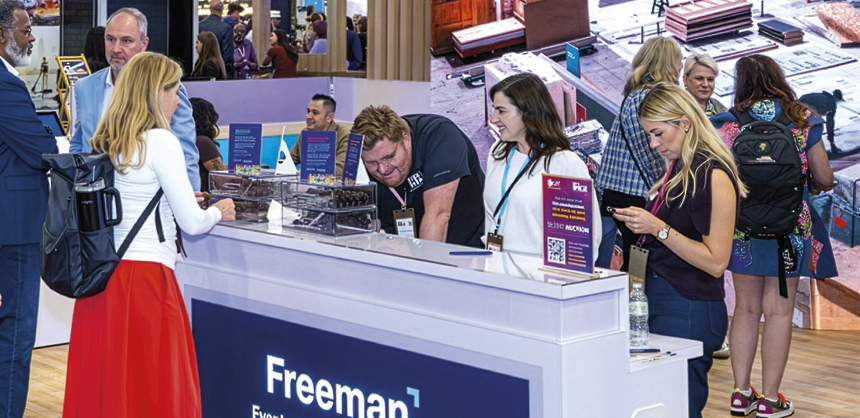
Attendees tend to focus on connection and content, according to a recent Freeman Study.
Making the Show Personal
One of the most effective ways to shrink the scale of an event so attendees feel like more than a number is to use emerging technology. Artificial intelligence, in particular, is proving to be a real timesaver for planners seeking to improve the reach of their shows.
AI tools helped NAB analyze registration patterns and identify emerging attendee groups, says Chupka. Three audience areas typically underrepresented at the NAB show were targeted: Content creators, corporate media professionals and representatives from professional and collegiate sports teams and organizations.
Using AI, NAB generated a list of prospective attendees who would likely benefit from attending the event but had not traditionally been part of its core audience.
The marketing team then developed messaging and marketing materials to attract members of the targeted segments. The effort provided a significant result:
- The number of registered attendees who identified as content creators increased 140% from 2025.
- More than 13,000 attendees reported that they are corporate media professionals, almost double the 2025 number.
- About 75 professional sports teams, 22 professional leagues and governing bodies, 30 sports venues, 15 esports/gaming organizations, 35 collegiate athletic departments and 15 sports content producers/distributors came to the show.
Building off its success, NAB also created a Content Creator VIP Program, whose members receive exclusive perks, industry discounts and complimentary access to the show.
Rather than designing one-size-fits-all experiences, organizers are curating learning journeys for distinct attendee groups. NAB, for instance, had customized tracks focused on sports, enterprise video, the business of media and entertainment, the creator economy and AI and innovation. “We put some of those things in place to also make it easier for first-timers to come in and really have a successful event,” says Chupka.
Moore adds it’s important to meet attendees where they are rather than force them to conform to traditional trade show models.
That starts before the show. Attendees have been inundated with too many emails for years, acknowledges Moore. To break through the noise, organizations like ASAE have to be more intentional about what information to send, when to deliver it to attendees and use platforms most likely to reach the desired audience. Even the language should be scrutinized to make sure associations demonstrate understanding of attendees’ needs and desires. “We’re really focused on bringing the voice of the members into communications,” Moore says.
How Tech Can Help
NAB and NRF both attract attendees from more than 100 countries. The upside of this is there are more opportunities to build business leads, but the challenge is meeting the people you are most likely to develop long-term relationships with.
For its Big Show, NRF analyzes audience expectations yearly to identify shifts and emerging trends, says Newman. That data fuels how it will promote the trade show and how it will help guide attendees on an engaging journey. Attendees do not have to navigate the process of making meaningful connections alone. Likewise, planners have technology ready to serve as the assistant they have always wanted. NAB debuted a new app this year specifically to encourage networking, adds Chupka.
New apps and badge-scanning tools can help organizers understand attendee interests and booth behavior, notes Moore. That information is vital for improving future show layouts, networking design and educational programming. Improved networking can take the form of AI-powered tools acting as matchmakers for prescheduled appointments, recommending which booths to visit and suggesting whom to meet at designated gathering functions. Newman adds this is another case of understanding how attendees work best within your show. “Attendees frequently connect organically through sessions, lounges and interactions across the show floor” at NRF, Newman says.
Lounge-style areas, charging stations, refreshments and casual gathering zones are being sprinkled throughout trade shows to support organic interaction. NAB added happy hours targeted to attendee identities and interests (young professionals, creators, first-timers) to create more meaningful encounters. “People knew that if I came to this location at this time, I was going to meet people like myself,” Chupka explains.
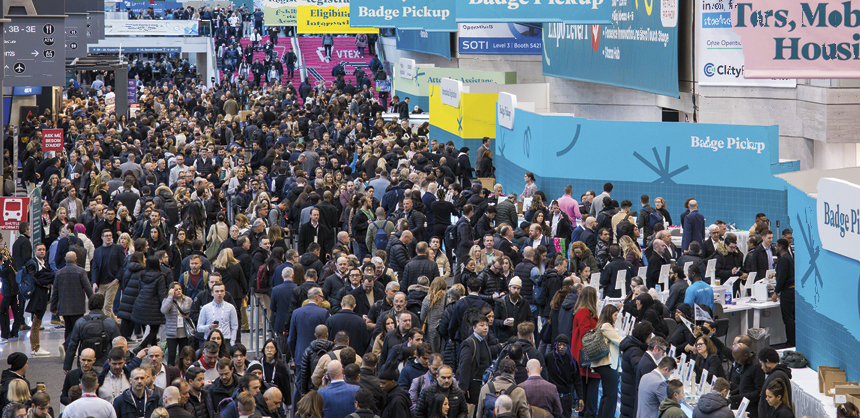
Attendees organically interact at the National Retail Foundation’s Big Show. Photo courtesy of Jason Dixson Photography
The Exhibitor Factor
Associations are not the only parties interested in creating engagement with attendees. It is a prime concern for exhibitors as well. The NAB Show featured more than 1,100 exhibitors from around the globe, across an exhibit floor spanning nearly eight soccer fields. Sponsors and partnering companies allocate large portions of their marketing budget to designing trade show booths that not only draw attendees in, but maintain their interest long enough to generate genuine leads.
The Exhibitor Advocate, a nonprofit association dedicated to booth operators’ needs, says exhibitors are feeling the pinch and scaling back efforts due to high costs that may not justify the expenses. The Advocate’s study last year found that 55% of exhibitors believe the increased costs outweigh the value of the investment at some events. As a result, 64% are scaling back their overall presence at events, 55% are limiting onsite staff attendance and 52% are re-evaluating event and exhibit budgets. If exhibitors opt to engage customers at offsite events or other avenues, trade shows could lose sponsorship dollars and struggle to maintain interest among attendees.
Association planners agree exhibitors have a chance to connect strongly with attendees by mixing in some razzle-dazzle. Newman says that sponsors gain more value when attendees see technologies working together in realistic settings, a sentiment Moore agrees with. “We’re seeing a lot more of the exhibitors trying to create experiences in their booths that are going to attract foot traffic,” he says. The key, Moore adds, is for booths to create useful experiences, not just visual attraction. Adds Newman: “Securing sponsorships that excite attendees, drive curiosity and drive traffic to booths benefits everyone.”
To that point, 91% of Generation Z would like a balance between technology and in-person opportunities to connect with others at their company and in their industry, Freeman finds. Chupka encourages exhibitors to employ AI like NAB has to understand who’s attending the show, who’s likely to visit their booth and how to engage them.
Planners are doing their part with efforts to steer attendees to sessions, booths, activations and high-touch moments that will pique interest. The NAB Show, for instance, had more than 530 conference sessions featuring about 900 speakers. A single attendee would be lucky to catch a handful of the presentations. Push notifications and chatbot suggestions that rely on registration data and past habits can accurately predict which sessions an attendee should prioritize.
Style Has Its Place
The issue is not spectacle versus substance — it’s whether spectacle serves substance. The strongest activations become educational environments, not entertainment, notes Newman, adding that immersive experiences are worthwhile when they showcase real-world applications.
Moore cautions against going too small with a trade show. Large-scale experiences, such as receptions and opening events, still have value. “The key is using them as an entry point to facilitate smaller, more meaningful interactions,” says Moore. “What we want to try to do is connect that big moment to smaller moments.”
Think of the big-name speaker, high-tech displays and entertainment as talking points. Encouraging discussion among attendees brings knowledge to both sides and also demonstrates to exhibitors that their products are making an impact.
Attendees are not rejecting spectacle; they’re rejecting spectacle without purpose, says Chupka. The strongest events use big moments to create more personalized experiences throughout the show.
Newman adds trade show organizers cannot design around a single attendee archetype anymore. Modern attendees want different things from the same event: networking, education, sourcing, downtime, streaming content or spontaneous meetings. As a result, balancing offerings is becoming more important than maximizing any single experience. “Trade shows have been around for many years. While there is often an expectation of a ‘major shift,’ each generation continues to value opportunities to learn from industry leaders, connect with peers and have fun,” says Newman. “Looking ahead, trade shows will look for new ways to continue to enhance their offerings, whether it is through technology, personalization or content that resonates with diverse audiences.” | AC&F |