







The Power of Trade ShowsMay 1, 2026
Providing a Foundation for Collaboration & Growth By Matt SwensonThe Power of Trade Shows
Providing a Foundation for Collaboration & Growth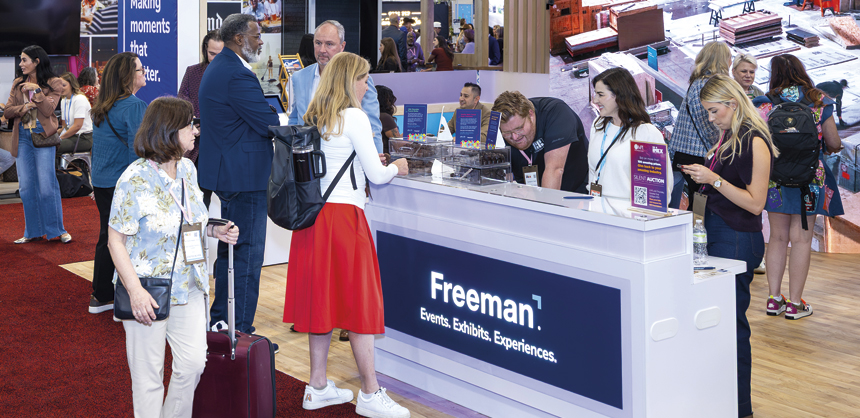
Trade shows offer potential buyers the opportunity to learn about products in a way they cannot do online. Photo courtesy of Freeman
More than 30 years ago, David Audrain became convinced of the value of trade shows in the marketplace. He’s sure in another three decades, no matter how much else changes, trade shows will remain the best place to spur business.
“Trade shows create short-term interactive opportunities for buyers and sellers to touch, taste, feel and learn about products and services that they just can’t do online or on paper,” says Audrain, CEO and partner at the Exposition Development Company, who has run some of the largest and most influential expos in the industry.
As the former CEO of the Society of Independent Show Organizers, and ex-president and CEO of both Clarion Events North America and Messe Frankfurt North America, Audrain says there is no better venue for international organizations to gain a foothold in a new market than at a trade show. They stand the test of time, he says, and as such, are valuable economic engines regardless of circumstances out of associations’ control.
Black swan events such as the 9/11 attacks and COVID-19 pandemic, which severely limited travel and in-person interaction, only demonstrated how important it is to gather at such hubs of connection and innovation.
Tariffs and geopolitical conflicts caused many industries to take a pause last year, but worst-case scenarios have yet to play out, according to Peter Rupert, a professor of economics at the University of California, Santa Barbara, who is also a frequent speaker at trade shows. That said, the early days of this year already signal that uncertainty is likely to remain prevalent among associations and organizations pining for stability.
It is at precisely these moments that Tommy Goodwin, executive vice president of the Exhibitions & Conferences Alliance, says organizations can take comfort in the reliability of trade shows. He points to overwhelming statistics making that case:
- About 70% of buyers prefer hybrid and in-person experiences, where there is increased trust and deeper engagement, according to McKinsey & Company, a management consulting firm.
- Trade shows generate, on average, 38% new leads per event, Oxford Economics reports.
- Face-to-face requests are 34 times more successful than email for generating action, according to the Harvard Business Review.
“Amid economic uncertainty, business and professional events continue to deliver unparalleled value to exhibitors and attendees alike,” says Goodwin. “There is nowhere else where people can come together to connect, share knowledge and do business at scale like they can at exhibitions, conferences, meetings, expositions and trade shows.”
‘A Valuable Channel’
Inflation, international travel restraints and budget cuts, particularly in the government, threaten to lower attendance figures and cut into revenue projections in 2026, notes Nancy Drapeau, IPC, vice president of research at the Center for Exhibition Industry Research (CEIR).
Still, while other types of events are either canceled, diminished or consolidated into other gatherings, organizations are loath to touch trade shows. Cancellations of trade shows are “negligible,” observes Drapeau, adding that many associations count on their annual convention and trade show to generate the money necessary to sustain operations and fund membership benefits.
Demand among exhibitors, the companies paying to set up booths in front of potential buyers, remains high. “The majority of exhibitors continue to dedicate a consistent share of their marketing spend to this channel,” she says.
Proof is showing up in the numbers. According to Freeman’s 2025 Spring Study, one-third of exhibitors expect their trade show budgets to increase, and another 35% anticipate they will remain flat.
“The increases in trade show spend reflect a continued belief in the power of in-person demonstrations, dialogue and relationship-building,” says David Saef, senior vice president of strategy at Freeman. “At a time when deeper customer engagement and trust matter more than ever, trade shows remain a valuable channel.”
A Trade Show for Everyone
Just as there is seemingly an association for every industry, there is a trade show as well. Many of the country’s largest events are annual expositions produced by associations. Among the largest are:
- The Consumer Electronics Show (CES), organized by the Consumer Technology Association, showcasing breakthrough technology and global innovation.
- The World of Concrete, organized and produced by Informa Markets with support from associations like the Tilt-Up Concrete Association (TCA) and American Concrete Institute (ACI), featuring the latest in tools, machinery and technology for concrete.
- The SEMA Show, organized by the Specialty Equipment Market Association, showcasing new products, custom vehicles and emerging technology.
These are just three of the expos that draw more than 100,000 attendees annually. All of them are also held at the Las Vegas Convention Center.
Audrain, who previously ran SEMA, adds his favorite trade shows to tour are related to manufacturing. “There is nothing better than a show full of equipment to really show the value of face-to-face events,” he says.
But other industries bring plenty to the table. The National Restaurant Association showcases innovation in equipment, technology, food and beverage at its annual event in Chicago. Likewise, the Specialty Food Association holds a large winter event in San Diego and summer expo in New York.
Freeman is seeing anecdotal evidence of strong growth in hosted buyer formats, in which the company pays for travel and lodging with the anticipation that the coveted attendees will attract high-paying exhibitors. This is a particularly popular format within the events industry. IMEX Frankfurt and IMEX Americas are two huge showcases for destinations and vendors to attract business from meeting planners.
According to last year’s CEIR Index, which was recently published, the largest trade shows (200,000 sf or more of paid space) are experiencing the biggest growth. Saef says that trend is to be expected. “When business or macroeconomic conditions tighten, we see companies concentrate on top-tier events,” he says.
Freeman’s research shows that 24% of organizers report that attendance is significantly or notably up compared with previous years.
Many large shows have, indeed, reported record-breaking success in recent years. Last year, the Shooting, Hunting and Outdoor Trade Show (SHOT Show), owned and operated by the National Shooting Sports Foundation (NSSF)— The Firearm Industry Trade Association, featured 2,800 companies displaying products and services in booths over 830,000 net sf spanning The Venetian Expo and Caesars Forum.
With more than 53,000 attendees last year, SHOT is the ninth largest trade show in the U.S., according to NSSF’s website. “The SHOT Show is more than a trade show; it’s a gathering of friends from a dedicated community,” according to a testimonial from Mat Best, co-founder of Black Rifle Coffee Company, in NSSF’s event recap last year.
That sentiment can be felt across many industries and shows, adds Saef, who says Freeman’s reports show that 70% of respondents call trade shows a critical place to discover and evaluate new products and offerings.
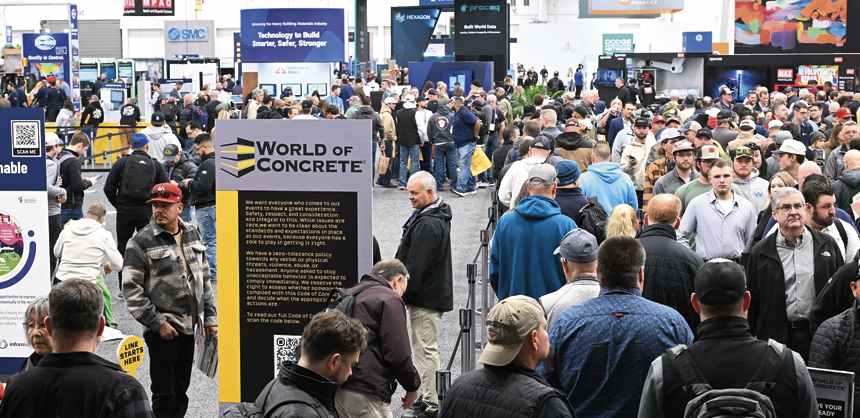
Large trade shows, like the World of Concrete, are experiencing the biggest growth, according to the CEIR Index.
Major Attractions
Exhibitions are drivers of business within their given sectors, but also play a vital role in the tourism economy.
CES typically draws over 130,000 attendees from more than 150 countries. Participants fill hotel rooms, eat at local restaurants and shop at nearby stores. The impact is huge. SHOT, meanwhile, places its economic impact at $88 million in non-gaming revenue.
Destinations that can accommodate such large groups can count on that large business regardless of other economic circumstances, says Rupert.
“Las Vegas and Atlanta and a whole bunch of different places are really well set up for these types of conferences and conventions,” he says.
Beyond the actual business done on the floor, the shows are a chance to visit a part of the country or world attendees have yet to visit. Rupert made his first trip to Savannah to attend an expo at the Savannah Convention Center, which doubled its exhibition space during a massive renovation completed last year.
The city poured $276 million into the project to ensure existing customers didn’t grow out of the existing space while attracting new events. The National Agricultural Aviation Association, best-known as crop-dusters, regularly holds their annual convention in the Georgia port city, and will do so again in November.
Some of the this country’s largest markets are also in the midst of major convention center expansions.
Austin, TX, took the extraordinary step of taking its convention center offline for four years to redo the space. The move was necessary, according to the CVB website, which notes that it previously turned down nearly 50% of the business leads it received due to size constraints and availability. The completed expansion project is estimated to generate an additional $285 million in yearly economic impact within the local community, provide nearly $13 million in additional annual tax revenue to the City, and support over 1,600 additional jobs, according to the convention center website dedicated to the upgrades.
Kay Bailey Hutchinson Convention Center remains open in Dallas amidst a major renovation, as is also the case with George R. Brown Convention Center in Houston, where the International Association of Exhibitions and Events’ (IAEE) Expo! Expo! brought together more than 1,800 industry professionals last year. Fort Worth Convention Center is also undergoing a major upgrade. These are just a few who are or have undergone renovations.
Growing Industries
Destinations dedicating such time and resources to attract the country’s largest events speaks to their belief in the power of trade shows.
“Exhibitions and conferences drive economic growth, support job creation, empower small businesses and help solve our most urgent societal challenges nationwide and around the world,” says Goodwin.
As business continues to be done internationally, trade shows will only increase in value, notes Saef. He is keeping a close eye on companies, such as Terrapinn and Closer Still Media, acquiring events, while others, including Renewing What’s Possible (RE+), Chicago Transit Authority (CTA) and Radiological Society of North America (RSNA), continue to enter and cultivate new markets.
Audrain, pointing to his time at Messe Frankfurt, adds the international element of trade shows has been critical for years. “There are many countries around the world that subsidize and organize country pavilions at a great many trade shows around the world year after year, because they work. The shows provide that unique market access to these international companies that cannot be replicated any other way,” he says.
Among the benefits of attending trade shows is that there is not a one-size-fits-all definition for achieving ROI on the exhibition floor. Notably, only 13% of exhibitors rate closing sales on the show floor as important, according to CEIR research. Lead generation (64%), brand awareness (60%) and customer relations (43%) are the highest-rated objectives in CEIR’s studies.
“If you’re able to talk to a company one-on-one, it really promotes the likelihood they will engage with that company later,” Rupert says.
Drapeau stresses the need for trade show organizers to continue to innovate to help attendees achieve those goals. “Even in a challenging business environment, attendee engagement tactics continue to prove effective in helping exhibitors achieve their overall goals and specific performance metrics,” she says.
Audrain recently joined the board of directors at ZenSpace because he was impressed with the flexible, on-demand meeting spaces they have developed for trade shows. The company uses data-driven tools that provide hosts and sponsors with usage data and the automated ability to manage the usage and access, he says.
Experience zones and interstitial spaces such as hallways, dining areas and networking areas, are also new ways in which planners are promoting interaction, adds Saef.
“Providing exhibitors with new and additional ways to engage with their customers and prospects, and for attendees to make the best use of their time at an event, is always a key goal of show organizers,” notes Audrain.
Saef adds that savvy organizers are benchmarking lead counts against comparable companies, offering insights into how exhibitor content and experiences resonate with different types of attendees through behavioral feedback, and providing more specific details about professional participants.
“These data points help exhibitors and sponsors articulate both financial ROI and non-financial value,” Saef says.
AI and the Future
The durability of trade shows is evident as the events industry has navigated through 9/11, the Great Recession and the pandemic. Yet, it’s not impervious to the shots across the industry’s bow.
Only 37% of exhibitions have surpassed pre-pandemic levels despite an average growth rate of 6% year over year, according to CEIR.
Last year’s tumult over travel bans and reduced funding stalled some of the recovery, but importantly did not result in a downturn, adds Drapeau.
Drapeau believes artificial intelligence will be a major catalyst for growth. She notes that organizers are increasingly:
- Showcasing AI-driven products and solutions on the exhibit floor.
- Integrating AI into matchmaking, lead retrieval and attendee engagement.
Expanding conference programming to help professionals adopt AI safely, ethically and effectively.
“This positions trade shows as not just marketplaces, but essential learning environments where businesses can evaluate emerging technologies firsthand,” she says.
Not only can planners use AI to better target attendees and sponsors, but the technology is also a crucial economic sector in its own right. AI was the strongest-performing sector last year, according to Drapeau, who says it “offers new commercial opportunities for nearly every exhibition category.”
While the industry is still completing its recovery from the pandemic, momentum is building, she notes. As the economy wavers, she believes trade shows will stand tall.
,” says Drapeau. “Their performance will continue to track closely with overall U.S. economic health, particularly GDP, corporate spending and sector-specific investment cycles.” | AC&F |