







Success by AssociationMarch 1, 2026
The Anatomy of Modern Leadership By Zach ChouteauSuccess by Association
The Anatomy of Modern Leadership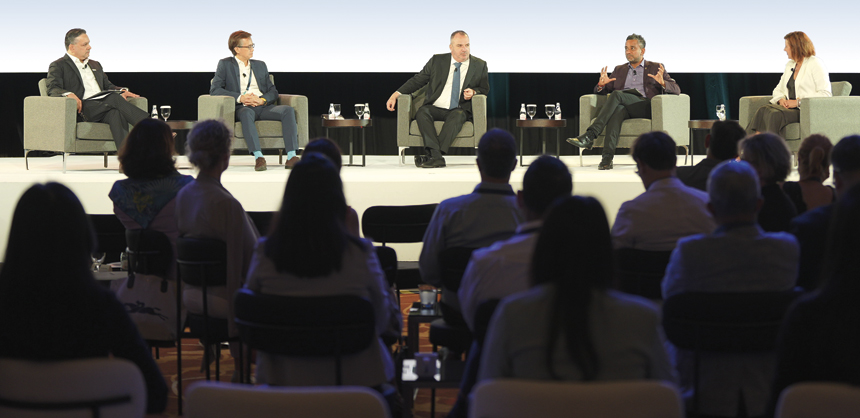
Leaders must be able to listen and understand diverse viewpoints. Pictured: Panel at The Game Changers of The Future.
Effective association leadership isn’t a one-size-fits-all matter. In reaching out to some of today’s most accomplished association heads, we found that a variety of traits and approaches can spell out success in 2026.
The landscape of the mid-2020s has revealed a unique paradox: while technology like artificial intelligence has made communication instantaneous, the “human” element of leadership — the ability to nurture authentic belonging and trust — has become more valuable than ever.
The modern association executive must be a diplomat, a strategist and a steward simultaneously. From the “wise courage” required to navigate digital transformation to the invaluable art of deep listening, here’s a look at the topic from some of the leading minds in the industry today.
The Art of Listening
For John Brannelly, MPH, executive director of the Fairfield County Medical Association (FCMA) in Connecticut, leadership started as a lesson in group dynamics long before he entered the boardroom. And in an era of digital noise, Brannelly argues that the most vital act a leader can perform is simply paying attention.
“The most important quality that has served me as an association leader is the ability to listen,” Brannelly remarks. “As the youngest of eight children, I learned early what it means to be part of a group where every voice matters. Later, serving on my local city council as one of 20 equal members reinforced the importance of listening carefully, building consensus and respecting diverse perspectives.”
Brannelly leans on this democratic approach with the nearly 1,000 active and retired physician members at FCMA. In a high-pressure field like medicine, it’s crucial that members know their unique challenges are understood. He notes that no single viewpoint defines the organization, making purposeful outreach essential.
“I make a deliberate effort to listen to as many members as possible and to build meaningful relationships over time,” he explains. “Often that begins with something small, such as remembering a shared school, hometown, interest or team, but those personal connections help build trust and engagement.”
The Stewardship of Value
Beyond interpersonal skills, Brannelly emphasizes a genuine understanding of the “member-centered” model. In 2026, where “subscription fatigue” is a reality, associations must prove their worth daily.
“Equally important is understanding how membership organizations function,” he adds. “Whether it is Costco, AAA or a professional association, members expect clear value, strong advocacy and thoughtful stewardship. Having participated in many associations and civic organizations, from AFP and PRSA, to running, Irish and yacht clubs, I bring a strong member-centered perspective to my leadership at FCMA.”
Balancing Diversity With Strategy
Maintaining a clear vision while managing a gamut of opinions is possibly the greatest challenge for any executive. Brannelly suggests that the mission must serve as the ultimate filter to prevent “mission creep” or organizational paralysis.
“Balancing diverse interests begins with staying focused on the organization’s primary membership and core mission,” he comments. “While it is essential to be inclusive and responsive, losing sight of fundamental goals can weaken the association over time. A clear strategic direction provides the framework within which diverse perspectives can be heard, evaluated and aligned toward shared objectives.”
The Accountability Factor
What distinguishes the association leader from the corporate CEO? For Brannelly, it comes down to the depth and breadth of accountability.
“Association leaders are uniquely accountable to a broad and diverse membership body,” he says. “Unlike leaders in other sectors who may report to a single supervisor or primarily to a board of directors, association leaders must balance responsibility to both their board and their members. That dual accountability carries significant responsibility. It may be relatively easy to satisfy one boss, but it is far more challenging and meaningful to represent the interests of hundreds or thousands of members thoughtfully and effectively.”
Influence Over Control
Lynda Bouchard Patterson, FASAE, CAE, president & founder of Association CEO, based in Middleton, WI, sees leadership through the lens of emotional intelligence and influence. She opines that the “soft skills” of yesterday have become the “hard requirements” of today’s executive.
“The most effective association leaders bring vision, emotional intelligence and a strong sense of stewardship to the members and to their staff team,” Patterson remarks. “They must be able to listen and understand diverse — and sometimes conflicting — viewpoints. They bring together member needs, industry trends, governance dynamics and financial acumen to develop and execute a clear direction for the organization.”
Patterson notes that since associations are mission-driven and member-led, credibility is the “currency” of the leader. “Strong leaders listen carefully, communicate openly and often, and are willing to make difficult decisions to best serve the association in the long term,” she says.
The “Art” of the Collective Voice
Patterson highlights a key distinction in the nonprofit sector: the lack of traditional “command and control” levers. In a corporation, a CEO can mandate a change; in an association, a leader must invite it.
“While my leadership and commitment to the vision is strong on both for-profit and nonprofit Boards, I would say that association leaders operate based on influence rather than control,” she explains. “There is more of an art in creating a collective voice through exceptional facilitation skills, relationship management and systems thinking. They work closely with volunteer boards, rotating leadership and highly engaged members, all while balancing mission impact with financial success. Some say, no margin, no mission.”
This can lead to longer, more complex decision cycles. Success requires a leader who can create cohesiveness across stakeholders who may have very different priorities. “Finally, association leaders must excel at building alignment across diverse stakeholders and guiding organizations through longer decision cycles,” she adds.
The “Learner” & the “Bowtie” Strategy
In the Greater Chicago Area, Erin Volland, MPA, CAE, director of consulting at Association Management Center, applies her natural curiosity to drive organizational growth. She believes that the best leaders are those who look outside their own “bubble” for inspiration.
“My top Gallup CliftonStrengths is ‘Learner’ so I’m naturally curious, which drives me to continually explore new ideas, both inside and outside traditional association knowledge,” Volland states. “I believe the qualities that have served me best in my association career are my strong willingness and desire to learn, my curiosity about industries outside the association world and my ability to translate those insights back into meaningful strategies for associations. Additionally, I’m a relationship builder who values surrounding myself with smart, talented people as my very own cabinet of trusted advisors.”
Volland offers a specific structural approach to balancing member needs: the “bowtie” model, which visualizes the flow of information from broad input to narrow decision and back to broad communication.
“Association leaders can balance the needs of diverse member groups by actively seeking varied and diverse input when shaping strategic direction, and by clearly communicating that strategy back to all segments of the membership,” Volland explains. “With my colleagues, we refer to it as the bowtie; where there is increased transparency in gathering of diverse opinions on one side of a decision, and then communicating to those diverse member groups after a decision has been made.”
This model relies upon a balanced mix of strengths within the board and staff. Volland notes that maintaining “transparent pathways to both board and staff leadership and a fair, consistent and transparent selection process” is vital to ensuring the strategy reflects the community it serves.
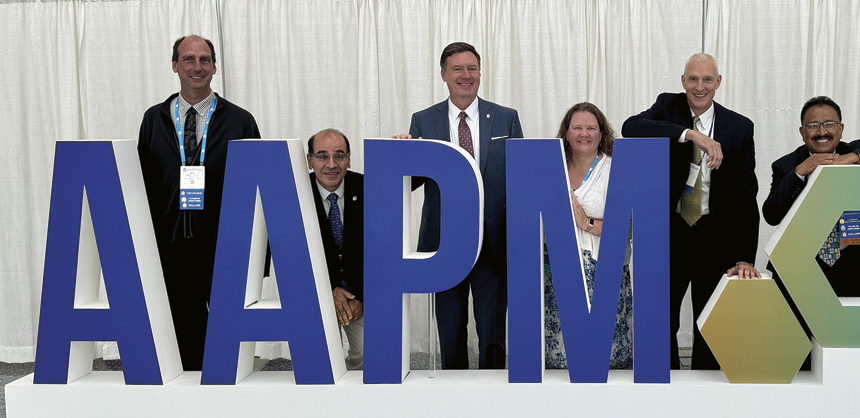
Leaders should find ways to keep attendees engaged and self-motivated. Pictured: AAPM Executive Committee at their annual event in Los Angeles.
A Dual Mindset
Volland sees impactful leadership today as a hybrid of a community servant and a corporate executive. “Effective association leaders stand out because their skills are highly transferable as they can thrive both within associations and in other sectors,” she says. “They balance interpersonal skills and emotional intelligence with sound business acumen, recognizing that associations are corporations and must be led as such. At the same time, a sense of altruism and service anchors their leadership and actions, ensuring decisions are made with the broader community and mission in mind.”
Finding the “Way to Yes”
David Gammel, FASAE, CAE, executive director of the American Association of Physicists in Medicine (AAPM), traces his leadership philosophy back to the basics of human psychology and respect. “At the core, the qualities that have served me best are listening deeply, respecting autonomy and helping people find their own way to yes,” Gammel says. “I learned those approaches early. When I was a summer camp counselor in college, part of our training included reading “How to Talk So Kids Will Listen & Listen So Kids Will Talk.” The authors emphasized reflective listening, providing options instead of hard nos and a variety of other techniques to build mutual respect and connection — all great traits in association management.”
Gammel believes that instead of trying to control member energy, leaders should empower it. In 2026, where professionals have limited free time, the “command” style of leadership simply doesn’t work.
“Engaged members are a tremendous asset and we should encourage and enable grassroots activity even as we try to drive toward common goals,” he notes. “The balance comes from being clear about high-level goals, while giving volunteers flexibility in how they contribute to them. When you invite that conversation early it almost always leads to greater alignment while retaining priorities they care about.”
The “Belonging Switch”
Gammel shares a thoughtful example of how one single leadership trait — empathy — can alter an individual’s career and an organization’s future.
“Showing up for those who may not feel naturally included has always made a difference,” Gammel recalls. “I once made a point of attending a postdoc presentation for an early-career member who had overcome significant challenges to attend the meeting. This individual later became involved in committee work and emerged as a volunteer leader. A little bit of human recognition from leadership can flip that belonging switch for someone who might not engage otherwise.”
This “human recognition” is what Gammel believes differentiates association work from other sectors. “You can’t force anyone to volunteer their time and effort for your association. So, you have to take approaches that help them be self-motivated to contribute. If you can’t do that, you’ll have a tough time in the association world. That’s why influence, trust-building and servant leadership matter more in associations than command-and-control skills,” he says.
The Planner’s Perspective
From the perspective of Joan Eisenstodt, who has had more than 50 years of experience as a hospitality and meetings consultant/planner based in D.C., the best leaders are those who remain ethically grounded and perpetually curious about the world around them.
Tapping into her decades of experience with association clients, Eisenstodt pinpoints several key attributes of a high-quality leader:
- Curiosity: Knowing what others think will “work” or solve a situation.
- Active Listening: Listening with an open mind to others’ ideas and asking “yes, and” questions.
- Empathy and Compassion: Honed by paying attention to others and ensuring that if help is needed, it’s offered.
- Cross-Pollination: Learning outside their association’s business — finding other businesses and associations doing good work and bringing that back to Boards.
- Ethical Behavior: Eisenstodt is candid about the importance of integrity, noting it means “not booking a city because they are willing to provide Super Bowl or other event tickets, or expecting/soliciting bribes to sign contracts.”
- Civic Mindset: Community involvement and being a lifelong learner.
The Road Ahead: 2026 and Beyond
As we look toward the future, the traits required for success are shifting alongside a rapidly evolving workforce.
The Rise of “Wise Courage”
Volland introduces the concept of “wise courage” as a vital trait for the next generation. It isn’t just about being brave; it’s about being strategically bold.
“Looking ahead, the next generation of association leaders will need to be highly adaptable, able to navigate rapid change and bring many different communities of people along with them through that change,” she says. “I have heard and spoken more about ‘wise courage’ in the past year of my association career than in the almost 20 previous years. ‘Wise courage’ is the ability to take smart risks and embrace innovation as a constant. Future leaders must also be prepared to explore new business lines, respond to new forms of competition and build unexpected partnerships. Ultimately, their success will depend on their ability to envision and build a new future for associations, often while the previous version may be dismantled.”
Technological Intuition & Transparency
Bouchard Patterson observes that future leaders will have a native advantage in the digital space, but will face higher expectations for transparency.
“Our future leaders are in some ways living and gaining the skills needed to lead without even knowing it,” Patterson says. “They don’t just use technology, they think in it, and they are able to pivot quickly and adopt AI or other technology without the friction of change management. Younger leaders demand transparency and inclusion, which will build trust with members.”
However, she warns that this must be balanced with traditional emotional intelligence. “Future leaders must be comfortable developing strategy while maintaining trust and credibility … Emotional intelligence and strong communication skills will matter more than ever. Leaders who can articulate purpose, navigate uncertainty and inspire confidence — especially in times of change — will be best positioned to lead in the future.”
Rethinking the Connection Point
Brannelly points out that the post-pandemic landscape is still settling into a new “normal,” requiring leaders to rethink how people gather.
“The ability to understand how people want to connect and engage in the future will be critical for the next generation of association leaders, particularly as technology and artificial intelligence continue to evolve,” Brannelly says. “During COVID, virtual meetings and webinars were widely embraced and highly effective. Today, while in-person engagement has returned, participation levels have not yet reached pre-pandemic norms. Future association leaders will need to remain adaptable and forward thinking, continually exploring new and meaningful ways to bring people together.”
The Persistent Core: Empathy
Even with the ongoing rise of AI and virtual tools, Gammel insists that the “human” element will remain the most critical factor for engagement. “Empathy has always been important and I think will remain so, especially as technology changes so much of how we work and engage with one another,” Gammel concludes. “Members are facing great opportunity along with great challenges. Leaders who empathize with both will help them feel recognized and valued, which is critical to sustained engagement.”
In 2026, the optimal association leader is a bridge-builder — connecting the traditions of the past with the innovations of the future; and doing so with a listening ear and a fearless heart. | AC&F |