








How to Do Site Selection RightMarch 1, 2014
It's All About the Best Fit By Gabi LoganHow to Do Site Selection Right
It's All About the Best Fit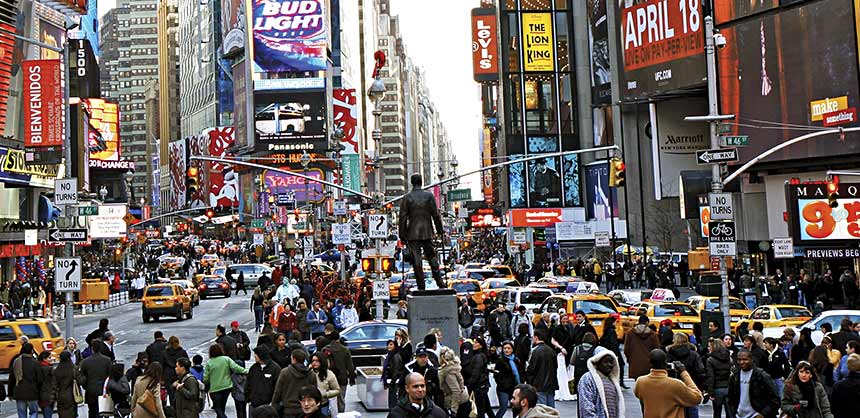
Selecting a walkable city is high on the must-have list for many meeting planners nowadays. Walking saves transportation costs, is a more “green” option, and provides meaningful cultural experiences. New York City (above) is often No. 1 on many walkable cities lists. Credit: NYC & Company
Meeting planners are entering a seller’s market, causing site selection and RFPing to take up an increasing amount of their time. No longer fishing around for the best deals, planners must research carefully and zero in on a few choice venues before sending out RFPs.
“In the industry right now, we’re finding a competitive arena for hotel rooms and meeting space on the buying side,” says Krista Brennan, CMP, senior meeting planner for Tokyo, Japan-based Daiichi Sankyo Inc. “Hotels are being selective in who they place in their meeting space. It comes to discount; if they know with company A they’ll make 15 percent more on F&B or room rate, they’ll place company A rather than company B.
“When we go to purchase hotel rooms and meeting space, we find that we’re getting turned down a lot in the RFP process, so it’s a challenge, and sometimes the negotiation factor isn’t there. Just like any business economy, when supply is high, there’s a lower price and more options. In the last nine months, we’ve seen a marked change in RFPs being turned down,” says Brennan.
When asked what is the single most important factor, more and more planners answer that the city and property must align with the goals and objectives of the event and the company.
Site Selection Is About the Best Fit, Not the Best
Dream destinations, accommodations and meeting spaces that are guaranteed to wow all of your attendees may still be out there, but the chance that they fit in your budget and are available on your dates is becoming increasingly less likely the more the industry recovers from the recession.
“We’re sending out more RFPs because you know people are saying no,” Brennan explains. “It’s like when you’re having a cocktail party, and you send 50 invites to get 25 people. When you come back to a business owner, and they say, ‘Hey, where are we going?’ they don’t want to hear about the great places that turned you down. They want to hear, ‘Here’s four good places we’ve narrowed down out of the 20 we looked at.’ The ultimate goal is having the right fit, the right venue, the right hotel.”
In the 1990s, the higher education industry went through a sort of rebirth and ranking reshuffling as top students stopped aiming solely at the Ivy Leagues and took the time to pick through the country’s liberal arts colleges for the best place for them personally to grow as people and students. In the current hotel booking climate, many planners are feeling a similar pull to look outside the major brands and find venues that make them, their staff and their attendees feel at home.
“It’s not just the space. It’s about relationships and the little things,” shares Diane Watanabe, CMP, senior meeting and events planner for CSP Business Media in Mesa, AZ. “I have had an advisory meeting at one Florida property for four to five years in a row, and the CSM was wonderfully attentive. The banquet managers said, ‘Whatever you want, we’ll go ahead and do it.’ They got me a cup of coffee every morning. They were always checking up on me. One time, our room was overlooking a courtyard and there was a leaf blower, and she immediately called and asked for it to stop. Someone went outside right away. It was off in barely a minute.”
When You Book Can Dictate Your Choice
The probability of finding the best fit with most of your must-haves depends more on when you’re able to book than ever before. While having top-notch properties book up in advance is nothing new, as Brennan mentioned, getting in anywhere has become difficult in many cases, especially when booking close in.
“We do try, whenever we can, when we get a green light on a budget, to book as far in advance as we can and lock down a contract, because that kind of procedure works best for everyone’s budget,” Brennan shares. “The venue knows they’re getting the business. They can check it off the list. Where we run into a snag is when we book closer in. That’s when they can ride the rails and get more money for the room.
“The leftovers might be a little higher priced and that’s why no one booked them earlier, but also, they know they have you,” she continues. “They can look at the sourcing system and see there’s no rooms for that block, and they can say that we’re the only one with space available and we’re really going to ride the high end of a pricing structure. When that happens, I try to book something else 12 months out and even out of the budget, but locking in multi-year contracts is also a priority right now. Especially for meetings that are cookie-cutter, where the agenda stays the same, two nights, three days. I actually just did three years and got a major deal from some big hotel chains.
“For general business meetings, we like to have at least six months notice,” she says. “Incentives are 12 months minimum, but that would be a rush. That’s the latest you can book. For small meetings, we sometimes get two weeks, but for a smaller meeting, it’s typically running three months and that’s because budgets are coming in and business owners are finding money and saying, ‘Yes, we can do it.’ ”
When you book close in, in today’s competitive market, with a very specific space request, you can end up with very few viable options. “For my upcoming Dallas meeting, I just sent out a bunch of RFPs and I got a nice cross-section back, but some of those I did decline fairly quickly because they just gave me a room that I thought wasn’t really big enough,” Watanabe says. “For U-shaped seating for 30 people, they wanted to give me a room that was less than 1,000 sf. In theory they would fit, but I don’t want them to feel like they’re in a sardine can.
“A few people said, ‘For those dates, that’s all I’ve got,’ and a few said, ‘I can give you this room, but it might be a little too big,’ ” she explains. “I’m going to lean toward the largest rooms I can possibly get, knowing that even though I have a target number of attendees, it could grow, and I don’t want to have to turn people away. Now, 10 weeks out, what I’m working with is that the attendee size increased so I went back to the hotel, and she may not be able to give me the space that I need, and I may have to go back to one of the venues that I declined and see, 10 weeks out, if they still have space available. Luckily the contract hasn’t been signed yet, but I don’t know if they’re going to have the space, so I may have to find a new hotel.”
Who Chooses Your Destination?
While competition from other meetings is putting a strain on the site choices available to planners, internal politics also are increasingly narrowing the field.
“It’s been more difficult recently in a way, because the sales team is who really sells the meeting, and they don’t understand my logistical needs,” says Watanabe. “Sometimes I’m lucky enough to book seven to eight months in advance and sometimes I’m pushing the envelope and booking four to five months out. For example, I’m currently trying to book something for mid-May. It’s barely five months out, and I’m trying to get a meeting approved for June that will be four to five months out. The selling part is kind of out of my hands, and I do the best I can with what I’ve got.”
When planners have the ability to choose their destination — or at least slot pre-selected destinations into the years that work best — the process becomes easier, not only in terms of budget, but scheduling.
Boston, for example, has been on many planners’ request lists this year, but the small city does not always have enough supply to meet meeting demand. When Lynn Rhoads, senior vice president, corporate events and community engagement at Cincinnati, OH-based Vantiv LLC, looks for a destination for her annual meeting with financial institution partners, she rotates the location around the country, but at her discretion, so she was able to get into Boston at a time when there was sufficient space for her group.
“I do try to rotate it,” she says. “In 2012, our meeting was on the West Coast in San Francisco, and in 2011 it was in New Orleans. I always try to pick a city we haven’t been to before and one that is easy for attendees to get in and out of. For 2013, I thought it was easy to do San Francisco’s sister city, which is Boston. We also acquired a company in Lowell, a suburb of Boston, in late 2012. But I try to look at the time of year that I’m having the meeting, so it’s the right time of year to visit that destination.”
Walkable Cities Are Drawing Planners in Droves
One of the best ways to enchant attendees and keep costs down is to let them explore their destination — not constantly move them from bus to meeting room to bus to ballroom. If the destination is too large or too spread out, though, that becomes a challenge.
“I think it’s important to be able to walk because we do have some free time in the afternoon,” says Rhoads. Walkable cities with accessible downtowns (or pseudo downtowns, as you’ll find in Las Vegas), make it easy for attendees with a free hour to actually see something in that stretch of time. No one wants their attendees to go home after an event and not know how the city was because they spent all their time at the hotel, and some cities make that more likely than others. Many planners are gravitating toward smaller or more compact urban areas today.
“It’s always nice if I can be within downtown Dallas or downtown Chicago because there are enough options in walking distance, and that makes it a little bit easier,” says Watanabe. “Some clients don’t have a problem being in a banquet room for all meals, so sometimes we stay on-property if the restaurant has a private dining room, but sometimes, like the Dallas meeting, they want to go off-property and experience Dallas. That meeting happens to have the budget where I can do the transportation, but oftentimes, the client will say, ‘We can go offsite but it has to be walkable.’”
“I like my group to still have some feeling of intimacy. That also is key in terms of picking a city. I want to keep it homegrown, close and informal, and I have to pick a property that allows me to do that.” — Lynn Rhoads
While “walkable” has become an important buzzword when researching destinations, it’s also code for a more intangible sensation that sets your events apart. “I like my group to still have some feeling of intimacy,” says Rhoads. “That also is key in terms of picking a city. I want to keep it homegrown, close and informal, and I have to pick a property that allows me to do that. I don’t want to pick a convention center. That isn’t the experience that I want, I want historic, intimate venues and where I can keep everything in one place.”
New York City leads the 2014 Walk Score list of most walkable cities followed by San Francisco, Boston, Chicago and Philadelphia.
Some Things Never Change, But Change Is on the Horizon
Distance to the airport and ease of transfer, attractiveness of the destination and proximity of restaurants and attractions all remain top factors in site selection. “For me, the main factors are distance to the airport, whether or not they have meeting space large enough for the meeting — we usually end up doing U-shape, which is pretty space-intensive — rate and preferred dates,” says Watanabe. “What I do is put together advisory meetings for our clients. Each client has different needs, and it all depends on what they’re looking for.
“As far as site selection, it’s pretty unique to the client,” she continues. “Some of them have a bare-bones budget, so I have to do the best I can, short of serving them peanut butter and jelly sandwiches. Others really want to have something that is a nice overall experience. My meetings run the gamut up to people who want to create a memorable experience and are willing to spend the money to create that.”
Finding a venue that is not only a good fit for one meeting but a whole company seems like a tall order at a time when meeting space is harder to come by, but it’s actually an advantage. As planners are increasingly prioritizing venues that best align with the goals of their company and meeting, they are discovering independent properties that offer a better match than big brands and building stronger relationships with hotels that deliver.
But while increased competition for rooms and meeting space is making site selection more difficult and time-consuming for planners for the time being, it’s a hallmark of good things on the horizon.
“Basically, in the marketplace, I feel like our business is getting stronger,” Brennan explains. “Meetings and events are back on track in the economy, and it’s a healthy economy again. The thing about the competitive side of the business is that it’s good when everybody is prospering. That outlook is very positive for planners in the business, as well as the hotels.” C&IT