









Making a Citywide WorkNovember 2, 2026
Experts Share Their Playbook for Success By Morgan ZacharyMaking a Citywide Work
Experts Share Their Playbook for Success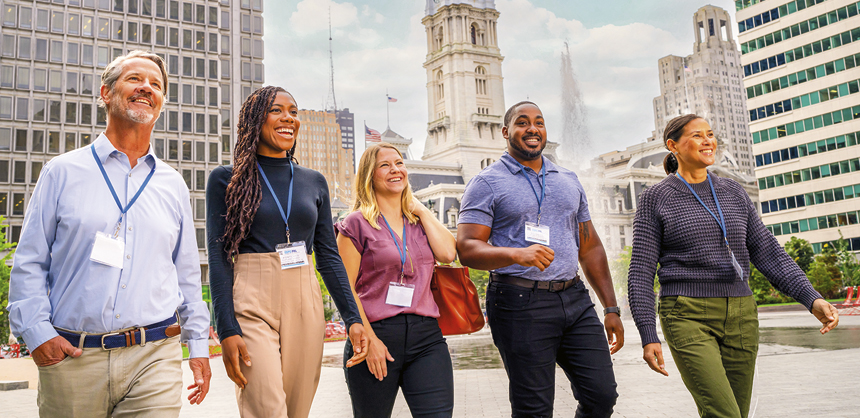
Attendees outside Philadelphia City Hall on a group walkthrough.
A citywide convention is often described as a massive puzzle. In reality it’s more like several puzzles being assembled simultaneously, with thousands of attendees, dozens of venues, multiple hotels, local businesses, transportation providers and city officials all playing a role in the final picture.
Unlike a traditional conference operating largely under one roof, a citywide meeting stretches across an entire destination. Attendees may be sleeping in a dozen different hotels, gathering in convention centers, attending receptions at cultural attractions and navigating transportation systems they have never used before. For planners, success depends not only on managing countless details, but also on aligning an entire city around a shared goal.
That level of complexity is exactly why citywide events have become some of the most rewarding, and challenging, assignments in the meetings industry. Executing one successfully requires long-range forecasting, strong partnerships, clear communication and the ability to keep attendees focused on the experience rather than the logistics behind it.
Industry experts who regularly work on large-scale conventions, festivals and destination-wide meetings say the common thread behind every successful citywide is simple: no planner or organization can pull it off alone.
Start With Strategy, Not Logistics
When planners think about citywides, it can be tempting to focus immediately on room blocks, venues or transportation plans. Experienced organizers say those decisions should come after establishing a clear strategic framework.
“Start the planning process early, have clearly defined goals and build a master timeline with assignments to specific people and teams,” urges Donna Patrick, founder of Donna Patrick Travel Design, LLC and travel advisor. One of the most important priorities, she says, is building strong relationships with both internal and external partners while establishing a central command structure for accurate and consistent communication.
That emphasis on planning fundamentals appears repeatedly among successful citywide organizers.
For Amelia Klatt, MPA, director of events for the Greater Des Moines Partnership and one of the leaders behind the World Food & Music Festival, which attracts tens of thousands of attendees over three days, large-scale event success starts with understanding exactly why the event exists.
“Start with the big picture and ‘why’ behind the event,” she shares. “Remind yourself what the community is getting out of an event this size.”
That larger purpose often becomes the guiding force behind countless operational decisions later in the planning process. Klatt says planners should continually step back to evaluate the event from a holistic perspective rather than becoming consumed by individual tasks.
“I think walking through the event through the attendee’s eyes helps lock in on some of those details,” she says.
That ability to connect long-range vision with day-to-day execution becomes especially important as citywide projects grow in complexity. Timelines stretch years into the future, stakeholders multiply and a change in one operational area can affect multiple other groups.
“For a large citywide event,” Klatt says, “there are so many different partners, vendors, volunteers and logistics involved that small delays can quickly affect other parts of the event.”
She also believes planners must learn to rely on others. “You can’t plan an event at this scale alone,” Klatt underscores. “Rely on your team and partners.”
Building the Right Hotel & Venue Plan
For association planners, one of the earliest and most important citywide decisions involves determining where attendees will stay and how those accommodations connect to the overall event experience.
According to Laura Werfelmann, CEM, event director at 360 Live Media, a Smithbucklin company, convention and visitors bureaus and destination marketing organizations often become invaluable allies at the very beginning of that process. “We use CVBs and DMOs as strategic partners early in the process because they know the destination best,” she explains. “We start by sharing the priorities that will shape the hotel portfolio, such as price point, full-service versus limited-service options, amenities, proximity to the venue and the attendee profiles we need to support.”
Working with destination organizations early allows planners to evaluate hotels not simply as room inventory but as components of a larger attendee experience strategy. The destination can often recommend properties that align with attendee demographics while helping streamline the sourcing process.
Once a city is selected, Werfelmann says planners typically transition to direct relationships with hotel properties while maintaining close communication with the CVB on overall timelines and destination support.
“The CVB typically helps gather a comprehensive proposal from the hotels,” she comments. “Once the client decides to move forward with a city, we align with the CVB on the contracting timeline, communicate that timeline back to the hotels and then transition to direct communication with each property.”
Long-range forecasting presents another challenge. Because many citywides are booked years in advance, planners must estimate attendance patterns, hotel demand and space requirements long before those numbers become clear.
Analyzing historical growth trends can help planners project future needs, but she cautions against overcommitting too early. One effective strategy is negotiating review periods into hotel contracts that allow room blocks to be adjusted as attendance projections become more accurate. That flexibility becomes increasingly valuable as economic conditions, travel patterns and attendee behavior continue to evolve.
Werfelmann frequently recommends another tactic: avoid contracting every room at once. “We may contract the headquarters hotel first, along with key full-service hotels, and then add limited-service properties closer to the event, often 18 months to two years out,” she remarks.
The approach allows planners to remain agile while reducing financial exposure. The same philosophy applies to meeting and exhibit space. Rather than focusing solely on square footage, planners should evaluate a venue’s ability to adapt as circumstances change.
“If a group is experiencing growth or contraction, I place more value on venues with airwalls, flexible room sets and multiple configuration options,” Werfelmann says.
In a world where attendance forecasts can shift significantly between booking and event execution, flexibility increasingly becomes as valuable as capacity.
The DMO as Chief Connector
One misconception about citywide events is that the planner alone coordinates every moving part. In reality, destination organizations often serve as the central hub connecting dozens of stakeholders. Few understand that dynamic better than Maria Grasso, chief sales officer for the Philadelphia Convention & Visitors Bureau.
“With a large citywide convention,” she says, “the attendee experience doesn’t begin when someone walks into the Pennsylvania Convention Center. It begins when they arrive in Philadelphia.”
That philosophy shapes how her organization approaches citywide support.
“Our Destination Services team serves as a connector between the meeting planner and the destination,” she says.
That coordination may involve convention centers, hotels, transportation providers, public safety officials, restaurants, attractions and numerous hospitality partners. The objective is identifying potential challenges before attendees arrive rather than scrambling to fix them onsite.
Winter meetings demonstrate the importance of such planning. Weather-related concerns can affect transportation schedules, pedestrian traffic patterns and arrival logistics.
“Communication becomes extremely important,” Grasso says. “We try to understand the client’s program, identify areas where the city can provide support and make sure our partners have the information they need.”
Philadelphia’s hosting of PCMA Convening Leaders offered one example of destination-wide collaboration. Hotels were selected within walking distance of the Pennsylvania Convention Center, reducing transportation dependency and simplifying attendee navigation.
More broadly, Grasso says destinations must evaluate everything occurring around a convention. “We look at everything from arrival and departure patterns to transportation needs, street activity, pedestrian movement, competing events and anything happening in the city that could potentially affect the attendee experience,” she says.
That level of coordination requires one critical ingredient: relationships. “Communication and relationships are what make a citywide successful,” Grasso says. “Our job is to help put the right people at the table early enough so we are solving issues proactively rather than reacting to them once attendees are here.” Her advice for both planners and destinations is straightforward: ”Start the conversation early and don’t operate in silos.”
Managing Budgets Without Diminishing Experience
As citywide meetings grow larger, expenses can quickly multiply. Beyond hotels and meeting space, planners often face costs associated with transportation, security, staffing, street closures, signage and other operational requirements.
Werfelmann recommends viewing those expenses through the lens of partnerships rather than treating them as isolated budget items. She adds, ”When working with hotels that pair with a convention center, they’re often willing to include a rebate to help offset the cost of rental and other pop-up costs.”
She also encourages planners to explore financial incentives available through destination partners. “When you have to provide shuttles, work with your CVB to see if they’re willing to provide an additional incentive per room night booked at hotels in your block,” she says. “We’ve successfully been able to defray shuttle costs almost completely by securing additional CVB incentives.”
The lesson is that successful citywide budgeting often begins with collaboration rather than cost-cutting.
“I find that the key is treating these costs as part of a larger destination partnership strategy rather than standalone line items,” Werfelmann says.
That mindset also extends to vendor management.
Felicia Ford, MSM, owner and growth strategist at Felicia Ford & Co., recommends consolidating vendors whenever possible. “Using vendors local to the event space whenever possible serves the purpose of convenience, relationship building and ease of access,” she says. “It also means fewer production relationships, fewer deliveries and fewer things that can go wrong.”
Reducing complexity can often be just as valuable as reducing expense.
Moving Thousands of People Efficiently
Transportation is one of the most visible indicators of whether a citywide event is operating smoothly. Attendees may forgive a long registration line or a crowded session room. They are far less forgiving when they miss an education session because they couldn’t find the shuttle.
Werfelmann recommends using multiple communications channels to eliminate confusion before attendees even leave their hotels. “Use your event app to clearly communicate shuttle routes, pickup locations and recommended commute times for each hotel,” she says.
As an additional touchpoint, she recommends QR codes on attendee badges that link directly to transportation information.
Technology helps, but operational planning remains essential. “Work with your transportation provider and venue to determine how shuttle arrivals will be managed during peak times,” Werfelmann says.
She says planners should evaluate everything from loading areas and building entrances to security staffing and registration placement to avoid bottlenecks. Destination management companies can also provide valuable support through onsite management, driver coordination and post-event analytics that help improve future transportation plans.
Ford approaches attendee movement from an equally practical perspective. “Do walk the experience physically,” she advises.
Many planners rely heavily on floorplans, schedules and spreadsheets during the planning process. While those tools remain important, Ford believes this can forge a false sense of certainty.
“Maps and spreadsheets conceal things,” she says. “A 10 minute transition on paper can become 25 minutes once you account for elevators, parking, accessibility, crowds, unfamiliar buildings, security or people simply stopping to talk.”
By physically experiencing attendee routes, planners can identify issues before they create frustration onsite.
Creating a Sense of Place
A flawlessly executed citywide is valuable. A citywide that attendees remember years later is even better. For many experts, that difference comes down to connecting attendees with the destination itself.
One relatively simple strategy, Werfelmann says, is taking advantage of CVB programs that encourage attendees to explore local restaurants, attractions and retailers. Many destinations provide badge-discount programs and other incentives that drive economic activity while enriching the attendee experience. She also recommends incorporating local entertainment, cuisine and cultural elements whenever possible. “These touches may seem small, but they can create a stronger sense of place and leave a lasting impression,” she says.
Offsite events often play a major role in that effort.
“When appropriate, consider hosting an offsite event outside the traditional meeting environment,” Werfelmann says. While additional planning may be required, she says these experiences often provide more authentic connections with the destination.
The City of Philadelphia embraces a similar philosophy. Grasso says, “Philadelphia is known as a city of neighborhoods, each with their own distinct identity.”
Rather than steering every group toward the same venues, her team begins by understanding the planner’s objectives.
“Our role is to learn what the planner is trying to accomplish and then connect them with Philadelphia experiences that fit their audience,” she says.
For one event, that might mean an iconic cultural venue. For another, it may mean highlighting culinary experiences, historic attractions or emerging neighborhoods.
Ford likewise believes memorable events begin with a clearly defined purpose and identity. “Branding the event gives me an internal compass and boundaries for venue and menu selection, colors, signage, name badges, presentation, the type of decor and favors or guest gifts,” she explains.
When every aspect of the experience reinforces the event’s purpose, attendees are more likely to remember not only what they learned, but also how the destination made them feel.
Communication is the Event
Perhaps no topic generated more consensus among experts than communication. At citywide scale, operational failures often stem not from poor intentions or inadequate resources, but from information breakdowns. Different audiences need different information at different times. Hotels need one set of updates. Vendors need another. Volunteers, sponsors, city officials and attendees each have unique communication requirements.
Ford says planners must think intentionally about both internal and external communication strategies. Internally, that includes meetings with city officials, first responders, entertainment providers, caterers, venues and event staff. Walk-throughs, contingency planning and real-time communications tools all contribute to smoother execution. Externally, attendees require information about registration, arrival procedures, parking, transportation, programming, safety protocols and departures.
Patrick similarly emphasizes centralized planning tools and thorough documentation, saying, “Define event objectives and outcomes, centralize project planning, gather a list of team members, key partners, templates locally and start building the project strategy.”
Klatt points to documentation, schedules, delegation and feedback as essential components of large-event communication. Clear channels help teams remain aligned while also creating opportunities for mid-course corrections when circumstances change.
Collecting ongoing evaluations throughout the project allows organizers to pivot when necessary, rather than waiting for post-event feedback.
Expect the Unexpected
Even with years of preparation, citywides rarely unfold exactly as planned. Weather shifts. Vendors encounter problems. Attendance numbers fluctuate. Deliveries run late. Permits take longer than expected. Successful planners understand that contingency planning is not separate from event planning. It is event planning.
“Be flexible,” Klatt says. “You can plan all the things in the world, but it is important to have a contingency plan.”
Ford encourages planners to think systematically about risk management, including accessibility, allergens, staffing needs, communications systems and program execution. She also advises planners to identify which elements of an event have become fixed and which remain adaptable.
“As the date gets closer, more things become fixed: printed materials, contracts, permits,” she says. “When something goes wrong late, don’t fight what’s locked. Change what’s still flexible.”
Perhaps her most important advice concerns leadership itself. “Your role is decisions, not labor,” Ford says. “If you’re unloading, setting tables and running errands, no one is watching the whole picture.”
In other words, citywide planners must resist the temptation to solve every problem personally. Their value lies in managing the larger system. And that may be the defining challenge of citywide meetings. Success requires planners to think simultaneously about contracts and culture, transportation and attendee experience, logistics and relationships. The events may span entire cities, but the goal remains remarkably simple: create an experience that feels effortless to the people attending it.
When that happens, attendees rarely notice the thousands of decisions and partnerships that made it possible. They simply remember a great convention and a destination that welcomed all of them as one. | AC&F |