







New & Renovated VenuesMarch 1, 2026
To Book or Not To Book By Christine LoomisNew & Renovated Venues
To Book or Not To Book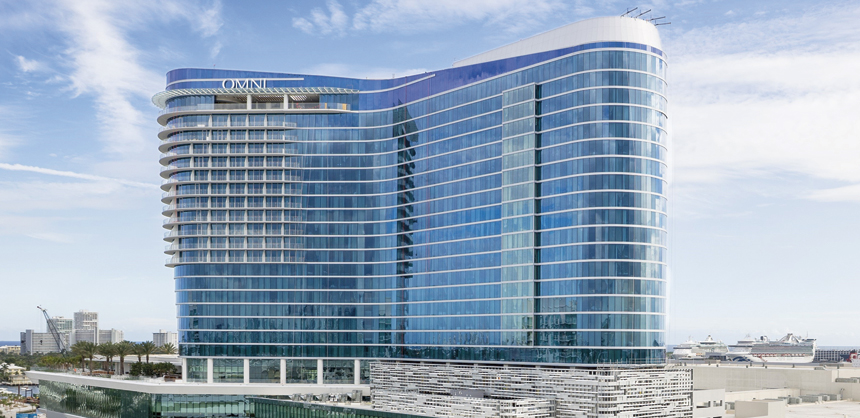
The newly opened Omni Fort Lauderdale offers 120,000 sf of meeting and event space minutes from the Fort Lauderdale-Hollywood International Airport.
Is a new or renovated venue the best option for your next event? What are the pros and cons? What happens if the venue isn’t ready on time? What if it doesn’t deliver as promised? There are many things to consider before signing on the dotted line. A group of experienced planners answers those important questions you need to consider.
Considering the Pros
“There are so many positives to booking a new or renovated venue,” says Kate Shattuck, CMP, conference & events operations manager for the Association of International Certified Professional Accountants. “Not only is everything brand new and shiny for your attendees and stakeholders, but new building designs have so much institutional knowledge about what works and what doesn’t from a group’s perspective. Designers integrate technology instead of working around it. Ceiling heights, airwall placement, common areas, back of house access, even restrooms are designed to enhance the user experience.”
Jeanette Stensgaard, CMP, MBA, HMCC, who works with the Kidney Cancer Association and is the chief brilliance officer for ShePlans Co., also sees multiple advantages to booking new or recently renovated venue — but the space only matters if the renovation improves how meetings function.
“Among the biggest positives is when a renovation fixes longstanding issues at a property you already trust,” she says. “Many hotels and conference centers have strong service teams but outdated meeting infrastructure. Renovations can address problems planners have been managing for years, such as poor acoustics, limited power, inadequate lighting or awkward room layouts. A good example of this on the convention center side is the Kentucky International Convention Center in Louisville, KY, where the renovation focused on modernizing meeting space, improving flow and creating more usable, flexible environments for groups.”
Also important are sound mitigation and quality. “Renovations that properly address sound bleed can make a huge difference when multiple sessions are running at the same time,” she says. “Being able to divide a room cleanly, without sacrificing sound quality or sightlines, allows planners to adapt the space to the program, rather than forcing the program to fit the space. The Colorado Convention Center in Denver, CO, is a good example of a venue that has invested in expanded and more flexible meeting space that better supports a wide range of event formats. This kind of investment is something planners increasingly look for in both convention centers and hotels.”
However, Stensgaard warns, there’s a difference between cosmetic updates and meaningful investment. “A facelift can refresh a space that feels dated. But it’s the investment in functional and innovative features that really matters for meetings. Hotels like Hyatt Regency San Antonio Riverwalk have focused renovations on upgrading meeting technology, improving layouts and enhancing pre-function space, which has a much bigger impact on the attendee experience than surface-level updates.”
Kristen Torres, senior executive director, meetings & events, National Cattlemen’s Beef Association, says updates can change up or freshen a program. “That’s especially true if it’s a venue you’ve used before. Many times, technologies are improved. And if space is added, that creates different ways to use the space. Additionally,” she notes, “I do think it makes for an easier sell internally. “
Stefanie Arnold, managing director, experience strategy and operations for ISTE+ASCD, says renovations can resolve issues within a space you’ve booked previously, especially if the venue has taken planner feedback and critiques into consideration during the process. “For us,” she says, “additional space can make or break a city as an option.”
But timing is everything. Arnold’s team booked a multi-year deal with the Colorado Convention Center before knowing about the future Bluebird Ballroom addition. “The added space allowed us to keep all content at the center instead of adding hotel space, which saved on costs and made for a better attendee experience. But, it was critical for us to see the finished product before our event, as we’d made incorrect assumptions about utilities, airwalls, signage, etc. If we had booked closer to the opening, it would have been difficult for us to accommodate those changes/misassumptions.”
Casi Maynard, CMP, CASE, co-founder of Mindful Meeting Pros, says one advantage of a new property is that attendees won’t have been there even if they’ve been to the destination before. “New venues also typically offer more services or better features right from the start that you can’t find at existing properties, such as complimentary and faster internet access, a higher level of food and beverage offerings and additional guestroom amenities. And many times,” she adds, “new hotels offer pre-opening booking promotions, such as significantly reduced rates, more F&B and AV savings, rebates and potentially higher allowable attrition percentages.”
Finally, Shonna Nitzel, MSHM, CMP, HMCC, SEPC, MPP, EAS, CMM, a global event strategist with Maritz, says new and renovated spaces provide a new atmosphere, adding, “The style and vibe are fresh. The staff is excited and eager to please. It’s a wonderful experience all around when things work well.”
The Cons Pose Challenges
Delayed openings, renovations running long and incomplete final finishes pose challenges for planners. “Even when a venue technically opens on schedule, parts of the space may still be under construction, or temporary solutions are in place that don’t support a live-meeting environment,” Stensgaard says. “And renderings don’t always match reality. What looks spacious and flexible on paper can feel very different once walls are built and furniture is in place. In some cases, rooms don’t accommodate the numbers originally promised. That can force last-minute program changes or uncomfortable compromises.”
New spaces and systems also mean teams are still learning how everything works. “Renovations can change egress patterns in ways that aren’t always obvious until people are moving through the space. Wayfinding may not be intuitive, and the building may not have been fully tested under the pressure of a large, multi-session meeting. None of these risks mean new or renovated spaces should be avoided,” Stensgaard says, “but they do mean planners need to go in with clear eyes, strong documentation and realistic expectations about what ‘ready’ actually means.”
Arnold says delays put planners in a difficult spot — especially if the space is critical to meeting success. Her group once contracted with a hotel years before it was constructed. “It should have been finished months before our event, but delays pushed back the opening, forcing us to scramble to find room at other hotels. The destination was uniquely tricky due to its heavy transient pickup, so it was not an easy negotiation to get additional rooms,” she says.
And even if the space is truly available, you have to find out if the staff have been trained on everything new and if the kinks have been worked out. “The worst thing that can happen is your event becomes the training ground for finding all the issues and challenges. Surprises are also a huge challenge when what was planned doesn’t translate to what gets built,” she says.
Torres points to another problem. “Renovated hotels and convention centers can become difficult to work with. Either they charge considerably more for things that were previously included or not charged for or they become inflexible with the space. We have a lot of sponsorships and many times a newly renovated venue won’t allow planners to place signage or place a cling on floors, columns or walls. I’ve found many times that event managers will lead with ‘no’ as the answer to any request. I’ve literally been told that they need to ‘protect their investment’ and therefore, certain things aren’t permitted.”
Despite challenges, Maynard says it’s not possible to avoid new builds or renovations when booking three to five years or more in advance — and you wouldn’t want to. “In Texas right now, there are four major cities whose convention centers are under construction and closed anywhere from one to three more years. Once the centers start accepting future bookings, associations that use convention center space, and who typically book Texas, or those needing a central U.S. location in their rotation, will all be trying to source and book the same cities for the same timeframe. If newly constructed venues aren’t considered, you’ve already lost out on four potential future opportunities,” she says.
Best Strategies
Communication is paramount from the start, says Arnold, who adds, “We make sure we’re in active communications with the city regarding progress. To buy some buffer time, we try to not book anything that wouldn’t be ready the year before our meeting. We also don’t count on anything being available if shovels aren’t yet in the ground. I think it’s also incumbent on cities to be proactive in communication on these challenges. I’d rather have a surprise further in advance to plan around than one that could have been known about but is sprung last minute.”
In an ideal world, Stensgaard notes, planners would only book spaces that are fully open, fully tested and proven. “But that’s not always possible, especially for association meetings booked years in advance. When you book a space far in advance that may not be ready on time, planning starts at the contract stage. That’s where expectations are set and risk is managed. From the beginning, it’s important to build in specific language around readiness, timelines and remedies. That includes clearly defined milestones, regular progress updates and the ability to conduct site visits as construction or renovations move forward.”
The goal, she continues, is to avoid surprises by identifying issues when there are still options. “Pre-meeting planning involves asking more detailed questions than usual — what exactly does ‘open’ mean, what areas will be fully operational versus still settling in and what systems are brand new? For newer AV, room configurations or building systems, it’s important to confirm testing timelines and whether the venue has supported live events under real conditions. The best strategy overall is staying engaged. Open communication with the venue team, updated floor plans and regular check-ins help planners adjust early instead of reacting late. Booking a space that isn’t fully ready doesn’t have to be a dealbreaker, but it does require more diligence, more documentation and a willingness to plan beyond the ideal scenario.”
Nitzel says groups can use a space that’s not finished under some circumstances. “We’ve held meetings in spaces that weren’t fully finished if they were functional enough, and we’re often given a monetary discount for the inconvenience. I write into the contract touchstone dates throughout the project where we check in on progress. There’s always a ‘get out of jail free clause’ if the project falls behind significantly. In general, the closest I’ll book a group is six months within the given opening date. That gives a good buffer zone for unforeseen circumstances that might delay opening,” she says.
Maynard advises including a construction/renovation clause in your contract with clear terms regarding specific timelines, remedies for delays and any compensation or alternative arrangements that will be provided by the venue. Communication about the construction progress should start as early as the sourcing and RFP process and continue until the start of the event. “At a minimum, that will hold the venue accountable to keeping you informed of construction progress (or setbacks) every step of the way. I tell my clients they should consider any anticipated opening date as tentative, and it may be best not to schedule their meeting super close to that date. Everyone loves the idea of a new property, but they also don’t want to be the guinea pig while the venue works out its kinks!”
Bottom line, planners should always plan for the possibility that the space won’t be available for whatever reason. “This is true for any future booking,” Maynard says, “regardless of whether there are planned construction projects at the time or not.”
Like others, Shattuck stresses the importance of trying to negate risks during contracting. “Incorporate contingency arrangements into the contract, specifying alternative spaces that will cause minimal disruption to your program. Outline the owner’s responsibilities if construction deadlines are not achieved. What additional concessions will they offer? Build as much as you can into the contract and put the onus on the property. Additionally, ensure that your national sales representatives are part of the process as they have an eagle’s eye view and are looking at your overall portfolio and not just a single event.”
If you do decide to book a new or renovated space, Shattuck advises doing so as soon as possible. “You don’t want to miss out on an amazing property. It’s more advantageous to book in advance of a grand opening because that property is likely going to be highly coveted after it opens. You should try to book a minimum of eight months to a year out from the grand-opening date. This allows the property time to work out the kinks and build experience around servicing their new space.”
Incorporating a Plan B
If it becomes clear that the space will not be ready, when is the right time to go to Plan B? “Immediately,” says Shattuck. “As soon as you know you need to switch gears, do it. Allow your attendees, stakeholders and vendors as much time as possible to adjust. The importance of your messaging and marketing plan to communicate this effectively cannot be over-emphasized.”
Construction rarely finishes on time, but the question is how much won’t be finished? Torres says, “My approach is to try to be a partner to the facility. If we’re able to work with the situation and not make them jump through hoops, we always try that first. In some situations, we ask for financial compensation as well as additional concessions for our attendees. There are so many factors that come into play when determining if we try to work with the venue or make a complete change. But we always have a backup plan ready.”
If you learn at the last minute that a space won’t be finished as promised, immediately get clear on exactly what isn’t ready and how that impacts the meeting, Stensgaard advises, adding, “Not every delay is equal. The priority is understanding whether the issues affect core program elements. The focus then shifts to minimizing disruption for attendees. That may mean relocating functions within the same property, reassigning rooms, adjusting room sets or shifting the schedule to avoid unfinished areas. In some cases, it means consolidating sessions or rethinking how space is used. A strong hotel or convention-center partner should be actively involved in problem-solving. Clear communication and a collaborative approach make a significant difference in how manageable the situation becomes.”
Contracts are also critical for determining what Plan B will be. “Readiness clauses, performance language and defined remedies give planners leverage and clarity when plans change,” Stensgaard continues. “Without that groundwork, options are limited and decisions become more reactive. If the planning team stays focused, flexible and decisive, it’s often possible to deliver a successful meeting when the venue isn’t exactly what was promised.”
Having a backup plan is always part of the strategy, even if it’s informal, Stensgaard says. “That may mean identifying alternate space within the same property or knowing whether nearby hotels or venues could absorb a portion of the program if needed. While it’s not always possible to fully contract backup space, knowing the options reduces risk and speeds up decision-making when plans change,” she adds.
Planner to Planner: Best Practices
Experienced planners offer ways to mitigate challenges that might arise.
Nitzel encourages planners to thoroughly research a building’s management and ownership before signing an agreement for a newly built or significantly renovated property.
“Communicate, communicate, communicate,” Torres advises. “Ask for regular status updates from your venue and, if you’re able, add in an additional site visit to see for yourself how renovations are progressing.”
Communication is front and center for Arnold, too, who also emphasizes a strong partnership with the venue and the city. “Continue to check in on construction progress. You may feel like a bother but it’s better to make sure they know you’re paying attention than to be surprised down the road. Include a clause in your agreement that they must help you find an alternative location or space if deadlines aren’t met and provide financial compensation if your event is impacted.”
Stensgaard encourages new planners to be curious, cautious and very clear-eyed. “Don’t assume that new automatically means better, and don’t be afraid to ask hard questions early. In this industry, ‘almost ready’ can mean anything from fresh paint to active power tools. Build protections into your contracts and keep good documentation. Experience teaches you that optimism is not a strategy. The more clarity you have upfront, the easier it is to manage issues later without panic. Plan beyond the ideal scenario. Think through how you would adapt if a room were not available, if technology doesn’t perform as expected and if attendee flow needs to change. Hope is nice. A backup plan is better,” she says.
If you can conduct a site visit before signing the contract, absolutely do it, says Shattuck, adding, “Walking through the space is the most effective way to check if the flow suits your program and attendees. If you cannot physically visit the property, have your salesperson and/or your CSM conduct a virtual tour. And if that’s not possible, have diagrams created for all your meeting rooms that show the max seating you may need as well as space for AV and F&B. Vet these diagrams with your decorator and production company leads. Build in a buffer from the beginning and if possible, do not be the first group in-house after a renovation or grand opening. | AC&F |