








Make Learning FunJune 27, 2025
Top Tips for Keeping Your Attendees Engaged By Sara KarnishMake Learning Fun
Top Tips for Keeping Your Attendees Engaged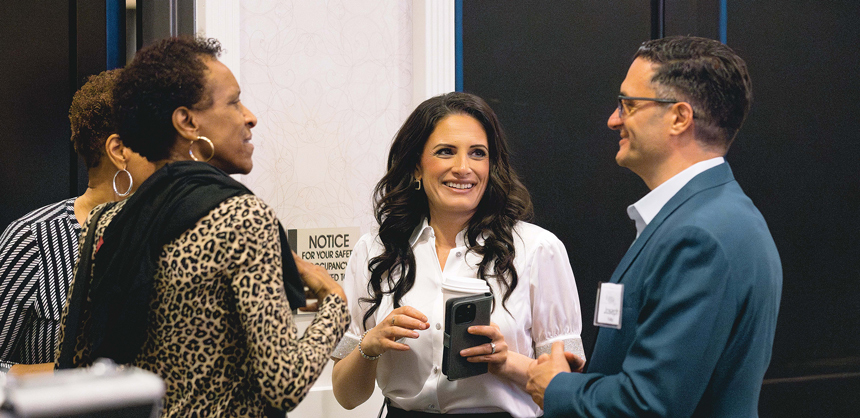
Elite planners are finding creative ways to help attendees interact more effectively, as learning from peers is mutually valuable. Photos courtesy of Elyse Stoner / Event Advisors
Networking and learning are two common expectations for anyone attending an event. For planners tasked with the latter, it can be a tall order to make content engaging, easy to understand and enjoyable. However, if they use different strategies to incorporate education into an event in fun and unexpected ways, attendees can walk away with a far richer experience.
As co-owners of Event Advisors, Angela York and Elyse Stoner draw on their own respective backgrounds in financial services and arena management to help financial advisers host events that strengthen client relationships and create growth opportunities.
“I think anything is possible these days,” Stoner says. “When we work with our clients, one of the things we tell them is to put themselves in the seat of the attendee. Would you want to go to an event that just had a talking head in the front of the room, spewing information at you? Would you be excited to take that back to your clients? Another thought we share is: We live in a time of amazing technology. Use it.”
How to Boost Engagement
The level of interactivity and engagement will depend on both the topics and the audience at an event. Planners face two challenges. They must make complex content easily digestible for those who are new to the industry or in an adjacent role such as marketing. They also have to boost engagement for internal meetings when many of the attendees already know each other. One solution is to be very intentional when choosing your presenters.
Pia Williams, vice president of events for CoBank, says that for the programs she oversees, the type of event dictates the amount of “fun” she can infuse into the program. She repeatedly turns to engaging speakers who can capture the audience’s attention, as well as those with different presentation styles to mix up delivery methods.
“I lean toward speakers who are interactive and doing fun little exercises, especially if it’s an after-lunch speaker. We have a military guy who’s spoken at our events, and he really gets people on their feet. I think people are tired of sitting and listening to hourlong speeches,” Williams says. She books speakers for 45 to 60 minutes, with 30 or 45 minutes of presentation and moderated Q&A.
Shorter, more impactful sessions are now the norm. Most breakout sessions are no more than 60 minutes, and agendas include several breaks throughout the day so attendees can stretch, check email or tend to other personal business. Rather than the traditional one-way lecture-type format for each session, Williams’ faculty includes more intimate “fireside chat”-type approaches and lively panel discussions.
Stoner and York like “Ask Me Anything” breakout sessions, which help attendees get out of their respective silos and gain a more holistic knowledge base, as learning from peers is mutually valuable. “When we’re building a multichannel conference, there is so much discussion about what people want to know about, what are your products, how can you have people help themselves? It’s a great way to keep up that relationship with adviser clients,” Stoner says. “Who doesn’t want someone to come up to them and say: ‘You’re doing great things — come and talk to our people?’”
Choosing Content
Hot topics and industry trends frequently drive program content for events. Planners use different methods to choose that which is both timely and applicable. “It depends on the program,” Williams says. “We will often partner with our business line to determine the ‘hot topics.’ We might also work with a speakers’ bureau.”
However, Williams and her team are shifting away from broad leadership messages to more specific topics. “We’re making a little push away from leadership speakers to things that are new and different and help people in their everyday and business lives,” she says. “For instance, we booked a neuroscientist who explained how the brain works. We’ll hire speakers who will train you on communication styles rather than a straightforward leadership topic,” she explains.
Feedback from internal and external audiences is another major source of program content. “We’re big fans of follow-up to gain feedback,” Stoner says. “What has your past told you? What speakers have been the most interesting? What are your attendees finding most valuable?”
Likewise, what questions are insurance agents and financial advisers getting from their clients? “Your job as the planner is to then go out and find people who can answer those questions, then market to your attendee pool by saying: ‘We’re going to have people answering these questions,’” Stoner explains.
She also suggests looking outside of the immediate industry to what other professionals are doing, and finding ways to apply it to insurance and financial services. “One of my favorite things to do is look at parallels,” she adds. “Financial advisers look at what other financial advisers are doing, but how about what Realtors are doing? Look at other industries and see what they’re doing, then morph it into a pertinent space of your own.”
Francisco Quinonez, director of event operations for Epic Events, works exclusively with financial advisers to execute memorable, impactful client events. Some of them have a client panel on whom they lean for program content ideas. “It’s a good source of feedback. [Client panels] are great sounding boards for event feedback, planning and referral strategies,” he says.
Williams takes her cues from what’s going on in the world, and its potential impact on the industry. “In some cases, we’ve been going outside of our normal cadence of speakers and have presenters who are teaching a skill rather than delivering a leadership message,” she says. Some recent topics have included cybersecurity, AI, energy, geopolitical issues and change management.
“Definitely keep up with industry trends,” Quinonez advises. “Are there any big market shifts or innovations in the financial services space? Right now, AI — and how it may impact the financial services model — is big.”
Planners working to execute client appreciation events for advisers should expect questions from the audience on these issues. If the adviser is not a naturally comfortable speaker, work with them beforehand to rehearse content, prepare for likely questions (as well as the unexpected ones) and polish their overall stage presence.
Look at small details and how they might be adjusted to boost engagement and make attendees more comfortable. As an example, Williams changed the room setups. “We used to be strictly classroom-style, but now we use crescent rounds. It’s been more effective for networking and helps … with serving,” she says.
Learning (With a Twist)
Planners are also turning to experiential learning, corporate social responsibility (CSR) and gamification to make learning more fun and engaging. Experiential learning — education combined with an activity or experience — is extremely popular as a focal point of a smaller event, such as a team-building retreat or as an add-on activity for a large or multiday gathering.
Quinonez is a big advocate of experiential learning and regularly encourages his clients to pair education with an activity. “When an adviser I work with is having a client appreciation event with a learning component, we’ll put it around a wine tasting. The educational component is the main event, but wrapping it around something else makes it fun, too,” he says.
He recalls one financial adviser client who rented a large paddleboat with enough room for guests to gather and relax. The adviser shared some industry highlights, and his clients had drinks and passed hors d’oeuvres were served. After the presentation, the group could relax and enjoy themselves. Another adviser client rented out the bottom level of a speakeasy and combined sharing information with a cocktail demonstration. “Things like that are really impactful — they help to solidify the experience and soak in that information a little better,” Quinonez says.
He, too, echoes the importance of working with a dynamic speaker. “It helps to have someone who can really deliver the message in an impactful way,” he says. Though insurance and financial advisers spend a large part of their day talking to clients and colleagues, speaking in front of a large group is a decidedly different experience. “I have a few advisers I work with who might not be the most dynamic speakers, so we’ll reach out to other speakers who are a bit more engaging, and they will either come in and deliver the content themselves, or team up with the client to give the presentation,” Quinonez adds.
For a multiday event, Quinonez suggests choosing a central concept to drive content and other event aspects. “I have a client who does an event for over 200 financial advisers in San Diego, CA. We really focus on choosing an overarching theme that serves as a ‘common thread’ for the whole event,” he explains. “We look at trends in the industry and how we’re going to tie it into the theme. From there, we create an agenda that also ties into the theme. It drives everything, from the case studies we present to the presenters we bring in.” The theme will also bookend the event, with mentions in the welcome address and perhaps something during the conclusion or wrap-up about how it was addressed.
Quinonez explains that a theme provides structure and “helps with some of the smaller events throughout the few days, and it helps to have something in between that’s a little more entertaining but is still connected to the theme. That’s also important for creating a more experiential event.”
Williams has also added experiential components to events in the past. “I lean more toward ‘gifting’ experiences rather than a giveaway,” she explains. “There’s something about ‘design your own Nikes’ versus giving everyone a polo shirt. [It] leaves a lasting impression. Make it fun and create experiences.”
She suggests incorporating activations into meals and smaller moments. “Giving people something to talk about, incorporating fun photo ops into receptions and evening events — that’s all really important,” Williams says. Likewise, she’s added “Give Back” events as a way for attendees to pay it forward to a designated nonprofit, giving that organization a way to teach attendees about its mission and current projects.
‘Out of the Box’ Learning
Gamification is emerging as an effective way to deliver content and also keep attendees engaged during a session. In fact, Stoner and York have incorporated games into several client events.
“We had an agent in Texas who was doing an educational seminar, and he had the question of how to make it fun,” York says. The solution was a longtime favorite: bingo. “We created bingo cards, and on those cards was information that came up during the presentation. People stayed engaged because they wanted to fill out those bingo cards.”
Creating simple cards online, the Event Advisors team used the game to break down complex terminology, help attendees focus on key terms and add some friendly competition. “We gave away Target gift cards to the winners. People were listening subconsciously because they wanted to fill out the cards, and they left the session saying: ‘Well that was cool!’” York says.
However, opportunities for engagement are not limited to traditional learning. They can be incorporated throughout the program — and that can start by giving attendees ways to learn more about each other at registration through the use of nametags, which are a great way to initiate conversation.
Rather than just populating them with the person’s name and company (for large events), or their title/role (for internal events), get creative and find ways to inspire attendees to begin talking with each other. “It feels like we’re saying you have to do more work, but if you want to create a memorable experience, there are things that can be done that most people aren’t currently doing,” Stoner says.
Start small, York suggests. “There are all kinds of ways to do things. It’s really what works best for the agent or firm,” she says. “For instance, put each attendee’s city on their nametag to start conversations while they’re networking. Or get really creative and include something fun like their favorite ice cream flavor. So, my tag would say ‘Angela/chocolate chip.’ There are ideas you can pepper in to make each client’s event their own. It doesn’t have to be so black-and-white. Empower stakeholders to mingle and interact with each other. Pepper in little experiences to give the event some life.”
The Event’s Over – the Learning Isn’t
Events are learning opportunities for planners, too. First, there’s gaining knowledge from looking at the big picture. “We talk a lot about the ‘Return on the Moment,’ which is how we look at events,” York says. “A successful event isn’t going to be determined by ‘we had this event, it cost X, we sold X number of policies.’ It’s about the relationships that are developed in between — how many advisers attended, how many had a strong Return on the Moment, and then if we had a strong bottom-line result. It’s an interesting concept that’s new to the industry.”
Next, learn from attendee and presenter feedback to identify what worked, what didn’t and other ideas for a future event. Follow-up is a critical piece of the event planning puzzle. “You plan this great event, you identify your business goals (i.e., sell more plans, engage with more female clients, ask your attendees what interests them) and plan your follow-up when you’re planning the event, not the day after,” York says.
One challenge for planners is finding ways to continue the engagement with attendees after the event is over. Instead, start the conversation in that moment and keep it going during the follow-up. Work the room and initiate conversations with attendees on behalf of your client. Start by asking different people what they thought of the event. Then get more specific. “Ask people what interests them when you have them in the room. What else do they want to learn about?” Stoner says. Beyond that, clients should be encouraged to do the same.
In today’s event planning environment, traditional content delivery methods are no longer as effective as they were even a decade ago. Attendees have come to expect the unexpected and now appreciate ways of learning that make an impact and encourage some fun along the way. Use your resources and brainstorm with your clients to find new methods of teaching attendees about both evergreen and emerging topics within the insurance and financial services industry. I&FMM