b60c5130-d799-4e1a-bd9c-e0284ec1f5a3

The Struggle at Home

CIT-Feat2-Parenthood1-860x418

Balancing the demands of work with family responsibilities remains one of the most talked-about issues for parents today. Add to that a pandemic requiring professionals to work from home, and you have a whole new set of challenges. Of course, for professional meeting and event planners who constantly need to display a sense of professionalism throughout client and vendor interactions, working from home in this age of COVID-19 brings about its own unique set of challenges.

Finding Your Groove

For Heather Pilcher, CMP, CSEP, CEO and executive producer at Blue Spark Event Design in Orlando, Florida, when Florida’s governor announced the state’s stay at home order, all of Blue Spark’s employees relocated their workstations to their homes. “I moved my workstation to my dining room table next to my kids’ home-schooling area. I have three children, ages 3, 6 and 8. The older two had online course work to complete for the rest of the school year, so my office mates quickly changed from adults to my children,” Pilcher says.

In addition to homeschooling and keeping the 3-year-old entertained, maintaining a professional environment while on the phone or a Zoom call is challenging. Pilcher says, “My favorite moment was when I was on a conference call with a hotelier and my 3-year-old walked up to me and announced ‘I just peed.’ He’s almost 100% potty trained, but all of these changes have caused some regression. Luckily, the ladies on the call understood, but it was not my most professional moment!”

As a Type A personality, Allie Magyar, CMP, CEO and founder of Vancouver, Washington-based Hubb and former president and CEO of Dynamic Events, needs routine and consistency. However, amidst a pandemic that has turned the business world on its proverbial head, consistency has totally gone out the window. “My work environment can include screaming kids, my dog trying to attack the delivery person and satellite internet that is spotty at best,” Magyar says. “Gone are the days of having my own space.” Balance to Magyar is all about choice. Meeting planners should prioritize based on what is needed in the moment. “Some days are more about the kids when they really need you, and some days are more about work when you have a tight deadline,” Magyar says. “Being home can cause a lot of conflict as you see your kids throughout the day and can be pulled in or even feel guilty for not being more involved. But, I also look at that and know my hours are longer at work. I start early or work late, and know that there is a give and take.”

Linda Newlin, master certified coach, work from home expert and author of “WFH: Working From Home: A Thrival Guide for Challenging Times and Beyond” says COVID-19 has brought about an instantaneous global experiment in working from home. This pandemic has caused more than a billion people to be forced to work from home, many of whom had never ever tried it before. As Newlin explains, up until this spring, there were only an estimated 50% to 60% of companies that had been allowing certain employees in their company to work from home either full time or part time. “Typically, it was sales reps and/or tech programmers who could do their work remotely,” Newlin says. “The debate continued for the previous three decades as to whether working from home was truly effective.”

As a result of the pandemic, many companies have learned that it can be done, and may even bring an end to the brick-and-mortar mentality that real work only gets done in the office building where managers can see what people are doing. Debi Tracy, CMP, CH, E-RYT, master event strategist at Event Yogi, has been a certified meeting planner since 1997 and has been working from home since 1994. Tracy says that, although it may be more challenging with younger children in the household during this work-from-home COVID-19 situation, it is definitely doable. “When my children were in elementary and middle school, I often had to tend to clients in different time zones. Often, I was on a Skype call at 7 a.m. with staff in Holland, then I had to get the kids on their buses. On the other end, after putting them to bed, I was up at 1 a.m. with a client in Hong Kong. Working off my iPad gave me the flexibility to take my work wherever I needed to be, and often I could enjoy being in my backyard as the kids were either at school, or in the house making noise and just being kids.”

Establishing a Strategy

Founded in 2019, Clutch is a certified women-owned consulting, event management and professional contract holding business, run by founder Anne Descalzo and her business partner and co-founder, Rachel Zillner. Prior to COVID-19, event and meeting management made up 85% of Descalzo’s company’s business. As the landscape of business has changed due to COVID-19 and working from home is the new normal, business professionals can maintain what Descalzo lovingly refers to as “counterbalance between work and parenthood.”

Authors of the book, “The One Thing: The Surprisingly Simple Truth Behind Extraordinary Results”, Gary Keller and Jay Papasan, describe it like this, “Counterbalance is the process of focusing exclusively on the important task at hand, whether it’s work, teaching our kids something or working out. We have to choose what’s critical and give it as much time as it needs before switching to the next most important thing.”

So how does Descalzo recommend making counterbalancing successful? “Time blocking between activities is extremely important, comparing calendars for the day, if it’s a two-adult household, and assigning one person as the adult in charge during meetings to minimize child distractions,” Descalzo says. “I often will warn my colleagues, via conference call chats, that my children are ‘extra fussy’ or that I won’t be able to close out the meeting. When the opportunity presents itself, I appreciate having a co-pilot in meetings that will allow for me to ‘tag’ them and take over if my children are being too disruptive during a conference call.”

And just because a working professional has children, that does not detract from their skills nor their professionalism. If anything, Descalzo says, it makes them more human and more relatable to their colleagues and team members. There won’t be one right answer to striking the perfect balance. “For example, on a Zoom call this past week, I didn’t hit mute like I thought, and I announced into my headset a question poised for my 2-year-old daughter to 10 of my consultant colleagues. They quickly, and with humor, let me know I hadn’t muted myself. It didn’t make me any less professional. I’m human; we all are,” Descalzo says.

Newlin points out that balancing work and family can be done, but it takes much of the following to be successful: Flexibility, resilience, processes and partnership, and a ton of compassion for self and others during this difficult time. For those meeting planners with children younger than 5, you may have to use the times of day they are napping, or still sleeping in the morning or evening, to do your focused work. When you have team conference calls or virtual client meetings, you may have to find activities or tasks the children can do quietly while you complete your meetings. “One great idea is to have your children’s grandparents or relatives do a Zoom call with them while you are working. They can read to them over Zoom, play a game, practice a language, color or make a craft project, or just talk together,” Newlin says. “When children are a little older, it’s easier to work with them to create expectations and processes like practicing not interrupting when the sign says, ‘In Meeting, Emergencies Only.’ Build scenario plans with them. If you need mommy and my sign is on the door, what should they do first?”

Tracy also stresses the importance of a schedule to help meeting planners maintain their professionalism amidst juggling parental duties. “Just like we say in the industry, ‘Proper planning prevents poor performance.’ Proper planning also prevents, or at the least minimizes, poor parenting,” Tracy says. “The adage, ‘If you fail to plan, you plan to fail’ also seems to be a no-brainer in our industry when we apply it to our work, but then we forget about it when it comes to our home life. Just like we prep a client, a VIP or a speaker, we need to do the same with our kids and listen to their input while keeping our focus on the goals at hand.”

When Pilcher started Blue Spark more than eight years ago, she worked out of a home office she had set up in a guest room. “I think parenthood and professionalism can be balanced by establishing a routine for your kids and, hopefully, creating an official office space in your home — preferably with a door,” Pilcher says. One of Blue Spark’s event associates works remotely 100% of the time in her basement during business hours and is assisted by a nanny who tends to her children upstairs. “The balance is possible, but it depends on how adaptable you can be to the situation,” Pilcher says. “I think having a workstation that is consistent from day to day helps as well. You will be less productive, for example, if you work from your bed one day, then from your couch, then from your kitchen table.”

Experts and planners agree that each individual has to work to do what’s best for themselves to find a work/life balance while working remotely. DepositPhotos.com

Experts and planners agree that each individual has to work to do what’s best for themselves to find a work/life balance while working remotely. DepositPhotos.com

Pilcher says the key strategy for this should start with your kids’ routines and how they are going to manage while you’re working at home. When Pilcher’s kids were infants, she had her mother come over and watch them while she worked for a few solid hours; then, she took a break to be with them and then went back to work until the end of the day. “If you start with your work strategy first and then try to fit your kids into it, it’s much harder,” Pilcher says. “Kids have their own needs and being respectful of that will help you create a better balance so that you can focus on work for a specific amount of time during the day when the kids are otherwise occupied.”

Indeed, establishing a routine is extremely important for both parents and children. Children thrive in a scheduled environment. And a routine also allows the parent to schedule important business calls or to focus on work when they know they’ll have quiet time. From a productivity standpoint, it’s important to remember that some days you will be in the flow and able to work well from home. Some days you will be struggling to find time without interruptions and juggle all that has to happen. “One important truth is that when people are in the office, they are really only productive four to five hours per day, due to interruptions, meetings, breaks, talking with people, etc.,” Newlin says. “So, when you’re home, do not beat yourself up if you feel like you are only in your home office focused for four to five hours per day.”

While working with a baby — or a child of any age for that matter — is replete with interruptions, meeting planners must find what works best for them and their child in that situation. “As a working parent, you learn to maximize your time, prioritize the top three things you need to accomplish in the day, leave space in your calendar for catching up or getting ahead on work and lower your expectations — especially in a pandemic,” Descalzo says.

Kelli Anderson, Mindset & Career Coach, and founder of Mindset Mamas, used to struggle to find that work/life balance. But in an attempt to “balance” and limit stress, she actually turned to a more integrated approach. “If I was working when I was supposed to be hanging out with my kids, I felt guilty. If I was focused on my kids during work, I felt guilty,” Anderson says. In her opinion, it’s better to strive for integration when it comes to parenthood and professionalism. That means focusing less on working a strict 8 a.m. to 4 p.m. schedule and more on finding time slots for true productivity. If parents can adopt this new mindset around work and life, they will feel less pressure and stress.

“Parents can absolutely be professional when working from home with kids, but there’s give and take,” Anderson says. “It might require playing a game for 20 minutes with your kids — and being fully present — and then having them watch a show while you jump into a virtual meeting for 45 minutes.” Anderson recommends setting timers throughout the day. Read a book, play restaurant or draw with sidewalk chalk with the kids for 20 minutes, and be clear that when the timer goes off, it’s work time. Have an independent play or screen-time activity ready for them when you go back into work mode. Set your timer again and, once it goes off, it’s time for another short “kid” session. “One note — if the kids are perfectly happy and not nagging you, by all means, continue working,” Anderson says.

Future Management Techniques

As the world continues to struggle through the global pandemic, meeting and event industry professionals need to recognize that future workspace options will continue to evolve. As Pilcher explains, COVID-19 is forcing many companies to review variations of a permanent, remote workforce. However, what effects that ultimately has on other factors such as work/life balance, engagement and productivity remain to be seen. “Several years ago, the open-plan office layout was very trendy,” Pilcher says. “It was later discovered that it promoted a less collaborative work environment. I suspect we will soon begin to see some of the benefits and challenges of working remotely.”

Magyar adds that one of the beautiful things about the pandemic situation is the emphasis that it has put back on family. And, as we continue to evolve, we will find ways of living life to the fullest — taking advantage of extra time in our day from limited commutes or being comfortable taking breaks mid-day to work longer into the evening on some days. These experiences give both personal and professional fulfillment. And it is Newlin’s hope that companies will finally see through this global experiment and realize that it’s not how much someone works that matters; it’s what they produce. “For many meeting planners, this time working from home will help you focus and get more done in less time because you have to,” Newlin says. “And this actually brings benefits to you, your company and your family.”

Tracy believes that the ever-evolving workplace experience will continue to present new challenges. She also believes more planners will request to remain working from home for better life/work balance. Likewise, more companies may offer the option as they recognize the cost effectiveness of a virtual staff. “At the end of the day, the best meetings planners are like cats,” Tracy says. “We always land on our feet.” C&IT

CIT-2020-Aug-Sept-200x268

Sophisticated Sustainability

CIT-Feat1-Sustainability1-860x418

Traditionally, the phrase “sustainable events” has been synonymous with green or eco-friendly gatherings. But many people have long championed a broader definition of sustainability — one that takes issues such as social justice, equity and inclusion, and corporate social responsibility, into account. Given the current emphasis on social issues, it’s impossible not to think about a more comprehensive definition of the term.

“When you mention sustainability, it means something different to every group,” says Erik Hansen, chief sustainability officer for Wynn Resorts. “Some groups have the definition of ‘I just want to do less harm.’ But there’s a second group that’s even more engaged, and they want to take the route of doing more good with sustainable events.” For those companies, venues are excited to explore all kinds of interesting and exciting possibilities, including corporate social responsibility projects, zero-waste plans and green opportunities for meeting sponsors. Now more than ever, there are chances to make a real impact with sustainable meetings of all kinds, no matter how groups define that key term.

Working With Venues

Meeting sustainability efforts are becoming more sophisticated at the same time they’re becoming more comprehensive. More brands realize their sustainability efforts need to start at the very beginning of their event planning with the RFP. David Fiss, CMP, director of corporate relations, partnerships and event strategy for Sustainable Brands, recommends that planners embed requirements in their RFPs that will jumpstart conversation with sales staff about things like what eco-conscious features they offer and what post-event data they can provide.

Then, before sending the RFP, planners can use some helpful tools to determine what cities should even be allowed to bid. “There’s an emerging awareness around a program called the Global Sustainable Destination Index,” Fiss says. It helps planners understand the various things cities around the globe are doing in terms of environmental sustainability.

Venues know they have an important role to play in the greening of events, and many have really stepped up their games. For example, the Salt Palace Convention Center in Salt Lake City, Utah, managed by ASM Global, recently implemented what they call their “You Are Here Experience,” which is modeled after the United Nations’ 17 sustainable development goals. “We’ve taken those goals and customized them to the event industry, focusing on people, planet and profit,” says Chance Thompson, senior manager, sustainability and public relations. The program covers topics such as creating sustainable cities, reducing inequality and providing affordable, clean energy.

Goal 17 on the UN’s list is “partnership to achieve the goals,” and the Salt Palace has taken this very seriously too. Since 2017, it has worked with four entities — Visit Salt Lake, A/V provider PSAV, caterer Centerplate and the Mountain America Expo Center — to achieve the Events Industry Council’s Sustainable Events Standard. Salt Palace’s staff can now work with planners to help them certify their events to the same standard. It’s important to Thompson to help companies host more sustainable events without too much time and hassle. “Sustainability is not this thing that you just pick up and do,” he reports. “So many clients, I’m finding, they think about it and they care about it, but they’re still trying to figure out where to start and what to do. We understand planning a trade show is not an easy task. That’s why we’ve set up a system and make it really easy for planners.”

The TCF Center in Detroit is another venue that tries to make going green easy for planners. “We make it a point to engage each customer in our sustainability program throughout the life cycle of their event,” says Claude Molinari, general manager of Detroit’s TCF Center, which is also managed by ASM Global. “Our sales department offers sustainability information to customers with their electronic sales kits, on-site visit presentations and on our website, which has a great deal of information that show managers can use to create a green event.”

Officials speak at the TCF Center’s renaming ceremony. The center in Detroit is one of many nationwide that works with planners to help them devise carbon-neutral events. Courtesy of Claude Molinari

Officials speak at the TCF Center’s renaming ceremony. The center in Detroit is one of many nationwide that works with planners to help them devise carbon-neutral events. Courtesy of Claude Molinari

Carbon Neutral is Cool

Wynn Las Vegas also has an aggressive sustainability plan that can help planners. Between its off-site and on-site solar arrays, Wynn Las Vegas’ convention space is now powered with 100% renewable energy. Any company seeking to go carbon neutral can get a big bump in meeting its goal from that alone. But Hansen says the company can also determine the exact energy footprint for an event based on the number of guests and duration of visit. “We can calculate how many kilowatt hours of energy they would use on the whole property, not just the event space. Then, we can retire or transfer renewable energy credits to the client for their own sustainability or compliance goals. That gives the client the ability to come to Wynn, hold a meeting and say, ‘Here’s what our environmental impact was and we 100% offset it.’”

Salt Palace also has a large solar array and can offer credits to clients who want to offset some of the carbon emissions associated with their events through renewable energy. In addition, it works with several partners that sell carbon credits, including one called TerraPath. Carbon credits provide money to organizations that engage in activities that neutralize the carbon generated by events, including air travel, food production and energy usage. “We’ve got really strong engagement in this,” Thompson notes. “Two clients last year did carbon and energy offsets. We want to get to the point where offsetting the negative carbon footprint is standard in our industry.”

With the amount of green washing out there, it can be challenging to find a legitimate partner for carbon credits. “You have to be really familiar with the organization that you’re going to support,” says Anna Marie Rembold CMP, CSEP, president of Anna Marie Events. “Really do your research.” She’s a fan of a nonprofit called Health in Harmony, which is empowering local people to save the rain forests in Borneo.

Another way that firms are cutting their carbon footprint is by rethinking their food choices. “Where is the food coming from and what is the footprint?” Fiss says. Sourcing from local farms and ranches significantly lowers the amount of energy used to get it to an event.

Zero Waste is Hot

Cutting waste is a growing part of creating a sustainable event. “Because the convention center generates nearly 650 tons of waste a year, it becomes imperative that we take every measure possible through reuse, recycling and reduction of waste to get as close as we can to a zero-waste operation,” Molinari says. “Each year, the TCF Center Green Committee works hard to increase the diversion rate of the venue’s waste management operation. This year, we are on track to achieve a 50% diversion rate.”

With some pre-event planning, planners can easily reduce the amount of waste coming into an event. For example, at the TCF Center, companies can use the digital signage system instead of print materials to provide way finding and announcements for guests. “We encourage the most minimal amount of printed items,” Rembold says. Apps and other electronic tools can take the place of many program books and brochures.

Post-event donation programs are becoming very popular. “We have a network of over 100 nonprofits and small businesses that we donate our leftover trade show materials to,” Thompson says. So far, these partners have received more than 800,000 pounds of goods and 100,000 meals.

Wynn Las Vegas has several policies to eliminate waste, in addition to maintaining a donation program for nonprofits and schools. “As part of the Zero Carbon, Zero Waste program, there are no single-use plastics anywhere in event services, including water bottles,” Hansen says. “We partner with a company called Proud Source to provide all aluminum water bottles. We can recycle and upcycle any of the materials that are coming into the facility. We keep 90% away from the landfill.”

The Salt Palace Convention Center in Salt Lake City, Utah has a large solar array and offers credits to offset carbon emissions from events.

The Salt Palace Convention Center in Salt Lake City, Utah has a large solar array and offers credits to offset carbon emissions from events.

Talking About Sustainability

It used to be difficult to get guests, exhibitors and sponsors interested in sustainability. Now, it’s on everyone’s mind. “One of the things that we’re starting to see with planners is they want a method to tell the stories of whatever they’re going to achieve [around sustainability],” Thompson says. “Some clients want to really focus in on zero waste. Others just want to do a community service project. Some people may look at that and say, ‘They’re only doing it for the PR.’ But I think they’re doing it because they’re proud of it and stakeholders want to hear the story.”

Thompson provides an example of how communication can not only tell a positive story but improve event outcomes. Salt Palace Convention Center hosted a large solar energy trade show last September. The organizers wanted to make big improvements to their zero-waste strategy. When Thompson told them about the You Are Here Experience, which has a set of appealing graphics that help communicate the program’s goals, the organizers were so excited they adapted the icons for their own use. “It inspired them from a zero-waste standpoint, but also around equality and other goals,” he says. “It was cool to see them take a large communication strategy, and it helped them engage with their stakeholders in a way they never had before.” One of the biggest outcomes was that the trade show tripled the amount of material that was donated and was able to divert 118,000 pounds of material from the landfill.

Communicating the company’s goals around social sustainability for the event can also lead to better outcomes for the firm and attendees. These days it’s not uncommon to add a CSR component to conferences, meetings and even incentive trips. “It’s good for PR, but people also love it,” Hansen says. “They leave feeling like they had a great time, but they also did something good for the community. The key we see is getting information out in the right way. You want to deliver the message in a way that’s smart and doesn’t seem like it’s being pushed in your face and you have to do this. We prefer to do it through more subtle communication about doing the right thing.”

Increasingly, communicating about going green can also bring in green. “Something that we introduced to one of our clients is creating a whole list of sustainability-driven sponsorship packages,” Rembold says. “Interestingly, those sponsorship packages were the first to sell.”

Sustainability and COVID-19

The coronavirus pandemic has affected every corner of our lives, so it comes as no surprise that event sustainability efforts are not immune. Those interviewed saw both worrying and hopeful signs for the future of green events. The biggest setback is the marked increase in single-use items. Although face masks and gloves are a concern, one of the main areas where this switch is happening is in food service. “Buffets are going to struggle a lot,” Thompson says. “They may become a thing of the past. If that’s the case, you’re probably going to see grab-and-go become more of a priority, so that’s a concern from a zero-waste perspective.”

Rembold thinks served buffets may provide an alternative that will keep this service option alive. “Food safety has to come first, but I hope we don’t slide completely backward in terms of packaging and waste,” she adds.

Fiss, too, sees this as an opportunity to think about how to use more sustainable packaging. Instead of putting meals in plastic containers, they could go in reusable lunch boxes that can be sanitized. “That creates jobs, too, as opposed to eliminating them,” he says. “Events have always driven a lot of jobs and we want to make sure the jobs are still there.”

But there’s no doubt in anyone’s mind that sustainability will become a focus for meeting planners again. “It was paused for a little while, but now people are talking about again,” Hansen says. “Even in just the last five years it’s become the norm. The world has really flipped a switch with sustainability.”

In fact, professionals actually see many positive things coming out of the current crisis. Hansen is cheered by how the pandemic has sped up digital adoption. This change is likely to carry over and make it much easier for companies to use apps and online resources that cut paper. “Early communication to attendees is key,” he warned, so people have time to download and get familiar with the conference app and other tools like QR code readers.

“There’s still so much value in in-person events, but at the same time, there’s undeniable value [from an environmental standpoint] in going virtual,” Rembold says. “My view right now is that we’re going to start seeing more hybrid events going forward.”

Fiss has no doubt live meetings will rebound. “There’s a place for virtual, there’s a place for hybrid, but there’s a place for that in-person connection,” he says. “If you look at the history of humankind, we’ve been migrating and coming together for celebrations and convenings for a long time. But I do think people will ask themselves more often, ‘Is there a business value to having a meeting? Is there a clear business objective?’ If the answer is yes, they’ll ask themselves, ‘How do we come together sustainably?’”

Thompson thinks there will be much more emphasis on the cleanliness of events going forward. Salt Palace is in the process of becoming Global Biorisk Advisory Council STAR-certified. The program helps facilities ensure they can provide the safest, most hygienic environment possible. In addition to establishing and maintaining a system for disinfecting and cleaning spaces, managers must develop a three-step process outlining how they will prepare for a biorisk incident, respond and contain it, and return to normal operations.

Fiss is generally optimistic that the pandemic will help the sustainable events industry. “My hypothesis is that sustainable events are more thoughtful because you have to think about everything,” he says. “You have to go through and turn over every stone. COVID will do the same thing. People will rethink everything.”

Thompson can even see some important system changes coming as we move into a “new normal.” Salt Palace is incorporating components of the circular economy into its sustainability efforts. The Ellen MacArthur Foundation defines the circular economy as a system focused on designing out waste and pollution, keeping products in use for the entirety of their usable life and regenerating natural and social systems.

As one example of how this can work, the facility recently provided the nonprofit Utah Arts Alliance with upcycled materials for an art exhibit called Dreamscapes. “In the first six months they were open, they generated over $500,000 in brand-new revenue and hired 12 new people,” he says.

Many of those visitors attended events at the Salt Palace; the venue provided referrals and discount codes to people interested in checking out the exhibits. By rethinking its supply chain and how it deals with waste, and looking for ways to improve its community at the same time, the Salt Palace is connecting to that broader definition of sustainability that is becoming more important in today’s marketplace. C&IT

CIT-June-July-2020-Col4-Studer,Quint-Author-147x147

Helping Your Community Thrive On The Other Side: Things To Consider As We Reopen

CIT-June-July-2020-Col4-Studer,Quint-Author-110x140


Author of “Building a Vibrant Community: How Citizen-Powered Change Is Reshaping America”, Quint Studer is the founder of Pensacola, Florida’s Studer Community Institute, a nonprofit focused on improving the community’s quality of life. His latest book, “The Busy Leader’s Handbook: How to Lead People and Places That Thrive”, reached No. 5 on The Wall Street Journal bestseller list. He currently serves as Entrepreneur-in-Residence at the University of West Florida, Executive-in-Residence at George Washington University and is a lecturer at Cornell University.

In the next few months, we expect our communities to slowly start reopening. While we’re all eager to reboot our communities, we also realize we’re not going back to “normal”.  For starters, it’s not possible. When this is over, the world will have changed in many ways. However, we can still be very hopeful about the future. This can be the time to lay the groundwork to create vibrancy in your community.

Here are a few points to keep in mind as we move our communities forward post-pandemic:

A healthy community culture is paramount right now. How citizens feel about their community will likely determine their destiny. Communities need to see themselves as pioneers with opportunity, not victims. You need a healthy culture to exchange ideas if you are to collaborate effectively. If you can’t work together, you can’t possibly solve the big problems, execute on important things or take advantage of opportunity. The stakes are too high right now for anything less. One rule for a healthy culture: Don’t allow anonymity or accept wild generalities. Instead, make people carry their own messages. Saying “everyone says” or “everyone feels this way” is rarely true. Keep pressing until you find out who “everyone” is. It might be two or three people.

If you are a leader with a message, say it 13 times. That’s the magic number that it takes for it to become embedded knowledge with people. Sometimes, we get tired of saying the same things and assume that people are tired of hearing it. But, I encourage you to continue to repeat your messages with a high degree of humility and by starting where people are — with a realization that many are in different places.

On the restart, be flexible and willing to experiment. Use this time as a reset. Those who experiment with different ideas will likely hit on the best solution. Look at your zoning. Does it still make sense for where we are now? Take the lead from the private sector and focus on innovation. Here are some ideas: Consider closing the downtowns to cars to allow for more outdoor seating, try a drive-thru farmers market, turn your unused baseball stadium into the world’s largest open-air restaurant. Just try some things you haven’t tried before. You can always call it a “pilot”. If it doesn’t work, that’s okay.

Look to other communities for ideas. Many have gotten really creative and are doing cool things. Keep your eyes and ears to the ground so you can harvest things from other communities and be sure to share your ideas as well. While we don’t know what will happen on the other side, we do know that people will figure out new, and probably better, ways of doing things — and many already are. You just need the free flow of ideas.

Measurement really matters, and communities want the tools to do it. If you can’t measure, you can’t diagnose. If you can’t diagnose, you can’t treat. Be sure to measure outcomes, not transactions or activity — i.e., don’t measure the number of permits issued. Instead, consider measuring things like assessed property values or outside investment. Pick the metrics that make sense for your community. It is not a one-size-fits-all. Connect measurement to your specific goals.

Let the results speak for themselves. Don’t try to spin them. In Pensacola, our Quality of Life Survey is handled by the Pensacola Young Professionals. This gets them engaged in the community and promotes civic engagement, and the community likes it because they are apolitical and it gives a different level of authenticity. After all, they are going to inherit the community, so the decisions we make now will determine what gets handed to them.

Civic education is more crucial than ever. The only change that will succeed long-term is citizen-powered change. Without widespread and enthusiastic buy-in, initiatives will fail. Civic education makes everything so much easier. It gives you a common language and helps people understand the why behind the changes you’re asking them to make.

Healthy small businesses are the backbone of the community. Communities often chase the big whale and try to attract the big companies, but building a community brick by brick with healthy small businesses is a much more sustainable strategy. Do everything you can to help make them successful.

People want fiscal accountability attached to government investment. They want to help companies stay afloat but want to make sure they are viable in the long run. They don’t want to bail out companies, no matter what size, if they aren’t well run.

Communities need a leadership bench as much as companies do. One reason Pensacola has done so well with its revitalization is that many different people have been involved in the movement. The more people involved in driving change, the better. It takes a lot of minds and voices to build a strong community. Plus, it’s a big job. It’s not likely that a handful of people could really do it well.

Being a small community can be an advantage. You can pivot more quickly and experiment with things more readily. In small communities, you tend to have better access to decision-makers and can move quickly. You also have a better chance of making a difference. Small communities are also incredibly progressive. They are incredibly innovative because they have to be.

Nobody knows what communities will look like on the other side of this, but I’m incredibly optimistic. I’m already seeing innovative ideas and creative solutions being floated. Necessity is the father of invention! Things we have talked about doing for years will get accelerated, and that might not be a bad thing. I’m also seeing a surge in localism, which is always good for communities, and a collaborative spirit that will surely tie us together in a really productive way. C&IT

 

CIT-June-July-2020-Col3-Abburi,Hari-The-Preparation-Company-147x147

Five Business Agility Lessons Hard-Learned Amid The COVID-19 Catastrophe

CIT-June-July-2020-Col3-Abburi,Hari-The-Preparation-Company-110x140


Hari Abburi is an internationally recognized executive and consultant to Fortune 500 firms, small to mid-size enterprises and start-ups. He is a leading expert on businesses and how their leaders can become more strategic, and he is a frequent presenter at conferences in the U.S., Europe, Asia and India. His firm, The Preparation Company, helps CEOs, chief transformation officers and chief HR officers develop strategies that make them more competitive, responsive and multi-platform-based, which allows them to quickly scale their products and services to reach new customer segments. Reach him at PreparationCompany.com

If there’s one thing the global business community has learned from the COVID-19 pandemic that continues to ebb, flow and unfold daily, wreaking havoc on bottom lines in every corner of the world in its wake, it’s the outright imperative for companies to be agile “from top to bottom.” In fact, agility is rapidly establishing itself as “the great equalizer,” asserting its unbridled authority over which companies — from global conglomerates to mom and pops and everything in between — will survive another day. While business agility has always been a key driver and benchmark of notably successful operations, it has become abundantly clear that a business’s ability to rapidly and accurately assess a situation, and then pivot quickly and easily in response can be a deal breaker in the most profound sense. For many companies, lacking this ability on not just one, but multiple — if not all — levels of the operation, is the literal end of the road.

Though commonly correlated directly to “innovation,” business agility encompasses so much more. We know that superstar, wildly successful companies undertake tremendous efforts to best ensure that all facets of their business are aptly nimble to the forseeable extent. Then COVID-19 struck. This crisis has exposed unanticipated cracks, insufficiencies and vulnerabilities that have put companies and industries at-large in a tailspin — even those once ostensibly at the top of their agility game.

As we endure the pain and even appropriately shift focus to more human-centric health and socio-economic concerns, individual leaders, businesses and industries as a whole must still undertake due diligence in relatively short order to identify and shore up agility failures in order to emerge from this horrific happenstance stronger and more dexterous. This will, of course, be easier said than done. Learning from this crisis and implementing requisite change to become appropriately resourceful and flexible requires a seismic shift in operational paradigms, not simply tweaking crisis management plans. Below, are a few observations on some of the hard lessons learned amid the pandemic and some strategies. This includes the top three key elements of operational agility: intersections, interfaces and insights.

Hard Lesson #1: Not working at the speed of the customer

Crisis amplifies flaws. The pace at which the coronavirus has not only magnified, but also accelerated the damage these flaws create mhas been eye-opening and replete with lessons to be learned. Today, we see mid-sized companies scrambling to activate digital tools with customers and employees, but not realizing that interface tools are just one element of agility. Being digital is a delicate balance between design and scale that directly changes the way a business operates. Even companies that have had digital transformation projects underway for some time now have realized that they just aren’t “really” digital to the extent needed. Operating at the “speed of the customer” requires a deep understanding of where your customers and their experiences lie, though without any boundaries — of industries, technologies or expertise. It is about being at the right intersections and with the right interfaces and insights. New customer buying habits and expectations are being created right now. The businesses that are analyzing these emerging trends and modeling out the long-term implications will adjust faster to industry — and the global economy’s — new normal.

Hard Lesson #2: Not having a ‘globalized’ market mindset

We often hear that we live in an interdependent globalized economy. But situations like the COVID-19 pandemic have revealed the vulnerabilities and negative impacts of the closing of geographical borders, countries prioritizing their own needs and leaning hard on multinationals to function nationalistically in their own homelands. However, the problem and the solution are the same. No single company, or country, has all the expertise, experience or skills required to function at the speed of the customer. Hence sharing, trading and ongoing learning are the key necessities to promote a stable and healthy globalized economy. The key reason we have start-ups disrupting large traditional players, or being valued as much as those that have been in existence for multiple decades, is that access to knowledge, skills and capital is truly global.

Hard Lesson #3: Not identifying the right platform, data and technology

I hear many arguments on how and why large players have access to technology due to their deep pockets. While that is true, many traditional businesses have demonstrated the value of platform thinking whereby they build an ecosystem for their customers to connect their needs despite dissimilar services. This could be your local street corner bakery or an Airbnb. The ability to imagine your business as a platform is key. Otherwise, if you haven’t dealt with how your business can sustain itself if and when there is another pandemic, you are essentially risking losing it all. This time it was unexpected. Next time, businesses should be better prepared.

Hard Lesson #4: Not building an augmented workforce strategy

We can expect COVID-19 to spur huge changes in Robotic Process Automation (RPA) and intelligent automation. Yes, humans doing it alone is rapidly becoming an antiquated concept. Objectively speaking, augmented workforces are smarter — they learn fast, focus on value-adding activities and are overwhelmingly customer-centric. By 2025, I believe there will be a mix of four to five bots or virtual assistants, or RPA processes, per employee in all types of companies. Almost 30% of every job has some level of automation potential. If companies can redefine their strategic workforce planning to beyond just planning productivity with humans, they will multiply their customer value while actually creating more jobs in other areas of the economy.

Hard Lesson #5: Not thinking about the future in a different way

Those business leaders who believe we will return to “business as usual” are at a huge disadvantage. COVID-19 will have permanent consequences on the future of every type of company in every type of industry. While many leaders talk about the future, very few do something truly effective about it. This is an unfortunate truth even of enterprises with abundant capital. This is due to a combination of factors, including a lack of imagination or not knowing where to start the journey amid a litany of future issues that loom large. The ability to think, plan and execute in a clinical fashion is the key to realizing transformation. This is not to be confused with a rigid plan. Rather, it is about thinking through the ideas, experimenting quickly and scaling up. It is about surprising customers with possibilities that they never thought were possible.

All told, the World Economic Forum reports that the global economic slowdown is forecasted to cost the global economy at least $1 trillion in 2020 — and that’s aside from the tragic human consequences of the COVID-19 pandemic, according to the UN’s trade and development agency, UNCTAD. Such an estimate should be motivation enough to take a cold, hard look at your organization’s adaptability and think-tank strategies for a multitude of scenarios, even those that are “highly unlikely but possible”. The best plans will serve as “ideation insurance,” accounting for worlds we don’t yet live in, and, in some cases, hopefully never will. C&IT


CIT-June-July-2020-Col1-Cheng,Michael-147x147

Top Dining Trends For 
Post-Pandemic Meetings

CIT-June-July-2020-Col1-Cheng,Michael-110x140

Michael Cheng, Ph.D.

The dean at the Chaplin School of Hospitality & Tourism Management at Florida International University, Cheng is transforming hospitality, starting with the learner experience. He was previously a tenured associate professor and director of the Food and Beverage Program. He has subject-matter expertise in competency-based learning, hospitality management, Culinology, food product development, restaurant development, sensory analysis, and food and beverage management. Visit hospitality.fiu.edu

The abruptness of COVID-19 has caused many of us in the hospitality and meetings industry to stop in our tracks and pause for a minute. At first, we thought it was a temporary pause on life as we know it, on the way we socialize and the way we do meetings. But as the layoffs and furloughs started mounting in the hospitality industry, we began to realize this didn’t resemble anything normal. At the same time, restaurants, bars, hotels and conference centers were trying to determine their next move. As the weeks became months, it was evident that new health and safety protocols were going to be implemented when the economy reopened, and there was a new need to address and allay attendees’ fears over dining together. As a result, I project five group dining trends that will affect the corporate meetings industry emerging in a post-pandemic world:

Trend #1 Transparency and Communication
There will be a hyper-awareness of safety and sanitation on the part of meeting attendees in the post-pandemic world. The key will be to actively demonstrate adaptation to new safety and sanitation protocols, and simultaneously communicate this to groups at all times. It will be crucial to ensure that staff teams feel safe returning to work, and attendees feel safe on-site. A recent webinar hosted by a trend software, predictive analytics and consumer insights firm casts doubt on businesses acting responsibly when non-essentials reopen and travel resumes, which includes corporate and incentive travel. To allay concerns, cleaning should be highly visible at all times, and protocols should be clearly posted on the website and visibly displayed in all common areas for all to see.

Trend #2 Innovation and Creativity
During the COVID-19 shut down, select hotel restaurants and bars introduced service extensions, such as delivery and take-out options, as well as pop-up grocery stores, and there is no reason for that to stop once the economy is fully open. In fact, research shows that these new off-premise eating habits have been widely adopted by consumers and, we suspect, returning meeting attendees, alike. Planners can expect attendees to seek the same conveniences that they are growing accustomed to, including options for sanitary and easy-to-assemble individual meal kits as well as an abundance of grab-and-go or even grab-and-match dining options for their groups. Of note are the properties and restaurateurs who have paid it forward by providing meals to essential workers during this time. Will this continue and will it pivot toward a different demographic of interest after the pandemic is over? Only time will tell, but the spirit of corporate social responsibility can continue to thrive with operators making a stronger commitment to helping essential workers and responding to conference groups requesting this. In spite, or perhaps because of, the pandemic, innovation and creative social involvement has soared.

Trend #3 Technology and Gamification
Contactless check in, meeting agendas, payment and grab-and-go-like eating establishments will continue in the foreseeable future, as attendees continue to practice social distancing. In the meantime, the need to have contactless everything has intensified the meeting industry’s reliance on technology.

From socially distanced events to virtual team meetings, the conference and event industry is poised for a dramatic shift. Meeting planners will be looking for ideas and innovations on how to engage attendees through social distancing and, virtually, before and during, and with new modes of networking that have traditionally taken place over break-outs, refreshment breaks and meals.

With wireless capabilities readily available through smartphones, attendees can engage in virtual gamification designed to enhance their experience while maintaining their social distance.

The use of advanced analytics and Internet of Things, or IoT, technology will also reveal more robust information about attendees, allowing meeting planners to tailor program strategies and offerings targeting different segments of the industry and different demographics. Robotics and labor automation will become commonplace on-site as the need to adhere to safe distances and contactless capabilities continues.

Trend #4 A Collaborative Community
The conference and meeting planning community is tight-knit. During these uncertain times, many industry insiders and operators have been sharing their playbook. From launching relief funds within days of closure, such as the SOBEWFF & FIU Chaplin School Hospitality Industry Relief Fund, to sharing best practices for packaging and deliveries, they have all banded together to help each other out and prepare for post-lockdown reopenings.

Some have even recommended their own laid-off or furloughed employees to others who needed help setting up their technology or increasing their social media presence. As more and more brands, and families of properties, have set reopening dates, they are collaborating  with key planners on reopening guidelines and providing feedback on what works and what needs retooling.

This collaborative bond that is created today will continue as meeting planners continue to share resources and information with each other within the hospitality industry.

Trend #5 Reset!
This is a chance for a reset in the meeting planning industry. When a disruption of this magnitude hits our industry, the damage will be catastrophic, and not all businesses will survive.

Until a vaccine or herd immunity is achieved, federal guidelines will continue to recommend social distancing and a reduction in capacity. This disruption has accelerated the widespread adoption and reliance on technology. At the same time, it has also opened up vast opportunities.

With technology and a hybridized approach, meeting planners can plan virtual events with unlimited capacity spanning the globe while designing a curated event for VIPs or executive leaders that can reach all corners of the earth.

A large group event, such as Art Basel that is held in Hong Kong and Miami Beach, on different dates can now be organized to run simultaneously with the use of virtual and augmented reality. Global forums with leaders from different countries and simultaneous translation will become more commonplace, all designed with enhanced personalized experiences for local attendees.

Closer to home, hotels and conference centers are looking at their meeting and event space differently, applying social distancing and enhanced sanitation methodologies, contactless technology, and new food and beverages best practices that provide nutritious refreshment breaks, and meals, in a non-traditional dining set up or setting.

In Conclusion
While these are signs that we see today, the next 12 months will give us better clarity of the way forward. Whether or not we can secure herd immunity or provide a vaccine for everyone will determine if we can return to travel and meet at conferences the way we’ve been accustomed. We may not, however, want to give up some of these new learned best practices and behaviors. C&IT


CIT-June-July-2020-Col2-Tiersky,Howard-147x147

In-Person Meetings Still Matter: Here’s How To Hold One Now

CIT-June-July-2020-Col2-Tiersky,Howard-110x140


Howard Tiersky is the CEO of FROM: The Digital Transformation Agency, and author, along with Heidi Wisbach, of “Impactful Online Meetings: How to Run Polished Virtual Working Sessions That Are Engaging and Effective”. He is a successful entrepreneur who has been named by IDG as one of the “10 Digital Transformation Influencers to Follow Today” and by Enterprise Management 360 as “One of the Top 10 Digital Transformation Influencers That Will Change Your World.” For more information, visit ImpactfulOnlineMeetings.com.

Remote meetings have kept business going during the pandemic. But frankly, Zoom has its limits. As companies reopen, leaders are realizing that face-to-face meetings could really be beneficial — as long as those faces are at least 6 ft. apart. Remote work may be the new normal, but there are also times when getting everyone together in the same room is extremely valuable. Periodic in-person meetings — where you are thinking, strategizing and innovating in physical proximity — make daily remote work far more effective.

For instance:

• When you’re kicking off a complex project or in other circumstances where you need to build strong relationships. There’s a sense of connection and empathy that just can’t happen over video. Relationships are always the key to long-term business success so, from time to time, teams must meet in person.

• When you’re tackling tricky or complex problems. Being able to whiteboard together in person is still far better than via the web.

• When meetings need to be long. It can be very fatiguing to remain on a conferencing platform for full-day or even half-day, sessions. In-person meetings are far more natural and productive.

• When you need to move very quickly with fewer misunderstandings. Team members are more likely to fully engage and deal with issues in real time.

• When you need people to brainstorm. Idea-sharing is faster and clearer. People don’t have to wait to talk but can just jump in, and it creates a different kind of synergy — one idea building off the other.

• When you need people to be fully engaged. Let’s face it, while on Zoom, it’s just too easy to turn off your video and throw in a load of laundry or even take the dog out for a walk.

As lockdown requirements start to be relaxed a bit, businesses can start to consider where it makes sense to explore bringing teams together in person. However, it needs to be done in a way that takes social distancing and other transmission prevention practices into account. That can be very challenging for a number of reasons:

• Traditional corporate conference rooms aren’t particularly COVID-19 safe. A room designed for 12 people to sit around a fixed table may hold only three or four people when seats are spaced 6 ft. apart. Space across many conference tables is less than 6 ft., so meeting attendees cannot sit across from one another safely.

• Walls behind seats in most conference rooms are often only a few feet back. This means once the room is occupied, safe exit can only be done starting with those closest to the door. What if someone needs to go to the bathroom mid-meeting? Everyone between that person and the door would also have to leave the room to maintain the 6-ft. social distancing zone.

• Most masks block half the face from view. It can be difficult to hear clearly, interpret facial expressions and, sometimes, even identify people.

• Conference rooms are often used by team after team, and yet we’re told the virus can live on surfaces for a period of time. Most companies aren’t staffed to disinfect rooms after each meeting. Furthermore, many surfaces used in corporate environments, such as upholstery and carpeting, are porous and therefore sub-optimal for rapid disinfection.

I run a meeting facility in midtown Manhattan, right at the epicenter of the U.S. pandemic. Preparing for reopening has been challenging. However, in response to increased demands requesting COVID-19-safe meeting spaces, we have come up with a suite of approaches and services that we believe solve many of these obstacles.

Innovation Loft has reconfigured its 6,000-sf space to follow OSHA guidelines and has implemented a range of recommended prevention strategies designed to reduce transmission. Yet, it has retained all of the amenities, technologies and comforts that keep people in the right frame of mind to connect, create and collaborate.

ENABLING SOCIAL DISTANCING

Here are some guidelines I followed as we converted the facility into a social distancing meeting space:

• Avoid elevators. Elevators present a huge challenge for social distancing. I’m fortunate that my facility is on the second floor and has two stairways from the lobby, allowing rapid entry without the close proximity of elevators.

• Make sure there’s plenty of space. The Innovation Loft, with its 6,000 sf of open floorplan, normally houses groups of up to 120. I’ve reconfigured it for groups up to 30 using an innovative social distancing layout. Each participant has a seat spaced more than 6 ft. from any other. But it’s more than just sitting in one place. We’ve created a “racetrack” walking path on the outside perimeter of our large space, which is used in only one direction and is 6 ft. back from the seating area. In this way, participants can go to their seats without coming close to others, and can exit at any time without coming near other seated participants.

• Be sure food is delivered safely. Buffets are a common way to serve food and beverage at meeting facilities, but they are out of the question while we are living under pandemic conditions.

• Leverage technology to avoid accidental closeness. Even with all this protection, participants may accidentally forget social distancing and approach one another.

REDUCING GERMS IN THE ENVIRONMENT

• Insist on fever check on entry. We have contactless equipment for our clients, and any participants with a fever are asked to head home.

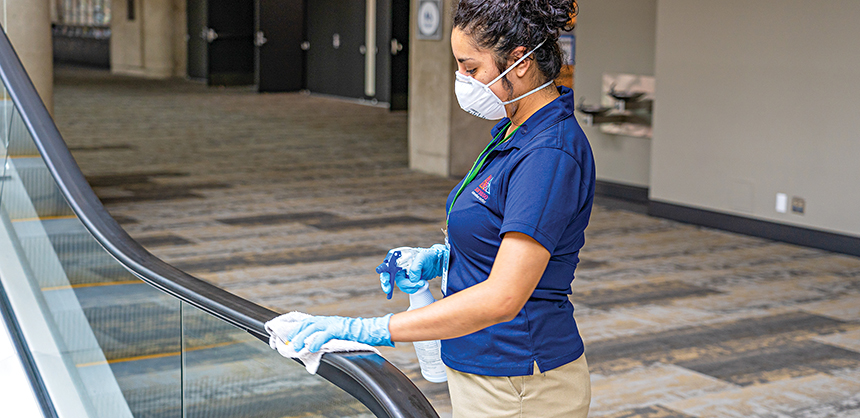
• Be vigilant about disinfecting. Any facility used for meetings needs to be disinfected vigorously between every session. At The Innovation Loft, meetings are typically half- or full-day sessions, so it means needing to thoroughly disinfect only once or twice a day. The Innovation Loft has hardwood floors, and they are disinfected each night, as are all hard surfaces. Seats have disinfectable surfaces and are also disinfected each night. All surfaces are also wiped down with strong disinfectant between every meeting. Lastly, during the course of the day, attendants, who remain 6 ft. away from participants, use UV wands to add additional disinfection to surfaces.

• Be careful about infected air. Many studies have shown that viruses can be carried by HVAC systems throughout a facility.

• Account for the “shoe problem.” Scientists warn that one way disease can be spread around a facility is through shoes that can track virus in from outside. Participants are given two options to avoid this: They are given a bag to place their shoes in on entry if they wish to go shoeless, or shoe “booties” can be used to cover the shoes to avoid any germs being tracked onto the floor. In general, make sure the space is in full compliance with new OSHA guidelines.

ENABLING OUTSTANDING COMMUNICATION

• Provide see-through masks for participants. Masks are a common tool to reduce disease transmission but, regrettably, they also reduce communications. Non-verbal cues, including smiles and other facial expressions, go a long way toward building trust and creating strong relationships. I’m providing all participants in meetings at the Innovation Loft the option to use clear face masks, which enable their expressions to be easily seen.

• Maximize audio amplification. While you can typically hear a fellow meeting attendee who is speaking 6 ft. away, if you have a meeting of more than four or five people, the math starts to indicate that some of your colleagues may be more than 20 ft. away. That’s a long way to be heard when speaking in a normal voice. We provide microphones at each seat so participants’ voices are subtly amplified and, therefore, can be heard by everyone in the meeting.

• Make whiteboarding easy and effective. Being able to draw on whiteboards is a classic and highly useful collaboration technique during meetings. One is provided behind each participant’s seat. If a participant is sharing their whiteboard thinking with the whole room, a camera is used to put their whiteboard content up on screens around the room, similar to how one might share a computer screen.

Yes, it’s more challenging to host an in-person meeting now, but it is possible to do so and still follow social distancing guidelines. Online meetings are great, but there’s nothing like getting together in the same physical space. Business is still a human activity, and there are times we need that human connection without a computer screen between us.

Bottom line? The increasing demand for COVID-19-safer meeting spaces reflects our realization that business is all about connections — and connections happen best in person. C&IT


AC

Atlantic City

Atlantic City has been closed since March, but casino executives hope to open soon to kick off a big summer season.

Atlantic City has been closed since March, but casino executives hope to open soon to kick off a big summer season.

The impact of the recent COVID-19 pandemic has had far-reaching effects on every industry, including the meetings and events industries. From months-long closures to altering the way leisure and hospitality business is conducted, COVID-19 has forever changed the way hotels, casinos and restaurants operate. As Atlantic City looks to reopen, it’s time to learn more about the impact the coronavirus pandemic has had on the area, as well as how casinos are upping their game and safely getting back to “business as usual.”

As Shelley Williams, vice president of sales at Hard Rock Hotel & Casino Atlantic City, explains, all nine casinos in Atlantic City were ordered to close in March by state and local officials due to the enormous impact COVID-19 was having on this region in particular. “The difficulty is the widespread and long-lasting effects it has had on people, their families and our industry,” Williams says. “It has been a challenge to navigate the pandemic due to its length, but also try to understand how we will pivot and what is next. Frequent communication and involvement are key, both with teams and customers, whether that is via calls, text messages or Zoom. Checking in on their health and well-being has been a priority. Being present for them and responsive is valuable and rewarding. I personally feel how we cope with the pandemic is coming together with flexibility and understanding of the underlying issues, as it will ultimately foster a deeper relationship.”

Getting Ready
While the Hard Rock Hotel property has been operationally closed, they have taken this time to deep clean the building and put new protocols in place that will responsibly provide guests with good clean fun when they return. “I am confident that no one could have imagined or predicted a lengthy closure, ultimately having an enormous impact on our industry, among many others globally,” Williams says. Over the course of the closure, the owners of Hard Rock Hotel & Casino Atlantic City have been keen on conserving the culture, leading by example, and living up to Hard Rock’s core mottoes.

Williams stresses that this is a historic moment for casino closures for Atlantic City and it has had widespread impact on the industry, particularly for so many dedicated men and women who help serve up the outstanding hospitality and entertainment for this destination. “Hard Rock Atlantic City keeps its core mottoes at the center of its business principles: All is One, Love All – Serve All, Save the Planet and Take time to be Kind,” Williams says. “The fact that the Seminole Tribe of Florida, along with Jim Allen, chairman of Hard Rock International and CEO of Seminole Gaming, and partners Jack Morris, and Joe and Michael Jingoli, committed $1 million in ShopRite gift cards to team members during the closure, and extended health benefits through the month of June, truly shows they put the team and community first.”

For the coming weeks and months after reopening, Hard Rock Hotel & Casino Atlantic City will operate under new and thorough Safe + Sound program guidelines. According to Williams, the reopening plan has been developed in accordance with guidelines provided by Hard Rock International, and adopts the Atlantic City casino industry’s summary plan of proposed reopening protocols, in an effort to take a responsible and conservative approach in providing a safe, secure and fun environment.

Hard Rock Hotel & Casino Atlantic City has protocols in place for a safe return for guests and attendees.

Hard Rock Hotel & Casino Atlantic City has protocols in place for a safe return for guests and attendees.

“All of our guests and team members will be required to wear a mask while staying and playing at our property, and follow proper social distancing guidelines,” Williams says. The new protocols will also include thermal imaging technology that takes the temperature of both attendees and team members upon entry, along with a “Clean Team” made up of more than 100 team members focusing on cleaning and disinfecting surfaces throughout the complex, with special emphasis on high-touch surfaces and common areas. The team will focus especially on the deep cleaning of all gaming surfaces, chips, hotel rooms, restaurants, pool and public areas. The property will also have more than 200 hand sanitation stations.

“Our team members will receive general health and hygiene training on COVID-19 sanitization protocols followed by a comprehensive position-specific training of their new standard operating procedures,” Williams says. “They will also be required to complete a health questionnaire prior to returning to work and before entering the property daily.” Finally, Plexiglas will be installed in areas such as the front desk, cage, Wildcard Services, sportsbook, box office and select table games.

Following the CDC and state guidelines, Ocean Casino Resort in Atlantic City also has implemented an enhanced health and sanitization plan to complement the exceptional level of personalized service that meeting attendees have come to expect from the resort. “Communication and reassurance are key to gain meeting planners and attendees’ confidence,” says Peter Ciccone, senior vice president of sales and marketing at Ocean Casino Resort. Like all businesses, due to COVID-19, Ocean Casino Resort has also experienced cancellations and a hesitancy with planning for future months. “We are working with planners to reschedule their meetings as opposed to cancelling with a financial penalty,” Ciccone says. “We are also being more relaxed with attrition clauses for 2020 and early 2021.”

According to Michael Massari, chief sales officer at Caesars Entertainment, which has four Atlantic City properties, “Partnership and collaboration also have become so much more important over the last 12 weeks. It has always been important, as it has always been on everyone’s list. But when you think about the people partnering today, we are talking to our contemporaries at other companies almost every day,” he says. “We are asking each other things like, ‘What are you doing? How are you doing it? How are you interpreting this governmental information?’ We are working so closely with our customers, our contemporaries and our competitors to understand how we navigate through this. It is really heartwarming.”

While the Caesar’s Atlantic City properties — which include Caesars Atlantic City, Harrah’s Resort Atlantic City and Bally’s Atlantic City — are not currently open, officials are hoping to open soon under state and local guidelines. “We are opening at the height of the summer season. We will open up to people who are really looking forward to enjoying the experience,” Massari says. “We are working hard to make sure that we are doing all the right things in terms of the various government protocols that have been put in place.” Indeed, Caesars Entertainment has established a wealth of health and safety protocols. From hand sanitation stations to limiting the number of patrons at various table games, the Caesars team has covered all bases to ensure the utmost safety for patrons when they return. For meetings and events at Caesar’s Atlantic City locales, as well as other Caesar’s properties dotting the country, all meeting spaces, including convention centers, will adhere to strict guidelines as well as extensive employee training.

Ocean Casino Resort has trained its employees to ensure attendees will be protected from COVID-19.

Ocean Casino Resort has trained its employees to ensure attendees will be protected from COVID-19.

Impact on Meetings and Events
Atlantic City attracts regional meetings for the Northeast market due to the fact it is a short drive to many commercial centers, making this location desirable for event attendees. As Williams explains, Atlantic City also is a destination with rich history, and proper attractions and amenities for meetings and events. It is set on the world-famous Atlantic City Boardwalk with the ocean as a backdrop.

According to Massari, approximately 35% of the U.S. population can be found within the Northeast region of the U.S., many of whom can reach this New Jersey gem with a one-day car ride. “If you have a company or customers that are congregated in that area, Atlantic City is a great place for them to gather, and the facilities in Atlantic City allow that to happen. You’ve got large hotels and event complexes. So, you’ve got the people there and you’ve got the product to support it. And none of that is going to change. If anything, it is going to be even more of a destination for that region for people who want to stay closer to home over the next couple of years.”

According to Ciccone, due to the large amount of meeting space and guest rooms, Atlantic City soon will be able to capture meetings and groups that may require air travel. “New Jersey has been one of the strictest states in following CDC guidelines and putting procedures in place,” Ciccone says. “Ocean’s plans include social distancing meeting attendees and utilizing larger meeting rooms. For meal periods, all buffets will be served by Ocean’s culinary team to ensure standards are being met. Due to the increased focus on health and sanitization measures, Ocean has increased its cleaning staff.” Ocean Casino Resort offers more than 6.4 million sf of space. Built in 2012, the resort has state-of-the-art HVAC systems that continually utilize 100% fresh outside air. The resort’s floorplan offers spacious open areas, perfect for social distancing. Also, Ocean has 160,000 sf of flexible meeting space with indoor and outdoor venues. There are 24 separate meeting rooms, including the 77,000-sf Ovation Hall. This room can accommodate up to 4,200 people theater-style and is also ideal for a formal banquet or a classroom-style meeting.

Hard Rock Atlantic City is a newer property for the Northeast. Its music, vibe and upscale amenities offer a unique themed experience for attendees with 150,000 sf of meeting space and alternative venues, among many other features that surprise many organizations. “Casino resorts like ours have enough space and square footage to ensure social distancing and provide a more safe and sound experience. That is a true advantage to booking meetings at our property versus a small venue,” Williams says.

A variety of venues are available to amplify programs and are designed to accommodate groups of all sizes — from intimate board meetings to large-scale events and conferences. For the largest gatherings, Hard Rock Live at Etess Arena can stage a general session of 7,000 people or a trade show with more than 300 booths. What’s more, Hard Rock’s 29,000-sf Seminole Ballroom, divisible into six sections, can be configured to accommodate everything from spectacular banquets and corporate events to intimate private concerts. Hard Rock’s Flexibility Zero program for attrition or cancellation fees will apply to contracted room and F&B revenue on new meetings scheduled through June 30, 2021, until 90 days in advance of arrival.

As for meetings and conferences, there has been much discussion about the social distancing rules, food service, hybrid meetings, etc. Recovery for the meeting industry and for Hard Rock Hotel & Casino Atlantic City is about a transparent partnership, commitment to safety and flexibility, Williams says. Therefore, Hard Rock Atlantic City will respect and follow the capacities and the rules that are industry standards, as well as listen to clients to ensure that all questions or concerns are answered. “With that being said, we are committed to ensuring there is a level of comfort to pursuing the meeting through discussion, investigation and planning all aspects of every personal contact for the meeting,” Williams says. “From pre-arrival, security, set ups, audiovisual, check-in, food service, hospitality and recreation, and food and beverage service.”

Resorts Casino Hotel in Atlantic City also is eager to welcome meeting and event attendees to the new Resorts Conference Center, which recently added 12,500 sf of state-of-the-art conference space in 12 new meeting rooms. In addition, the more than 64,000 sf of meeting and event space can accommodate gatherings large or small. Recently, Resorts Casino Hotel announced its “Play Safe, Work Safe” plan, which includes significant investments made by the company in the installation of advanced bipolar ionization and UV technology to purify air and clean surfaces throughout the property.

Harrah’s Resort Atlantic City, and other Caesars Entertainment properties, have meeting facilities that can ensure social distancing.

Harrah’s Resort Atlantic City, and other Caesars Entertainment properties, have meeting facilities that can ensure social distancing.

Looking Toward the Future
Massari and his team are working hard to continually monitor the protocol changes and procedures that will ensure that its Atlantic City properties are safe for all visitors. As Atlantic City, and other meeting and event locales, attempt to return to normal, what does that “new normal” look like for meeting and event professionals as well as attendees?

Williams is simply not certain if a new normal exists. “I hear the term discussed openly in many circles and I am cautious about its use,” Williams says. “Our businesses evolve over time, as they should. During this pandemic, we have all learned to take precautions to not contract a virus. My opinion is that safety is not a compromise. I believe that a new normal only exists when people feel safe enough to return to engage as a group.” As an industry and a company, Hard Rock Hotel & Casino Atlantic City is committed to taking a responsible and conservative approach that is necessary to create this “safe space”, and there will always be new advances in processes, procedures and policies. “When we return, it will be because we are safe,” Williams says. “I trust the steps we have taken to arrive where we are and the implementation of our new Safe + Sound protocols implemented will ensure safety is the main priority for our guests and team members.”

As such, it will be critical that casinos, hotels and resorts collaborate with meeting planners to work together, and follow the proper guidelines and protocols, to keep guests and visitors safe. “Any time there is a critical world event, specifically a pandemic or widespread disruption, it is a learning experience, and I believe face-to-face meetings will become even more valuable, with deeper content and purpose,” Williams says. “It will take time to engage, but intimate meetings are necessary in this industry, and I feel we can still safely have these.” She adds, “What we have been taught about engagement during this pandemic is that it will never replace the overwhelming feeling of the need to connect face-to-face. There is a deeper value and human satisfaction when communication, trust and agreement occur. The topic is debatable, yet the need to connect teams, engage and discuss live in-person is important for progress. Entities will progress, yet the rate at which they progress will be longer without face-to-face contact.”

As Ciccone says, the future experience of meetings and events will continue to evolve as social distancing measures are embraced by all.

“Everyone has been living in this COVID world for nearly three months now. We have become accustomed and we have adapted to a new sense of normal where masks and social distancing are commonplace in public spaces,” he says. “That will make it easier for attendees when they return to Ocean. Attendees have shared that they cannot wait to return.”

Massari adds that for meetings and events, the human desire to gather together is a gravitational pull that can’t be forsaken. “Whether it is a wedding, celebration, a meeting or event, watching a show, the human desire to be together is simply undeniable. People will figure out ways that we can gather together in ways that they are comfortable with and in ways that are safe,” he says. C&IT


CIT-June-July-2020-Feat6-TechSecurity1-147x147

Meeting Security In An Insecure World

DepositPhotos.com

In an age where technology controls many facets of a business, attention to cybersecurity when face-to-face meetings resume will be paramount. Meeting and event planners recognize how technological breaches can rob them of vital intangible assets and affect the security of events of all sizes. Today’s meeting leaders must change how they’re incorporating appropriate resources to handle both attendee privacy and cybersecurity perspectives, and to properly assess their readiness to deal with a compromised event.

According to Sanjay Deo, president and founder of 24By7Security, a national online security and compliance advisory firm headquartered in Coral Springs, Florida, the cybersecurity threat landscape within meetings has drastically increased and become more complex as we’ve become more reliant on connected devices.

“Cybersecurity defense has had to evolve to keep up with the threats, which is driven by advances in technology on both sides,” Deo says. “Changes in cyberthreats means IT security experts have to change their strategies for any industry, including the events space. A threat isn’t about if it will happen, but it’s about when. When planning for a major conference, it takes the whole team to get involved, and adopt a safe and secure mindset. That’s a big shift we are seeing nowadays. Meeting planners need to adopt a cybersecurity culture as they plan events, again, because threats will eventually happen.”

Gabe Turner, attorney and director of content at SecurityBaron.com, a company that is dedicated to cybersecurity, says that since there have been a number of attacks on large-scale festivals and events, people are more hesitant to share personal information at large public events, according to the most recent Unisys Security Index.

“This has caused an increase in event security,” Turner says. “Venues have begun reaching out to learn about security from the Department of Homeland Security, as well as the Cybersecurity and Infrastructure Security Agency.” These organizations provide risk assessments, training and technical assistance to event spaces. Turner says there is also more concern regarding cybersecurity at large events, particularly because of the use of public Wi-Fi and credit card use.

“In the meeting industry, especially at shared workplaces or conference rooms, one concern is making sure that customer data is protected, even if they’re using the Wi-Fi of the shared space,” Turner says. In a large, shared office, like at WeWork, it’s easier for people to hack into accounts, which is why Turner recommends using VPNs to encrypt all web traffic and replace IP addresses.

While protecting information and data associated with meeting attendees is vital, another key reason meeting planners need to focus on cybersecurity is based purely on reputation. “With so much information being shared at meetings, if something goes awry, meeting planners risk damaging their own reputations, their companies’ and their clients and hotels that they work with,” Deo says. “So, if they have a weak and insecure website, for instance, anybody can change the content of the website and put disparaging remarks about the hotel, the venues and the customers that they are working with.”

Deo and his team also are seeing a rise in ransomware and malware in the service industry. Wherever there is money, there are hackers. “It’s important meeting planners make sure that their laptop, desktop and email are secure,” Deo says. “So, you may send financial instructions to transfer money or send money to others. And if the hackers are in their email inbox, they may change those instructions so that the money will go to somebody else and the meeting planner will never receive it. Planners have to be very careful and double check when they send financial instructions to customers.”

Avani Desai, president of Schellman & Company LLC, a global independent security and privacy compliance assessor, says “Most of the time you go to events, you can easily connect to the open Wi-Fi at the hotel or conference room.” However, meeting planners should know that open Wi-Fi can increase the risk of unwanted intruders sniffing data they don’t want them to see. So making sure that the networks are secure and each user needs a SSID name and a password specifically for the attendees, guests and speakers.

Recently, consumers, including meeting and event attendees, have become much more online savvy, and they understand the necessity of having appropriate online hygiene. In turn, the need to safeguard personal data is now at the forefront for meeting planners as well, especially since these administrators themselves are using more technology to run conferences.

“Ten years ago, we didn’t have connected projectors, real-time polls or social media frenzy — all of these new digital developments increase the exposure to people and more data, which in turn increases the allure and potential of large-scale meetings being compromised,” Desai says.

Planners are paying more attention to cybersecurity as reputations can be harmed if hundreds of attendees are affected by a data breach. DepositPhotos.com

Planners are paying more attention to cybersecurity as reputations can be harmed if hundreds of attendees are affected by a data breach. DepositPhotos.com

Techniques To Use
Erin Thompson, vice president of conference services at MetroConnections, says meeting planners often provide online registration to their attendees. As such, they are responsible for that data and, therefore, it needs to be cybersafe.

“Attendees are more aware of data breaches and are looking for confirmation that events they’re attending are cybersafe,” Thompson says. Major online registration software providers like Certain and Cvent have teams of people that focus on cybersafety and are constantly upgrading their products to protect data. Additionally, regulations like General Data Protection Regulation (GDPR) have been passed requiring online protections be in place.

And, remember, it isn’t about if you are going to be hacked, it is about when you are going to be hacked. Keep in mind, the entire purpose of meetings and events is to bring a diverse group together. As such, as Desai explains, you have attendees from different geographical areas, companies, and industries, each bringing their individual phones, laptops, etc., making the environment a hot bed for bad actors to steal data or compromise devices.

“I haven’t heard about a large-scale attack, but I have heard about several smaller ones that saw attendees or guests connect to the hotel or conference Wi-Fi only to have their data stolen,” Desai says.

Now that music and A/V equipment are connected to the internet, these systems can also be compromised — leading to a major disruption of an event. “Let’s say a hacker could either shut the audiovisual down or change the images on the TV screen to controversial images,” Deo says. “They may play different music that was not selected by the host or worse.”

According to Desai, when working a large-scale conference, there will be several vendors and partners working together. That means there will be several different types of devices and software being used. Meeting planners need to educate the teams about good cybersecurity practices, such as making sure everyone has up-to-date antivirus software, there are passcodes or locks on mobile devices, passwords are not shared or written down, etc. “All meetings also want to see some trending on social media. However, bad actors use social media to mine data,” Desai says. “So, make sure your teams know to be careful on what is posted, what is discussed publicly, redacting pictures of slides, etc. Keep in mind the more exposure the event gets, the riskier it gets from a cybersecurity perspective. Using social media to promote the event details can make you susceptible to hackers, who can make changes and then attendees might go to the wrong place at the wrong time.”

Because of this, Deo says meeting planners should make sure that they’re using very good antivirus software to protect the A/V equipment they are deploying across the venue or hotel. They need to make sure that all that equipment connected to Wi-Fi that they’re providing to the attendees has adequate security by way of firewalls and intrusion detection systems. Another technique is to make sure that there is a security-monitoring component added to all of this, not just for the A/V side. That way if there is a security compromise, security professionals can handle any breaches immediately.

For example, in 2012, Lynn University in Boca Raton, Florida, hosted the presidential debate. Deo and his company provided the security and firewalls for the event.

“Think about the security level involved — the monitors, the lights, the audiovisual equipment were all connected to the internet,” Deo says. “The teleprompter was connected to the internet. The building security, the air conditioning unit, the lighting of the venue also are connected to the internet. So all of these things could have easily been compromised.”

And when it comes to registration, Thompson says meeting planners need to choose online registration providers that are actively PCI Level 1 compliant and utilize GDPR compliant software. They should also have cybersecurity insurance to protect them should there be a problem. Data encryption, multifactor authentication and frequently changing passwords are just a few of the ways making it harder for someone to access attendee data for an event.

“Meeting planners also are gravitating toward making their own virtual private networks, or VPNs, for the meeting specifically,” Turner says. “This is a welcome alternative to public Wi-Fi networks, which can make devices susceptible to hacking.”

What’s more, meeting attendees also are gravitating toward using VPNs, as well as two or multi-factor authentication, to ensure that only authorized users are accessing accounts.

As Turner explains, two-factor authentication requires that the user enter a passcode sent to their mobile devices in order to access an account, while multi-factor authentication requires biometrics such as fingerprint or facial recognition.

“In order to keep company and customer data safe, these measures are essential in any meeting using digital data,” Turner says.

Mistakes To Avoid
If an event isn’t online secure, the data will be vulnerable. Of course, it’s possible that nothing might happen, but Thompson doesn’t think that any meeting planner would want to take that chance.

“Attendees count on us to be the experts and to protect their information,” Thompson says, “If data was breached it could bankrupt a business that didn’t have insurance.”

One of the most common mistakes that both planners and attendees make is not fully understanding how vulnerable their data can be. For example, as Thompson explains, attendees will commonly provide their full credit card numbers with expiration date, CSC number, etc. to meeting planners in the body of an email. Email is not a secure transmission method of data unless encrypted.

“When we receive these types of emails, we remove the credit card information and we advise those attendees that we received it, but that they should not send in this manner in the future as it is not secure,” Thompson says. “We never request to receive credit card information via email, rather we ask attendees to call us with the information or we provide a secure link to them.”

Another common mistake that meeting planners need to avoid includes cutting corners to keep the costs down by not provisioning for security around their own equipment and the equipment that they use at the venue or the hotel.

So how can meeting planners stay on top of the ever-changing cybersecurity environment? With frequent changes to data security and compliance policies, meeting planners should be taking time to educate themselves, read articles and partner with companies that are up to date and place a high priority on cybersafety.

“Meeting planners should be working with a trusted partner that understands the importance of cybersecurity and that uses software that is GDPR and PCI Level 1 compliant,” Thompson says. A company that is well versed in this area will be able to provide documentation of its security practices and understand the importance of protecting event data.

“They need to start planning for security. So, if they are hosting large events with celebrities and high-profile people or government officials, they need to make sure that everything that’s connected to the internet has been secured,” Deo says. “Plus, they need to also let the venue know to have a cybersecurity specialist available during the event just in case a problem occurs.”

Planners should also make sure that their clients are aware of the extra charges related to cybersecurity costs that may arise in the protection of the infrastructure. These days, many large hotels now have cybersecurity professionals on staff. Or, they can go to turn to cybersecurity consulting firms that can help with assessing cybersecurity risks and help put together a mitigation plan.

Desai says she cannot emphasize education and awareness enough — that goes for everyone, including meeting planners, vendors and speakers.

“It’s essential to set the expectation that cybersecurity is a must and that following security protocol is not negotiable,” Desai says. “Other useful avenues pertinent to events include utilizing a secure file sharing system on a secure network rather than sending files via text message or email.” Another key point is making sure that both attendees and planners understand what can or cannot be posted on social media, as that is the first place hackers go to mine data for social engineering. They identify a person, where they are, what they are speaking about and, through that data, will try to obtain unauthorized access to systems.

“Falling susceptible to the common assumption that while cybersecurity breaches may happen everywhere else, they won’t happen here — that mistake always inevitably leads to abandoning a focus on cybersecurity,” Desai says. “At every event, at every meeting, always be prepared for an attack and have an incident response plan in place, ready to execute. Not only that, but make sure that plan has been tested and that everyone involved knows their roles in making sure continuity and safety is the priority.”

Turner recommends meeting and event planners read reviews of the best VPNs and password managers and make a plan for how to educate the attendees on proper usage of both.

“I think meetings and event coordinators are becoming more concerned with cybersecurity in addition to physical security, as this field is becoming increasingly necessary in our digital landscape,” Turner says.

As far as what cybersecurity looks like in the future for meetings and events — experts agree that online incidents are only going to become more prevalent, and meeting planners have to be ahead of the curve.

“Working with cybersecurity specialists on identifying risks and how to mitigate them is going to be key, and that includes testing internal systems and controls through audits, and penetration testing,” Desai says. “Vulnerability assessments like these will help identify and remediate weaknesses mitigating just how much they can be exploited, if at all. It’s important to understand that a compromise to your system will happen, but it is how well you are prepared to react to the incident that will determine the extent of the cleanup.” C&IT

CIT147-June-July-2020-Feat4-Island2-860x418

Sun & Sand On Demand

The Hotel El San Juan - Curio by Hilton, recently renamed the Fairmont El San Juan Hotel, offers nearly 40,000 sf of flexible space.

The Hotel El San Juan – Curio by Hilton, recently renamed the Fairmont El San Juan Hotel, offers nearly 40,000 sf of flexible space.

As retreats go, nothing beats having your convention or event on an island replete with sandy beaches, turquoise water and fun in the sun. Take a look at the following destinations for examples of everything island style.

PUERTO RICO
Holiday Inn Club Vacations Incorporated set its 2020 summit at Wyndham Grand Rio Mar Puerto Rico Golf & Beach Resort. Betsy Lemus, manager, brand performance, says the island was chosen “for its natural beauty, tranquility and great teambuilding options incorporating the history and culture of Puerto Rico. Our summit takes place each January and, because our leaders are based throughout the states, we seek warm-weather destinations that are unique.”

Lemus worked with Innovation DMC and Discover Puerto Rico to put the meeting in place. “I truly enjoyed working with the folks at Innovation DMC. They guided me and provided me with multiple options and exceptional support throughout my planning,” Lemus said. “They understood our goals and needs, and focused on ensuring they were met. Most importantly, the event could not have taken place without the support of Discover Puerto Rico, which assisted in arranging site tours at the hotels I was interested in visiting.”

The group experienced much that Puerto Rico offers. “We provided the team with different excursion options to choose from, including an Old San Juan Tour, El Yunque Rainforest, a Chinchorreo, a catamaran tour and golf at the resort. Some team members booked a Bioluminescence Bay kayak tour on their own,” Lemus adds. “We conducted our last meeting at Casa BACARDÍ distillery in the BACARDÍ Family Museum, followed by a fun mixology class. During our welcome reception, we had a tropical trio play, and one evening we had a Puerto Rican street fiesta (Noche Jibara), which incorporated a steel band, Bomba show, cigar roller and, of course, Puerto Rican traditional food: rice with gandules, chicken breast stuffed with mofongo, ripe plantains, tres leches and tembleque. Our bar was hosted by Rums of Puerto Rico, a special touch as well.”

The Wyndham was a hit. “It had everything we were looking for in one location,” Lemus says. “The multiple options of meeting-room settings we needed, on-site amenities, F&B and nearby attractions our attendees were able to explore on their own made this a great choice. And though the resort initially seemed big for our group of 60, it was perfect.”

The resort’s A/V services easily met their needs, and the overall attendee response to the F&B was that it exceeded expectations. “The staff and service were wonderful. Staff was always attentive to our needs and always available throughout our event,” Lemus notes. “Our team members appreciated the caring hospitality the staff provided.”

In the realm of things that cannot be predicted, Puerto Rico experienced an earthquake prior to the event. “This caused some concern,” Lemus says. “But my frequent communication with the resort, DMC and Discover Puerto Rico contacts assured me we would be safe and that the resort was operational and not affected. This, along with my leader’s research and assurance, made our group more at ease. Although the island was going through some challenges, the resilience, care and hard work of the people was visible, which made our event a success.”

Several hotels opened on the island late last year and early this year, including the chic Trópica Beach Hotel and Aloft San Juan hotel. Additionally, the renowned El San Juan Hotel became a Fairmont property.

Margaritaville Beach Resort Nassau is expected to open this year. It will offer a water park and 40,000 sf of meeting space.Margaritaville Beach Resort Nassau is expected to open this year. It will offer a water park and 40,000 sf of meeting space.

BAHAMAS
Heather Gottula, CMP, program manager with Trane Technologies Meeting Services, says the Bahamas made total sense for the company’s incentive program with 1,300 attendees. “It’s an international incentive destination and it’s in proximity to and has multiple flights daily from major U.S. cities.”

She notes that resort Baha Mar in Nassau was chosen before Hurricane Dorian devastated parts of the Bahamas, and while that caused concern prior to the November program, it also provided opportunity. “The majority of attendees are in the customer service industry and wanted to give back, so the program incorporated a fund allowing guests and sponsors to donate to relief efforts.”

This was the program’s 20th anniversary, and Gottula says Baha Mar was chosen as an upgraded location. “The resort is home to three international hotel brands — Grand Hyatt, SLS and Rosewood — and features 200,000 sf of flexible indoor and outdoor meeting spaces; more than 40 restaurants, bars and lounges; and an abundance of activities throughout the resort.”

Gottula worked with local DMC Equilibrium Events Bahamas, “whose knowledge and expertise were incredibly helpful. Equilibrium’s staff were friendly, on time for events, organized and cost conscious.”

The group used the majority of space at the resort convention center and its outdoor function area. “Baha Mar has a great layout with the convention space being separate, yet connected to the resort. Due to the number of attendees, there was high demand for Wi-Fi,” she says,” and we were able to add internet through the hotel, which nicely supported our event.”

Gottula notes that the F&B program was highly successful in part because budget and menu planning started  months in advance. She says, “That allowed us to stay in budget without any surprises. And with the resort’s wide variety of menu offerings, the group was able to eat all meals on property for three days with no repetitions.”

The traditional Bahamian offerings paired with a traditional Junkanoo band were an attendee favorite.

The resort was a positive partner. “Baha Mar partnered with us to offer mixology and cooking classes for afternoon activities, which received great feedback. And we provided a credit to guests to use on-property, which was a big hit. Not only did the credit allow attendees to experience the resort destination and all its offerings, it also gave the group a chance to spend money that went directly back to the hotel and the local staff,” Gottula says.

The convention center and planning team were a plus, too. “They made this a seamless process and fantastic experience. The team was incredibly dedicated to checking in on our group and utilizing WhatsApp for quick answers and requests,” Gottula adds. “The large amount of space allows for a variety of functions and creativity, and given all the space, there was always a backup plan in case of weather.”

To planners considering Baha Mar, Gottula says, “Give your group plenty of free time. Once guests arrive and see how beautiful the resort is and all its amenities and outdoor offerings, they’ll want limited time indoors. However, some activities and dining options could be considered expensive, so work closely with your CSM on your budget and have clear lines on costs upfront.”

It’s likely attendees will want to go off-property in free time, Gottula says. “It’s important that attendees are aware to be safe and use their best judgment when leaving any resort for a day or night trip. We always recommend they carry extra cash for cabs.”

One caution: Although there are frequent flights into Nassau, they fill fast. “Give attendees advance notice so they can book reasonable airfare,” Gottula says. “Additionally, many attendees will want to add on pre- or post-extension trips. With Baha Mar’s high occupancy, that should be worked through with the hotel far in advance and considered while contracting.”

Not far from Baha Mar, Margaritaville Beach Resort Nassau is slated to open this year. The resort’s 284 guestrooms are in two towers, 129 of them residential condominiums. Amenities include a waterpark, spa, high-tech entertainment center, 12 food and drink outlets and 40,000 sf of function space.

Also in the Bahamas, Atlantis, Paradise Island boasts a 30,000-sf spa; a 141-acre water park; an open-air marine habitat with more than 50,000 aquatic animals representing more than 250 marine species; and hands-on experiences at Dolphin Cay. Atlantis’ Conference Center encompasses 200,000 sf of indoor meeting spaces, including the 50,000-sf Imperial Ballroom, which has the capacity for groups of up to 4,000. The Conference Center also has 30 breakout rooms, three boardrooms, a large staging area and a banquet kitchen equipped with additional pantries and state-of-the-art facilities for groups of all sizes. Additionally, there are 300,000 sf of outdoor event space with multiple meeting facilities.

A teambuilding activity at St. Lucia’s Sugar Beach.

BERMUDA
A group of 35 radiologists met in Bermuda for a continuing medical education conference in October. “We selected the destination because of the island’s proximity to East Coast hubs,” says Lori Ehrich, CMP, HMCC, manager of professional education and events at Penn Medicine/Department of Radiology. “The fall meeting tends to draw attendees from the East Coast who can get to a destination in one flight. Bermuda seemed a bit more ‘exotic’ than going to Florida.”

Attendees register only for the medical portion of the conference, four half days of meetings from 7 a.m. to noon daily. “The remainder of the time, they’re on their own,” Ehrich says. “Many used the public ferry and public transportation to visit other parts of the island, including the caves.”

Ehrich was sold on Bermuda during a FAM hosted by the tourism board. “The FAM trip was in November, which I learned was the start of ‘winter’ season — yet the weather was still mild. However, many service schedules change in November, including the hotel’s shuttle to the beach club,” she says. “That’s why I selected mid-October for our meeting. I selected the Hamilton Princess & Beach Club because it was located just a few blocks from downtown so attendees could easily walk there, plus the hotel’s extensive art collection is interesting and would appeal to our attendees. They’re sophisticated travelers who like to explore new areas and have new experiences. There are other stunning hotels on the island but they felt remote, and Fairmont has a great reputation.”

The group’s meeting space needs are very straightforward. “A simple classroom with a high ceiling is important. We like a large screen to project our medical images. The attendees are all radiologists getting their continuing education, so the projected image along with the skills of the speaker are most important,” Ehrich says. In addition to classes, there was a welcome reception on a balcony off the hotel’s restaurant, Marcus’, which she calls “a perfect get-together.”

Ehrich points out that while the hotel, managed by Fairmont, has a couple of lovely pools, the beach club is a 25-minute ride away — hence the reason it’s important to know whether all hotel services, including shuttles and restaurants, will be up and running when you meet. “We enjoyed Bermuda and the hotel’s location on the water and marina was gorgeous,” she says. “We had several beautiful sunsets. Our meeting was not an incentive piece of business with group activities provided complimentary to participants. Our guests are individual travelers deciding how much they want to spend to have different experiences. If price is a factor, people may stay close to the hotel and never see other parts of the island. They miss out on the beauty Bermuda offers, though. The island is small, but with a 25 mph speed limit, it takes a while to get places. “

Attendees should also know, Ehrich notes, that tourists cannot drive on the island by law, with the exception of scooters and eco-friendly, mini-electric vehicles that hold a max of two people.

Bermuda has several hotel development projects on tap. Bermudiana Beach Resort, Hilton Tapestry, with 78 suites, is slated to open this year, while the 121-room St. Regis Bermuda Resort and 84-room Ritz-Carlton Reserve will open in 2021 and 2022, respectively. A new terminal at Bermuda L.F. Wade International Airport also is expected to open this year.

Guests at Casa de Campo Resort in the Dominican Republic have access to a golf learning center.Guests at Casa de Campo Resort in the Dominican Republic have access to a golf learning center.

DOMINICAN REPUBLIC
Hosts Global is the corporate entity overseeing a collection of DMCs around the world. Understandably, its annual Global Forum showcases the creativity and services of DMCs. Last year, the group convened at Paradisus Palma Real Golf & Spa Resort in Punta Cana. “The Dominican Republic, specifically Punta Cana, was a good fit for us as it matched all our needs — ease of guest arrivals and a property where we could host all our meetings, we’re space intensive, and also give the guests a ‘wow’ experience,” says Marty MacKay, DMCP, regional president, Global Alliance, Hosts Global. “While the meeting was educational, it had an incentive feel with high service expectations.”

Paradisus Palma Real is close to the Punta Cana International Airport and, as MacKay notes, blends ample meeting space with the feel of an incentive property, and there are a wide range of activities in the area, which Hosts tapped into via locally based Connect DMC. “There are so many options for tours on the island from cultural to active, foodie tours to the ultimate R&R,” MacKay notes. Among the popular options were a catamaran sail as well as a post-convention trip to historic island capital Santo Domingo.

The group used all the meeting space, but the biggest draw, MacKay says, “was the ballroom with the full-size video projection on the wall. It really made for an impact when guests entered the general session and allowed us to do some out-of-the box video without added cost.”

The hotel staff MacKay notes, “really outdid themselves and even managed to pull one event inside at the last minute due to rain and still wow the guests. Our group also did several CSR events with the hotel, and staff was really helpful in instituting a sustainable meeting.”

Paradisus Palma Real is an all-inclusive, MacKay adds. “You need to be willing to work with the hotel on locations for meals and ensure you know what will be private and what is a better experience for the group if public, such as the breakfasts.”

The conference was held last year, during the PR crisis the island was experiencing with reported deaths in the country — the kind of unforeseen challenge that demands excellent on-site partners. “The hotel, tourism board and local DMC worked on ensuring the safety of our guests and were willing to implement new procedures for us,” MacKay says. “The program was a huge success.”

The Dominican Republic isn’t a one-destination island. Around the eastern point from Punta Cana lies another resort area, La Romana, and one of the country’s best-known resorts, Casa de Campo Resort & Villas. That’s where John Lie-Nielsen, CEO of Florida-based One Park Financial, brought a group of top performers for a special weekend.

“We were kicking off our Founders Circle Award Weekend for the first time in our company’s history. Founders Circle Award winners are our top performers who have worked incredibly hard and consistently beat their metrics while being cultural role models for others in our company,” Lie-Nielsen says. “We have a few offices in the Dominican Republic and in Miami. That’s where our “Grovies” (what we call our employees) are located, so we wanted to keep it tropical, convenient and make it a truly amazing weekend for our top Grovies to remember.”

What stands out about the island, Lie-Nielsen says, are the “Incredibly friendly people, world-class beaches and some of the best food in the Caribbean.” He says Casa de Campo was chosen for its beauty, variety of activities, luxury and proximity to the company’s local office. Resort highlights include personal golf carts, top-notch service, beachfront restaurants, a wide range of activities, and the award ceremony set at nearby Altos de Chavón, a stunning re-creation of a Mediterranean-styled village perched above the Chavón River.  Of the food, Lie-Nielsen says, “It completely exceeded our expectations and not our budget.” The event was a huge success. “It was as special as we wanted it to be for our Founders’ Circle Award Weekend.”

Casa de Campo has completed a $12 million renovation, including enhancements to pool areas, new deluxe patio and balcony rooms, a new beach club, golf learning center and new taqueria in Altos de Chavón.

ST. LUCIA
St. Lucia may not be the well-known meeting destination other islands are, yet there are reasons for planners to consider it. Erwin Louisy, managing director of Barefoot Holidays St. Lucia LTD, a Hosts Global member, can think of many, starting with warm and hospitable people. “St. Lucia is also within easy access of the United States and serviced by major U.S airlines,” she says. “It has an array of four- and five-star resorts in stunning locations, historical and unique venues for off-property events, and cultural, musical and high-end entertainment. There’s also the majestic Piton mountains, culinary experiences with renowned island chefs and both soft- and high-adventure activities.”

It was the ideal meeting destination for her group, based at Sugar Beach, A Viceroy Resort. “The hotel provided easy access from the international airport and the accommodation pricing was suitable to the budget and allowed guests to participate in island activities and off-property dining experiences,” Louisy says.

A scavenger hunt was set up, giving attendees the opportunity to discover local culture and the lush interior of the island via 4×4 vehicles. “Participants followed clues that took them through our rich island vegetation, banana and coconut plantations, and outskirts of our rainforest. They also interacted with island people and experienced their kind hospitality,” Louisy says.

For the opening reception, attendees were welcomed to a bloom-filled flower market as they descended from their villas.

“The florists invited them to choose blooms and assisted them in crafting personal arrangements that were later sent to the villas and displayed for the duration of their stay. Led by folkloric dancers, they made their way to a beachside Caribbean-themed dinner,” Louisy says. “The sound of the waves and steel-band music set the mood for this immersive experience.”

The closing gala was set at a traditional cocoa plantation transformed into a rustic-elegant dinner setting.

“The island’s renowned Police Band provided an eclectic blend of music from classical to Calypso to traditional rhythms. Stilt walkers, choral groups and cultural entertainers all came together to make this a one-of-a-kind evening,” she adds.

Louisy has tips for planners considering St. Lucia: “U.S. citizens need passports. And while the U.S. dollar is widely accepted, we recommend that attendees exchange a small amount for purchasing goods from local vendors. If you’re going to ship materials,” she notes, “a local customs broker must clear them. And any items that will be ‘consumed’ on the island, such as insect repellent and sunscreen, will incur customs charges.”

Aruba, which sits outside the hurricane belt, enjoys blissful weather year-round.Aruba, which sits outside the hurricane belt, enjoys blissful weather year-round.

ARUBA
In the interest of providing high-quality products and services to visitors, the Aruba Tourism Authority and a partner have launched the Aruba Quality Seal program. The seal indicates local businesses that meet Aruba’s “highest-quality standards,” the authority says. Planners can learn more from the tourism authority and Aruba Convention Bureau.

A few of Aruba’s convention hotels include the Aruba Marriott Resort & Stellaris Casino, which offers 24-hour gaming; 10,450 sf of event space, including the 8,520-sf Grand Ballroom capable of hosting 880 attendees reception-style, and 450 for a banquet. The H2Oasis pool area is for adults only, and can accommodate 250 for a reception or 180 for a banquet.

The Hilton Aruba Caribbean Resort & Casino offers 15,000 sf of renovated indoor facilities and 24,000 sf of outdoor event space, which includes a beach venue. Its largest indoor venue, the 8,100-sf Morris Lapidus Grand Ballroom, can fit up to 900 for a reception, while the 8,000-sf Active Pool Deck can handle 700 reception-style and 550 banquet-style.

The Hyatt Regency Aruba Resort Spa and Casino, offers 33,000 sf of indoor and outdoor meeting and event space. The largest space is the 5,290-sf Regency Ballroom, which can accommodate 400 for a banquet and 600 for a reception. Its casino includes 13 gaming tables, 221 slot machines, 19 video poker machines and a casino bar serving hand-rolled cigars and exotic drinks.

The Renaissance Aruba Resort & Casino offers just more than 40,000 sf of meeting and event space, including the 15,120-sf Crystal Ballroom, which can hold 1,400 for a reception and 1,000 for a banquet. It boasts that its Renaissance Convention Center is the largest, most modern facility of its kind in Aruba.

The region encompassing the Caribbean, Bahamas and Bermuda is wildly diverse, from desert to dense tropics, flat to mountainous, and an aesthetic that might be British, French or Dutch, not to mention indigenous. “Something for everyone” is often an overstatement; not here. C&IT


CIT-June-July-2020-Feat3-Budget1-147x147

Budget Beaters

Liz Lathan, CMP, CEO of Haute Dokimazo, which hosts an annual Secret Family Reunion, below, says of proper budgeting, “It’s imperative to make every dollar you spend have a direct impact.” Courtesy of Liz Lathan

Liz Lathan, CMP, CEO of Haute Dokimazo, which hosts an annual Secret Family Reunion, below, says of proper budgeting, “It’s imperative to make every dollar you spend have a direct impact.” Courtesy of Liz Lathan

It was only a few months ago when corporate spending gave meeting and event professionals the proverbial blank check when it came to orchestrating a corporate affair. No longer. Nowadays, with the threat of COVID-19, businesses and their hired hands are abiding by a more restrictive code of conduct and recognizing the need to get the most “bang for their event buck” — all while creating innovative and inspirational events.

Liz Lathan, CMP, chief experience officer at Haute Dokimazo, says although budgets may be tighter, the pipeline and revenue goals are not. “In light of reduced marketing budgets, it’s imperative to make every dollar you spend have a direct impact on the pipeline you are driving with those dollars,” Lathan says. “Ensuring events and experiential activations are at or below budget will ensure that you can continue to get funding.” And while cost-conscious innovative event ideas can be incorporated into the majority of meeting and events, embracing key budgetary measures can help those innovative ideas stretch further.

Budgetary Basics
As we’ve seen, meeting and event costs, the one line item that can make a CEO cringe and raise eyebrows in meetings, is under greater scrutiny today. As large corporations and small businesses alike continue to fight for success in a suddenly sputtering economy, the focus on the bottom line has forced companies to re-evaluate the way money is spent. Increased scrutiny on corporate expenses has placed a tremendous amount of pressure on meeting professionals to show clear evidence those meetings and events are indeed valuable to a company.

As Caytie Pohlen-LaClare, founder and president of The LaClare Group Inc., explains, there are some common budgeting mistakes of which meeting planners need to be aware:

Mistake #1 — Not completing the budget process. Create a working budget, with one column for the initial budget projections and another column for the “actual” expenses as they begin to take form. When used correctly, the working budget will help identify any shortfalls or potential problems before they get out of hand.

“Numbers are your friend, and you need them to make the best decisions and course-corrections along the way,” Pohlen-LaClare says. “I prefer to overestimate on expenses, and under-estimate on revenue. This approach allows my team to successfully achieve budget projections for clients. Nobody wants to go over budget.”

Mistake #2 — Forgetting to add in all the taxes and service charges/gratuities for food and beverage, sleeping rooms and other goods/services. Remember to add in travel agent booking fees if you use an agency to purchase airfare.

Mistake #3 — Not keeping a full, detailed list of all revenue streams and all expenses.

Mistake #4 — Forgetting to update the budget if the number of participants changes. This is especially important if participant numbers increase.

Mistake #5 — When you calculate the F&B, spend the time to calculate the actual costs based on menu items selected for all meals, breaks, etc., plus any additional expenses, such as bartender fees or carving station chef fees; the various taxes, such as food, liquor, etc.; and the service charges, which usually are 19% to 23%. Forgetting to do this could mean under-estimating the F&B costs by 25% or more.

“We had a client who used the F&B minimum listed in the contract instead of the actual F&B cost estimates and it was a difference of over $30,000,” Pohlen-LaClare says. “After we were brought in and did a full budget for them, we had to give them the bad news of their underestimate.”

To truly embrace the innovative and inspirational aspects of what can be done on a limited budget, Lathan advises meeting planners to read the contracts, negotiate bulk deals and ensure the money is going toward impactful items. “If you have hired outside support from A/V vendors or suppliers, ensure their travel and expenses are included in the quote so the final billing does not surprise you,” Lathan says. “And make sure you know the attrition, cancellation, and tax and gratuity clauses on the hotel/venue contracts.”

And if a meeting planner has a series of events, or knows the road map for upcoming events, work with a set of suppliers to get a bulk or bundled discount. Also set up events to be “rinse and repeat.” If a planner has an event series, Lathan suggests working with a single hotel or event venue brand to make planning easier and to get better pricing. “Ensure the money is going toward impactful items,” Lathan says. “Don’t plan for cheap, random trade show giveaways.” Look for higher-quality items that deliver the message and only give them out to qualified leads. Try cutting back to just 10% of total attendees, so just 100 giveaways for a conference of 1,000.

Also, Lathan says it’s important to only invest in sponsorships that make sense. A lanyard sponsorship might not get the message out as it does not come with a clear call to action. “Aim for sponsorships that will either drive people to a booth, to a session or to a website,” Lathan says. “Also do pre-event marketing to target audiences to drive awareness. If the conference won’t share attendee info, but a company attended last year, take the leads from the previous year and run an email campaign to get people to the booth or sessions.”

For Larisa Draves, CMP, president at Draves & Associates, budget planning is vital for meetings and events, especially in light of today’s economy — but it doesn’t have to mean an event has to be a drab, boring affair. As Draves explains, budgeting is part of a larger overall goal-setting plan for any event or conference. “In light of the current economic situation, I think budgets will be highly scrutinized for quite some time and are a very important part of tracking goals,” Draves says.

If possible, Draves recommends reviewing historical data from previous years as it’s helpful to provide benchmark data. If you don’t have data readily accessible, a meeting planner can usually obtain it from the vendor, e.g. caterer or hotel. “I think being forthcoming with the client is important. Often the client doesn’t realize what things cost. For example, one of my clients saw a catering display they thought was attractive, but they didn’t realize it was a custom-built display and the client paid extra money for the display to be built, etc.,” Draves says.

When possible, Draves always tries to find local vendors — a local entertainer, a florist or perhaps using an area artist to make centerpieces or decorations. “I think most planners keep a log of ideas or active Pinterest pages so you have some fun ‘go-to’ ideas ready for the client,” Draves says. “I also think watching trends is important. Offering healthy food options doesn’t have to be costly either. Some groups really appreciate the small gestures like offering fruit-infused water at a break and limiting the sodas and unhealthy snacks. And offering fruit and other natural foods for snacks instead of processed foods can also save money.”

Lathan also advises that companies do fewer, more impactful events. “Start with getting an event road map all on one spreadsheet so you can see how many events an organization or company is running and in what cities,” Lathan says. “If you find overlap on field events in the same cities, consider consolidating the events or running them back-to-back in the same venue to leverage the branding.”

Also, rather than doing so many field events and small trade shows, meeting planners can advise their clients to focus on running ancillary events at industry conferences where the audience already congregates. “A company can also do more, cheaper regional events,” Lathan says. “Evaluate the pipeline goals and consider not going to large-scale industry conferences for large sums of money, and instead run smaller local events to connect on a more personal level with customers and prospects.”

Experts agree that good planning and teamwork result in excellent outcomes, even with tight budgets. Courtesy of Liz Lathan

Experts agree that good planning and teamwork result in excellent outcomes, even with tight budgets. Courtesy of Liz Lathan

Affordable, Innovative Event Elements
Bryan Mattimore, co-founder and “chief idea guy” at Growth Engine Innovation Agency, recently facilitated a session for business leaders in Connecticut as part of an eight-session program to “help develop community leaders.” Mattimore’s agency is based in Westport, Connecticut. He’s written three books on ideation and innovation processes and has personally planned and conducted more than 1,000 client meetings/teambuilding exercises.

This particular unique meeting idea involved having seven teams of seven participants each create a collage of their perceptions of Fairfield County, Connecticut. They passed out hundreds of visually oriented magazines — collected from the sponsoring organization, the Business Council of Fairfield County and the local library.

“All the magazines were free,” Mattimore says. “Our only expense: We provided large posters, scissors and glue sticks so the teams could construct their collages.” The instructions to the teams were to rip out any picture, word or phrase that reflects the essence of Fairfield County. They were asked to make sure to capture perceptions of all facets of society: business, education, government, healthcare, leisure, cultural, ethnic diversity, etc. Then, they were asked to arrange what they ripped out on the posters to create a collage. When they were done arranging and gluing, each team presented their completed collage to the group as a whole.

“The exercise was a big hit,” Mattimore says. “It was a fun and easy, and a quick way for the attendees to get to know one another — and garner some insight into their current perceptions of Fairfield County.” At the end of the meeting, Mattimore and his team collect the collages, and when the eight-session program is completed, he says, they have the teams revisit their collages to see how their perceptions of Fairfield County have changed.

As Mattimore explains this collaging technique can be used in small, medium and even large group meetings to gain insights into a wide variety of business challenges, i.e. to assess employee perceptions of the company’s culture, the current competitive environment, areas/opportunities for growth/innovation and customer experience.

At a different event, Mattimore orchestrated a “Junk Jamming” session, whereby 20 teams of eight people at Unilever did a “junk jam,” a teambuilding exercise where music was made from “junk,” such as discarded metal cans, hubcaps, soda cans, bottles, wooden planks and more. “The business principle we were invoking/reinforcing with the exercise is that you can do more with less in the marketing and promotion of your brands — as long as you add creativity to the mix, and the answer is often right in front of you if you have the eyes/creativity to see it,” Mattimore says.

Mattimore also conducted a war-gaming session with 50 executives from a large insurance company. He had seven teams role play seven competitors, not only obvious industry competitors, but potential industry disruptors as well. He explains, “The seven teams had great fun first building their own company strategies. Then, in the afternoon, everyone at the meeting came out of their competitive-company role plays to generate innovative new ideas to combat the potential competitive incursions from Amazon or Google, or Walmart.”

Lathan also recommends exploring innovative ideas that really cost next to nothing. “Meeting planners and the companies they work with should embrace the unconventional as part of their innovative budget planning,” Lathan says. “For example, bring in an engaging new format to break up the monotony of ‘sit-and-get’ sessions. These types of events create community, endearing customers and prospects to a company, and building deeper connections with them, while uncovering their business challenges that will directly grow a company’s pipeline.”

Activities and events aside, Lathan stresses that the most cost-effective and impactful element a meeting planner can add to any event is time. Attendees come to events to meet, share and learn. Help them do that by giving them more time with more people. “Longer coffee breaks give people time to check email so they can make it to the evening events on time but then plan those conference dinners better for networking,” Lathan says. Skip the loud band where people can only talk to the one person on either side of them, and opt for smaller rectangular tables and music that is loud enough to enjoy, but quiet enough that people don’t have to yell at each other.

“Also, create peer-to-peer sessions where participants can discuss topics of interest and share solutions,” Lathan says. “Create a physical problem/solution-focused message board by adding a roll of corkboard to a wall and have participants add things to it throughout the conference.”

And while success of incorporating cost-conscious innovative elements can be measured by the responses of attendees, it is also vital to keep ROI top of mind. In fact, this is true for any event — low cost or extravagant alike. Here’s why: Events are both significant opportunities to enhance relationships with the attendees as well as significant financial investments. Gaining insight into the event characteristics that drive progress against the objectives provides event managers with specific, actionable recommendations on where to best focus that investment.

As Pohlen-LaClare explains, each meeting or event may have a different measurement of ROI. So before holding a meeting, it’s important to discuss and be very clear on what the meeting objectives are and how ROI will be measured. “If a meeting’s objective is to be a revenue generator for an organization, but the budget shows lower revenue, that data can assist with future decisions,” Pohlen-LaClare says. “An accurate budget will show where there were shortfalls in income, and overages in time and expenses. This review process will help inform better decisions in the future.” C&IT