








Networking By DesignAugust 1, 2026
Making Meeting Breaks More Meaningful By Christine LoomisNetworking By Design
Making Meeting Breaks More Meaningful
Informal networking, such as coffee breaks, can lead to meaningful exchanges and follow-ups.
Meeting breaks are crucial. They give attendees time to sit and reflect; to unwind before the next content-rich session via snacks and drinks that help feed the brain; or even time to finish that piece of work that has kept them from concentrating fully on the conference.
But meeting breaks can serve other important functions as well, says Katie Karmowski, director of membership & operations for Financial & Insurance Conference Professionals (FICP) in Chicago, IL, the association group for meeting planners in the finance and insurance industries. Networking is one.
“Meeting breaks are incredibly important. They’re often where the most genuine and memorable connections happen. While formal networking sessions are valuable, breaks provide unstructured time for attendees to relax, recharge and naturally engage in conversation. We intentionally design our breaks to encourage these moments, whether it’s through color-coded lanyards that help attendees identify others they’d like to meet or creative food and beverage setups that spark organic interactions,” says Karmowski.
That distinction between formal and informal networking, Karmowski notes, is important. “Informal opportunities can be just as effective as formal networking sessions, but they serve a different purpose. Formal events, such as dinners or CSR activities, are great for building deeper relationships in a structured environment. Informal moments, such as coffee breaks or meetups, allow for quick, authentic exchanges that can lead to meaningful follow-ups later. For example, our Solo Travelers Meetup or Rising Professionals Happy Hour give attendees low-pressure opportunities to connect based on shared experiences, while our Braindate Lounge takes it a step further by pairing education with purposeful networking,” she says.
The type of conference can impact not only content and structure but also how planners design for networking. “Conferences that emphasize collaboration, education and relationship-building tend to see the most benefit from unstructured networking,” Karmowski says. “For example, meetings that bring together planners and hospitality partners are perfect for networking during breaks because both groups are looking to connect and share ideas. We’ve found that when attendees have common goals — such as sourcing venues or sharing best practices — networking during breaks happens naturally.”
While meeting breaks can foster networking organically, planners often create aids to help the process along. “Some connections happen organically,” Karmowski notes, “but a little design goes a long way toward sparking interaction. We intentionally add small conversation aids, such as tent cards and lanyards that help attendees mix with new people. Even simple elements like labeling coffee cups with conversation starters or offering ‘this or that’ badge stickers can make it easier for people to start talking. So, while we want networking to feel natural, subtle facilitation helps ensure everyone feels included and engaged.”
Karmowski notes that there are multiple ways in which planners can purposefully design a break to encourage networking. The setup, for example, makes a huge difference. “We focus on layout, movement and conversation cues. We also incorporate visual and thematic touchpoints, such as a Gratitude Wall where attendees can write messages and naturally strike up conversations. Timing also matters. Ideally, breaks are long enough to have a conversation but not so long that people disengage,” she says.
So, what does a successful meeting-break-as-networking-event look like?
For Karmowski and FICP, it’s about connections and changed outcomes for attendees. “A successful networking break is one where people who might have felt disconnected at the start of the event leave feeling like they belong,” Karmowski says.
“One great example was our First-Time Attendee Meetups and Solo Travelers Meetup. These sessions were designed specifically for attendees who didn’t come with a group or were new to the event community. For first-timers, we broke the larger session into smaller groups led by veteran attendees who served as ambassadors. We even labeled tables by hobbies such as travel, cooking or sports, so people could instantly find common ground.
The energy was amazing; conversations flowed naturally and you could see people continuing those connections throughout the rest of the conference. Similarly, our Solo Travelers Meetup provided a comfortable, welcoming environment for attendees who traveled without a team. It gave them an instant network to reconnect with throughout the event, turning what could’ve been an isolating experience into a shared one,” she says.
Both these meetups, Karmowski says, prove that with a little structure and creativity, even a short meeting break can turn into one of the most meaningful networking opportunities of a conference.
For planners who may not have deep experience turning meeting breaks into creative networking events, Karmowski notes that simplicity is key. She says, “Start small and intentional. You don’t need an elaborate setup; even little things can make a big difference. Use visual identifiers to help people connect more easily. Create conversation starters on tables, napkins or coffee cups.”
She also suggests themed meetups within a conference, like those FICP has used that are built around hobbies or a love of travel, or specific attendee groups such as solo travelers or first-time attendees. “All of these help attendees find common ground quickly. Most importantly,” she adds, “Observe and adjust. Notice where people gather and what sparks conversation, then build on that for your next event.”
Carrie Zimmerman, CMP, part of a global financial and business organization and who will also be president of her South Florida MPI chapter in 2026, calls meeting breaks “critical networking touchpoints that allow organic, spontaneous interactions that help to provide natural opportunities for professionals to connect outside formal structured sessions.”
That’s especially important because it’s a way for planners to give attendees what they want. Over and over, attendees list networking as a primary reason they attend conferences, trade shows and other meetings in the first place. Zimmerman points to a recent study, “Inside the Minds of Event Attendees” by Hanover Research, which shows that 52% of people say that networking is a top reason they’ll make the effort to show up. “With this statistic in mind, it’s more important than ever that planners today treat networking as a vital component of in-person gatherings,” she says.
Meeting breaks provide a perfect opportunity for planners to do just that. “Meeting breaks serve as mental and physical reset points and encourage conversation and relationship building among attendees,” Zimmerman says. “Attendees want to bond with peers with similar professional challenges and other topics not in a round of speed-dating-style networking sessions.”
For Zimmerman, creating these opportunities is less about the type of meeting and more about knowing the audience makeup and what will work for them, along with utilizing the venue to promote engagement and comfort. “Different things will work better than others depending on the makeup of your attendees and the venue layout. Just putting attendees in a large, crowded room with a bar and food won’t facilitate the connections today’s attendees are looking for from meetings,” she says.
“Take a financial services conference, for example, which would include high-value professional connections in a competitive yet collaborative environment, a knowledge sharing culture with technology driven interactions, and meaningful connections derived from peer-to-peer learning and discussions. What might work for this group is finding ways to connect attendees via technology to drive connections, collaboration and sharing experiences at the meeting that continue post event,” she adds.
She says the best networking moments have mixed professional levels, interdisciplinary attendees, clear networking objectives and flexible session structures.
Most conferences include a mix of formal and informal networking opportunities. Each type has its own structures and goals, and no single design fits every attendee. “Informal networking tends to be more spontaneous and low-pressure, allowing for natural conversations to emerge,” notes Zimmerman. “An informal setting can be better for the introverted attendee since it’s less structured and tends to be lower anxiety for these attendees. On the other hand, formal networking requires more work on the planner side as it’s more intentional and structured, and it also requires more active participant engagement.” She says there are also typically higher expectations for meaningful connections from all parties in a formal networking event, and such events can also have higher success in terms of attendees forming connections that continue post meeting.
While organic networking is good, Zimmerman says it also presents challenges that planners should be aware of. “Organic networking during meeting breaks allows the space and audience for the attendee to take lead on their networking needs and intentions. Professionals inherently seek connections and shared experiences to find common ground, and spontaneous interactions can allow this to happen naturally,” she says.
However, she notes, purely organic networking can often be inefficient because many attendees will not maximize the meeting’s opportunities without a little assistance. “Depending on our audience, a hybrid approach can work well,” she says. “We start by designing a framework, spaces and experiences that feel natural and encourage organic interactions for attendees, then provide subtle guidance that doesn’t feel forced such as strategic seating arrangements, conversation starter prompts, interest-based zone designations, technology-enabled connection tools and inviting environments.”
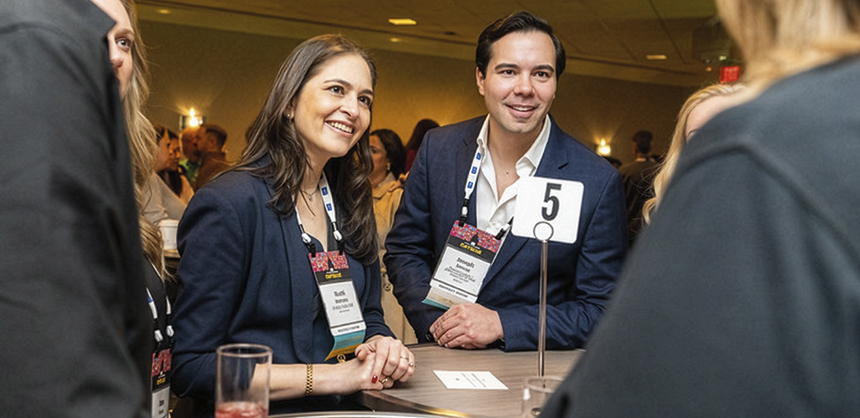
First-time attendee meetup at FICP’s annual conference. Photo Courtesy of Katie Karmowski
Breaks have inherent networking potential, Zimmerman says, “but planners can dramatically enhance organic interactions through meaningful, minimal design. The best networking breaks feel completely natural but are carefully engineered experiences that lower interaction barriers and create meaningful connection opportunities.”
There are many things a planner can do to help the process along. “Much of that depends on the physical space, timing constraints, food and beverage, and technology you have at play for your unique meeting,” Zimmerman says. “Ultimately, I like to design breaks as experiences, not just rest periods, creating environments that naturally lower interaction barriers and make connections feel effortless for the attendees.”
To that end, she offers an opportunity-filled list for planners to draw from at their next event.
Physical Spaces
- Open, fluid floor space with conversation zones
- Mixed seating styles: high-top tables for quick interactions, lounge areas, cluster seating and standing spaces
- Warm and inviting lighting
- Charging stations as a natural, comfortable gathering and wait space while devices charge
Timing & Comfort
- Stagger break times for different groups to avoid congestion and facilitate smaller group discussions
- Noise management, including softer, conversation-promoting music
F&B
- Interactive stations
- Small, easy-to-hold-and-eat items
- Food spaced out to encourage movement through the space
Technology
- Event networking apps
- Digital connection walls
- QR code business-card exchanges
- Interactive touchscreens and technology displays
- Social media interaction points
- Gamification elements
Unexpected Networking Boosters
- Mini-learning stations
- Quick skill-sharing opportunities
- Surprise connection challenges
- Name badges with conversation starters, color-coded industry or segment identifiers, or personal-interest indicators
“For me and the meetings I’ve planned, successful networking is defined by knowing my audience and knowing what will work and what won’t,” Zimmerman says. “Successful networking breaks are seamless, allowing natural interaction to flow for attendees. It’s a low-pressure, comfortable environment with multiple engagement opportunities. Depending on the ‘techy-ness’ of an audience, using technology to support and facilitate interaction can help. Successful networking breaks feel like natural conversations, not structured interactions. They should inspire connection, not mandate it.”
Despite significant industry shifts in recent years, Zimmerman says that some aspects of meetings have not changed, adding, “As our industry continues to evolve, building meaningful connections at meetings has remained a constant for attendees.” She encourages planners to drive value by focusing on human connection, personalized experiences and innovative strategies that work for the unique makeup of their meeting attendees.
Zimmerman also has a few strategies for newer planners, starting with tapping into professional planning associations for peer advice and industry case studies. She encourages the use of technology-assisted networking, such as an event app with networking features and connecting attendees via LinkedIn or QR business-card sharing. She points to low-effort facilitation, such as creating themed conversation areas and color-coded badges. And she suggests offering both digital and in-person connection options along with an inclusive networking approach that accommodates different personality types.
However, she adds, newer planners also need to avoid these rookie mistakes: overcrowded spaces with insufficient seating, lack of clear networking purpose and overly formal or intimidating environments.
Taryn Gamble, director of operations — meeting, events & experience team, with financial services company CliftonLarsonAllen, LLP in Minneapolis, MN, believes meeting breaks are extremely important for maximizing networking opportunities at conferences. “Unlike formal networking events, breaks offer an open, organic space where attendees can connect without a set agenda. This environment encourages spontaneous conversations, allowing people to build relationships, share ideas and discover common interests in a relaxed setting,” she says.
Gamble adds that some types of meetings and conferences naturally lend themselves to using breaks for networking, “especially those with diverse attendee groups or collaborative goals.” She also believes that informal networking during breaks can be just as effective — if not more so — than formal events, such as hosted dinners or scheduled activities. “The key difference is that breaks foster genuine, unplanned interactions, while formal events may feel structured or limited to specific groups,” she says.
Natural and organic opportunities notwithstanding, Gamble says, effective connections rarely happen by accident. “Planners don’t need to script every interaction, but they do need to consider elements like the physical space, timing, furniture arrangement and even the placement of food and beverages. These factors can subtly spark conversations and guide attendees to mingle and form new relationships without feeling forced,” she says.
Echoing Karmowski and Zimmerman, Gamble breaks down effective strategies for planners into five components.
- Design the Physical Space for Interaction: Arrange furniture in small clusters or provide standing tables to encourage movement and conversation among attendees.
- Strategically Place Food & Beverages: Position refreshments in areas that naturally draw people together, sparking spontaneous conversations as attendees gather.
- Optimize Timing & Flow: Schedule breaks at moments when energy is high and people are most receptive to networking, such as after engaging sessions or before group activities.
- Create Welcoming, Relaxed Environments: Use lighting, décor and background music to make the space feel inviting and comfortable, lowering barriers to interaction.
- Encourage Movement & Mixing: Avoid static seating; instead, design the break area to promote mingling, such as with interactive snack stations or conversation prompts.
Ultimately, Gamble says, “A successful networking break is one where people feel comfortable, welcomed and inspired to connect so they walk away with new ideas, actionable insights and relationships that extend beyond the event itself.”
She encourages planners to be intentional if they want to turn meeting breaks into effective networking functions. “Be intentional with the space and setup. Know what you want attendees to achieve — whether it’s making new connections, sharing ideas or sparking collaboration. This helps shape the setup and flow of the break. Equip attendees with name tags, digital contact-sharing options and an event app to make introductions easy and facilitate follow-up. Finally, gather feedback from attendees and reflect on what worked well and what could be improved for future networking breaks,” she says.
Whatever type of meeting or makeup of attendees, the bottom line remains the same. A simple meeting break is an opportunity for planners to deliver increased ROI for attendees — more professional connections, more learning and sharing, more inspiration, more collaboration, more relationships that extend well beyond the meeting. That’s a win for everyone. I&FMM